
For years, the digital divide was easy to describe. Some people had access to the internet. Some people didn’t.
That was the line. It shaped policy, infrastructure investment, mobile rollout, broadband targets, and most of the language around digital inclusion. And to be clear, that work still matters. Access isn't a solved problem. The International Telecommunication Union (ITU) estimated that 6 billion people were using the internet in 2025, which means 2.2 billion people were still offline.
But something has changed.
The next digital divide won’t be defined only by who can connect to a network. It’ll be defined by who can meaningfully use that connection once they have it.

That difference matters. A person can have mobile coverage and still not afford enough data to use essential services. They can own a smartphone and still lack the digital skills to apply for a job, verify information, use online banking, or protect themselves from fraud.
They can be technically connected and still be excluded from the digital economy because the systems around them weren’t designed for them to participate confidently. That’s where the conversation needs to move now. Not away from access, but beyond it.
The future of digital inclusion will depend on whether people can participate safely, affordably, reliably, and meaningfully in the systems that increasingly shape work, finance, education, healthcare, government services, and AI-driven opportunity.
Access Is Improving But Inclusion Gaps Remain
Access is still the foundation of digital inclusion. Without a connection, there’s no participation to discuss. And on paper, the access story has improved.
Mobile broadband coverage is now close to universal in many parts of the world. 5G is expanding quickly. The ITU reported that 5G networks covered 55 per cent of the global population in 2025, with 5G subscriptions accounting for around one third of all mobile broadband subscriptions worldwide.
That sounds like progress, because it is.
But averages have a habit of making uneven systems look smoother than they are. The same ITU data shows that 5G coverage reached 84 per cent of people in high-income countries, compared with only 4 per cent in low-income countries. In low-income rural areas, 5G is still almost non-existent.
So yes, access is improving. But it’s not improving evenly.
And even when coverage exists, usage doesn’t automatically follow.
This is where the old access-based view starts to wobble. If a network reaches someone’s area, we may be tempted to count them as included. But that only tells us the infrastructure exists. It doesn’t tell us whether the person can afford the device, pay for the data, understand the service, trust the system, or use it to improve their life.
That’s the distinction enterprise leaders need to understand. Internet access is an infrastructure question. Participation is an outcome question.
The difference between connected and included
Being connected means a person can technically reach the internet.
Being included means they can use digital systems in a way that gives them real agency.
That may sound like a small distinction, but it changes the whole shape of the problem.
GSMA’s 2025 State of Mobile Internet Connectivity work uses the idea of meaningful connectivity to describe this more mature view of inclusion. The point isn't simply whether people can get online. It’s whether the online experience is affordable, safe, useful, relevant, and productive.
That framing matters because digital life is no longer a nice-to-have layer sitting on top of the “real” economy. For many people, it’s how they access banking, benefits, education, work, healthcare, public information, and commercial services.


Inside Data-First AI Leadership
Stathopoulos links data architecture, AI readiness and workforce skills into one operating model for enterprise decision making.
If those systems are difficult to use, too expensive, unsafe, inaccessible, or not available in someone’s language or local context, then connection alone doesn’t carry them very far. They’re online, technically. But they’re still standing at the edge of the room.
Participation Depends On More Than A Network Connection
Digital participation is the ability to use digital systems effectively enough to benefit from them.
That includes simple things, like paying a bill online without needing help. It also includes more complex things, like accessing a government service, building a business through digital channels, learning new skills, applying for work, using digital finance, or taking advantage of AI tools.
Participation has become an economic issue because digital systems now sit inside almost every route to opportunity.
A small business that can’t use digital payments loses customers. A job seeker who can’t navigate online hiring platforms loses access to work. A student with unreliable data can’t properly use online learning tools. A citizen without trusted digital identity may struggle to access services that technically exist.
None of these are access problems in the narrow sense. They’re participation problems.
And they usually come from a mix of barriers that compound over time. One weak layer makes the next one harder. Poor affordability limits usage. Limited usage slows skills development. Low confidence reduces trust. Low trust discourages adoption. Eventually, a person may be counted as connected while still being functionally excluded.
That’s why participation needs its own framework.
The six foundations of digital participation
- The first foundation is affordable connectivity.
Coverage means very little when the cost of using the connection is too high. ITU’s 2025 affordability data found that low-income subscribers spend around 22 times more of their income on a mobile broadband basket than high-income subscribers.
That cost pressure changes behaviour. People ration data. They avoid heavier services. They delay updates. They skip digital tools that are technically available to them because using them has a real financial consequence.
- The second foundation is digital skills.
Inside Frontier AI Slowdown
Shared data centre and cloud stacks blur the line between routine work and frontier training, making any enforceable pause technically fraught.

People need more than the ability to tap an app icon. They need to search, compare, create, verify, protect, manage, and troubleshoot. They need to know when something looks suspicious. They need to understand what a digital service is asking of them and what happens when they agree.
The ITU has warned that digital skills data remains limited, but the available evidence shows wide differences in basic skill levels between countries and user groups. That gap becomes more serious as services become more digital by default.
- The third foundation is digital confidence.
This is softer, but it’s not vague. Confidence affects whether people try a service, complete a process, recover from an error, or give up when something goes wrong. Anyone who has watched a poorly designed government portal chew through an afternoon understands this on a spiritual level.
Confidence grows when systems are clear, forgiving, accessible, and designed for real users. It collapses when people feel stupid for not understanding a process that was badly built in the first place.
- The fourth foundation is digital identity.
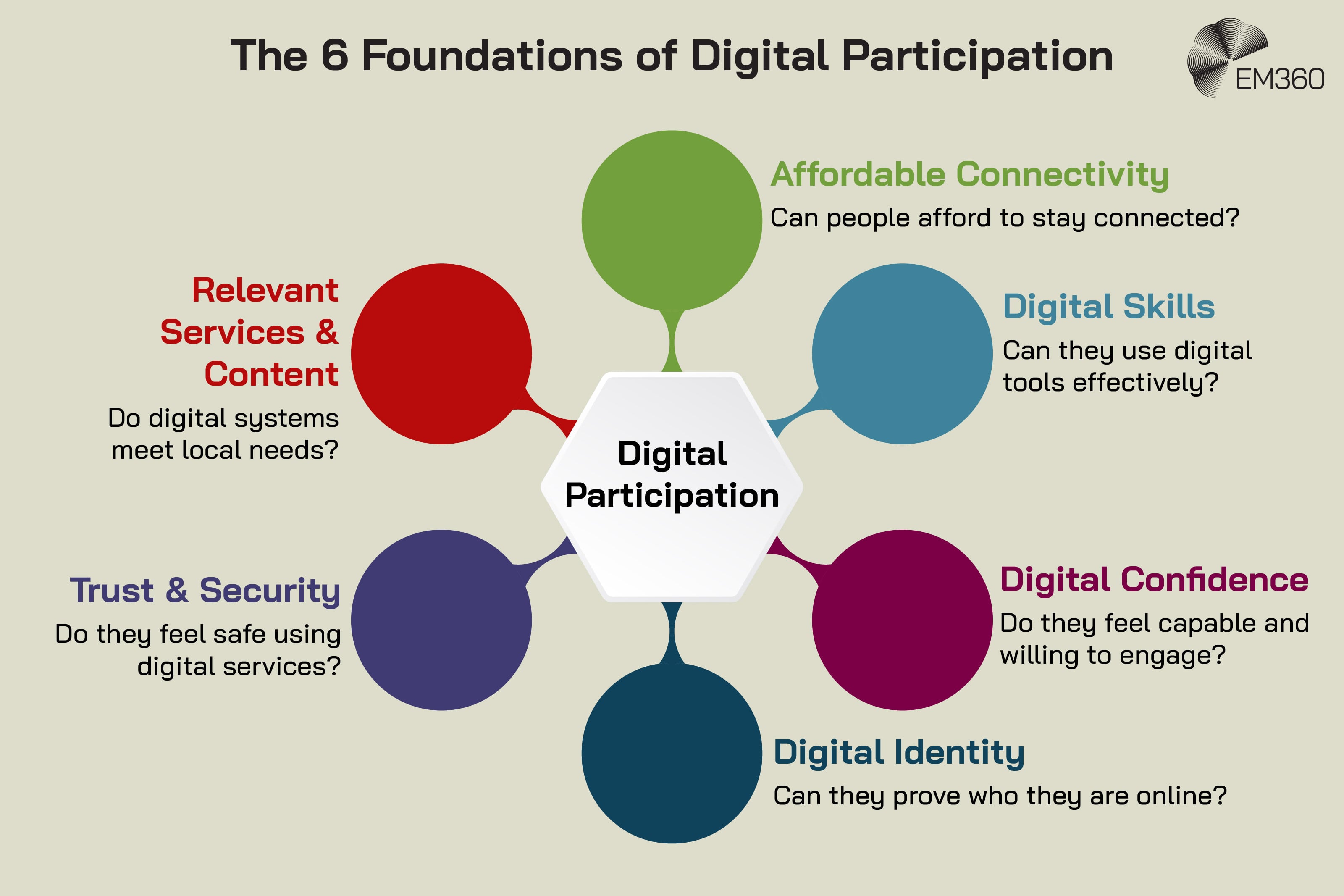

People increasingly need trusted identity to participate in online services. That includes banking, healthcare, public services, education, employment platforms, and secure transactions. World Bank ID4D estimates that around 800 million people lack official identification, while at least 2.8 billion people don’t have access to a government-recognised digital identity for secure online transactions.
Without usable identity, participation becomes fragile. People may be present in digital spaces but unable to prove who they are when it matters.
- The fifth foundation is trust and security.
People won’t keep using systems they believe will expose them to fraud, surveillance, scams, identity theft, or misuse of their personal information. Trust isn't a decorative layer. It’s part of the infrastructure of participation.
- The sixth foundation is relevant services and content.
A digital service can be technically available and still be irrelevant. If it doesn’t support local languages, local needs, local payment methods, local devices, or local realities, it may not meaningfully serve the people it claims to include.

AI Distillation as Market Weapon
Unauthorized learning from rival models marks a new front in IP disputes, safety gaps and competitive pressure across frontier AI providers.
This is the point where digital inclusion becomes less about putting networks in place and more about designing systems people can actually live with.
Why AI Risks Creating A New Participation Gap
AI changes the digital divide conversation because it raises the participation threshold. It’s no longer enough to ask whether someone can access the internet. We now also need to ask whether they can use AI-shaped systems effectively, understand their limits, and benefit from the opportunities they create.
That matters because AI is becoming a participation technology.
It’s moving into productivity suites, search engines, education platforms, hiring tools, customer service systems, financial services, healthcare workflows, software development, and public administration. Over time, more people will interact with AI whether they choose to or not.
The risk isn't only that some people won’t have access to AI tools. The deeper risk is that some people will become AI users while others become AI beneficiaries. There’s a difference.
A user can type a prompt into a tool. A beneficiary can apply it well enough to save time, make better decisions, learn faster, work more effectively, or create new value. That requires literacy, context, confidence, and judgement.
Microsoft’s AI Economy Institute reported that global generative AI adoption reached 16.3 per cent in the second half of 2025, but adoption in the Global North reached 24.7 per cent compared with 14.1 per cent in the Global South. That gap widened during 2025.
That’s the participation divide taking a new form.
From internet access to AI readiness
AI readiness depends on more than a model and a login screen.
The World Bank’s 2025 Digital Progress and Trends Report frames inclusive AI development around four foundations: connectivity, compute, context, and competency. Put simply, countries and organisations need infrastructure, processing power, relevant data and applications, and the skills to use them well.
That framework is useful because it stops the AI conversation from drifting into tool obsession.
AI Impact Moves Beyond Hype
Q3 nominees show AI value now hinges on governance, people and operating models, not model demos and click metrics.
For enterprises, the same logic applies. AI adoption won’t create equal value across teams just because licences are available. One team may use AI to compress research, improve service delivery, and build better workflows. Another may barely use it because people don’t trust the outputs, don’t know where it fits, or don’t have the time to learn properly.
The divide isn't just between those with AI and those without it.
It’s between those who can turn AI into capability and those who are left with another tool they’re expected to understand by Monday.
This is where workforce readiness becomes part of digital inclusion. Employees need AI literacy. Customers need transparency. Citizens need systems that can explain decisions. Leaders need governance that protects people without burying useful innovation under paperwork.
Otherwise, AI becomes another layer of participation reserved for those who already have the strongest skills, infrastructure, and institutional support.
Trust Is Becoming A Prerequisite For Participation
Trust is easy to underestimate because it doesn’t always show up in infrastructure dashboards. But people make digital choices based on trust every day.

They decide whether to enter personal information. Whether to use an online payment system. Whether to believe a message. Whether to click a link. Whether to apply for a service. Whether to accept an AI-generated answer. Whether to let a platform become part of their routine.
When trust is missing, participation slows down or stops. That’s especially important as digital services become more intimate. They don’t just carry entertainment or communication anymore. They carry identity, money, health records, work history, education, location data, and access to public services.
If people believe those systems are unsafe, confusing, exploitative, or impossible to challenge, they won’t fully participate. And honestly, they’d be right to hesitate. Trust has to be earned through design, governance, security, transparency, and accountability.
Why digital trust is now part of digital inclusion
Digital trust is now part of digital inclusion because people can’t meaningfully participate in systems they’re afraid to use. For enterprise leaders, this brings digital inclusion closer to cybersecurity, identity management, data governance, and responsible AI.
A secure-by-design system reduces the burden on the user. Good identity systems make access easier without weakening protection. Clear consent flows help people understand what’s happening to their data. Transparent AI processes help users know when automation is involved and where human accountability sits.
This isn't only an ethical issue. It’s operational.
If users don’t trust a digital service, adoption drops. If employees don’t trust AI tools, usage becomes inconsistent. If customers don’t understand how their data is used, confidence weakens. If citizens can’t challenge automated decisions, public trust erodes.
Connectivity without trust can still produce exclusion.
It just looks more modern while doing it.
The Participation Divide Is Becoming An Enterprise Challenge
The participation divide isn't only a public policy issue. It’s becoming an enterprise issue too.
Organisations increasingly depend on people being able and willing to participate digitally. Customers need to use apps, portals, payment systems, support channels, identity verification flows, and self-service tools.
Employees need to work across cloud platforms, AI assistants, collaboration tools, security processes, and data systems. Partners need to connect through shared platforms and supply chain systems. When participation is weak, the organisation feels it.
Customer experience suffers because people abandon digital journeys. Workforce transformation slows because employees can’t use the tools they’re given. Security risks increase because confused users make mistakes. AI adoption becomes uneven because confidence and capability sit in pockets rather than across the organisation.
That means connectivity strategy and inclusion strategy can’t sit in separate rooms anymore. A company may have strong digital infrastructure and still struggle because the humans around that infrastructure can’t participate well. That’s the part leaders need to take seriously.
Digital transformation doesn’t fail only because the technology is poor. Sometimes it fails because the system assumes a level of confidence, trust, access, language, identity, or skill that users simply don’t have.
Questions leaders should be asking
The practical test isn't complicated.
- Can people access our services?
That’s still the first question. But it’s not the last one.
- Can they afford to use them?
If the service depends on heavy data use, expensive devices, constant connectivity, or repeated authentication steps, the real cost may be higher than the organisation thinks.
- Do they understand them?
Clear journeys matter. Plain language matters. Accessibility matters. A service that only works for confident digital users isn't as inclusive as it looks.
- Do they trust them?
Security, privacy, transparency, and accountability shape adoption. Trust isn't a brand message. It’s built into the experience.

- Can they benefit from them?
This is the outcome question. A digital service hasn't succeeded just because it exists. It succeeds when people can use it to do something useful, necessary, or valuable.
- Are we designing for participation or merely access?
That’s the question that pulls the whole issue together.
Access asks whether the door is open. Participation asks whether people can actually get through it, understand where they are, move safely, and do what they came to do.
For enterprise leaders, that’s a much better measure of digital maturity.
Final Thoughts: Connectivity Only Creates Value When People Can Participate
The digital divide hasn't disappeared. It has changed shape. Access still matters. No one can participate in digital systems without the basic ability to connect. But access is no longer enough to prove inclusion, especially as more of everyday life moves through digital services, AI tools, identity systems, and connected platforms.
The next phase of digital inclusion will be measured by outcomes.
Can people learn? Can they work? Can they transact? Can they protect themselves? Can they use AI well? Can they access services without needing someone else to translate the system for them, literally or otherwise?
That’s where the real divide is forming.
The organisations that create the most value won’t simply be the ones that connect the most people. They’ll be the ones that make participation possible. Safely. Affordably. Reliably. Confidently.
As connectivity, AI, and digital services become more deeply woven into daily life, leaders need a clearer understanding of what meaningful participation actually requires. EM360Tech brings together industry experts, analysts, and technology leaders to examine the opportunities, risks, and decisions shaping a more connected future.




Comments ( 0 )