


Organizational data has never been more important in today’s data-driven age. The rise of big data, paired with the recent surge in AI and machine learning, means that data is now at the cornerstone of most of the technologies enterprises use today.
And enterprises are taking note. A 2023 survey by NewVantage Partners found that 3 in 5 organizations are currently using data analytics to drive business innovation, and around 1 in 4 data analytics leaders claim to have successfully created a data-driven organization.
While organizations today understand the importance of data in achieving their business objectives, many still struggle to know how to properly store, handle and gain insights from the various data sources at their disposal. That’s where extract, transform, and load (ETL) tools can help.

What is ETL?
ETL stands for Extract, Transform, and Load. It's a crucial process used in data integration that involves combining data from various sources into a single, consistent format for analysis. The method began in the 1970s and continues to be crucial for on-premise databases with finite memory and processing power.
ETL helps create a centralized view of data, making it easier to analyze trends, identify patterns, and gain valuable insights from your data assets.
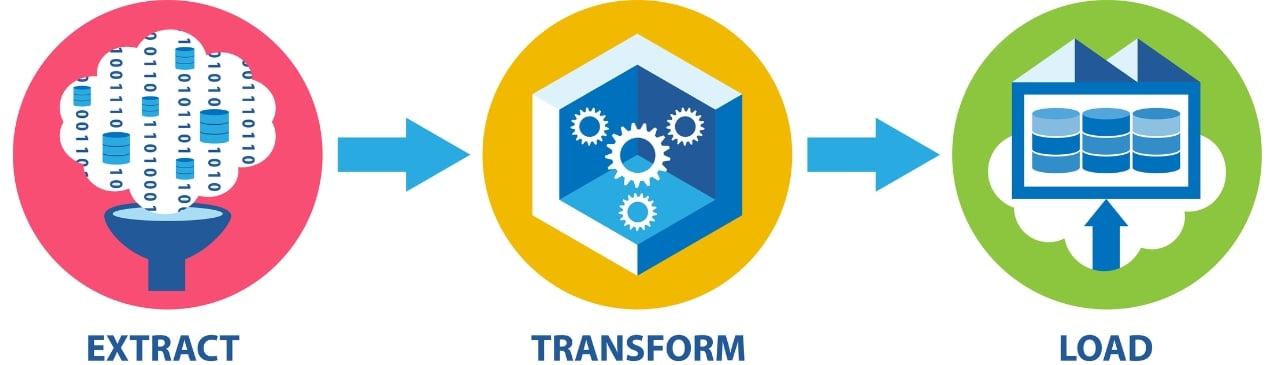
ETL processes clean and transform the data to ensure consistency and accuracy. This might involve fixing errors, formatting dates and currencies, or removing duplicates. Data is also often enriched once it’s combined with information from other sources.
Read: ETL vs ELT: What’s the Difference?
ETL is often confused with ELT. With ETL, the data is transformed before it’s loaded into the data warehouse. With ELT, however, data is extracted from its origins and loaded directly into the target system, and transformation happens after the data is loaded.
How does ETL work?
1. Extract
During extraction, data is pulled from various sources. These sources can be databases, spreadsheets, social media feeds, or any system that stores relevant information. The extracted data is often messy and inconsistent.
The extraction process often involves:
- Identifying Data Sources. This initial step involves pinpointing the systems holding relevant data. It could be internal databases (customer, sales), external sources (social media feeds, market research), flat files (spreadsheets), or even real-time data streams (sensor readings).
- Connection Methods. ETL tools utilize various methods to connect to these sources. Common methods include ODBC (Open Database Connectivity) for traditional databases, APIs (Application Programming Interfaces) for web services, and file system access for flat files.
- Data Extraction Strategies. Depending on the source, different strategies are employed for data extraction. Full table extracts (copying all data) are used for initial data loads, while incremental extracts (fetching only new or updated data) are preferred for ongoing updates.
- Scheduling and Automation. Scheduling regular data extraction ensures that your data warehouse or lake stays up-to-date. ETL tools allow setting schedules based on data update frequency or specific business needs.

When Master Data Drives ROI
How disciplined MDM investment turns fragmented records into a single source of truth that lifts margins, CX quality, and decision speed.
2. Transform
During transformation, the data is cleaned, formatted, and organized. This might involve correcting errors, removing duplicates, and converting data types to ensure consistency. Transformations can also involve enriching the data by combining it with data from other sources.
The transformation process often involves:
- Data Cleaning. Data cleaning addresses errors, inconsistencies, and missing values. This might involve correcting typos, handling null values, and standardizing formats.
- Data Validation. Data validation ensures the transformed data meets predefined quality standards. This can involve checking for data integrity, identifying and handling outliers, and guaranteeing data consistency across the dataset.
- Data Derivation. New data elements can be created through calculations and transformations. For example, deriving weekly sales figures from daily data or calculating customer lifetime value from purchase history.
3. Load
The transformed data is then loaded into a target system, which could be a data warehouse, data lake, or any analytics platform. This creates a centralized repository of clean and usable data for further analysis.
The Load process often involves:
- Target System Selection. The target system could be a data warehouse designed for historical data analysis, a data lake for storing all types of data (structured, semi-structured, unstructured), or a specific analytics application.
- Loading Strategies. Different loading strategies are used based on the target system and data volume. Full loads replace the entire dataset periodically, while incremental loads update specific records efficiently.
- Error Handling and Recovery. ETL tools typically offer mechanisms for error logging, retries, and rollback of failed loads.
- Data Archiving and Purging: Plan for data archiving and purging strategies to manage data storage requirements and ensure the target system remains efficient.
AI Defenders Versus Attackers
How LLM-driven attacks, disinformation and expanding healthcare attack surfaces demand AI-native detection, resilient architectures and new cyber skills.

ETL workflows are typically automated, allowing them to run on pre-defined schedules. This allows you to schedule data extraction, define transformation rules, and load the data into your target system. You can also orchestrate the flow of data from extraction to loading, ensuring a smooth and efficient transfer.
What are ETL tools?
ETL tools are software applications that automate the process of collecting data from various sources, transforming it into a usable format, and loading it into a target system.
These tools streamline the data integration process, making it faster, more efficient, and less error-prone. They also improve data quality by ensuring that the data used for analysis is accurate and consistent.
Many ETL tools can handle structured data from databases, semi-structured data like JSON files, and even unstructured data from log files. This allows you to create a unified view of your data, eliminating silos and enabling comprehensive analysis.
They can also handle a wide range of data sources and formats, too, and offer options for configuring transformation rules to meet your specific data needs. This flexibility makes ETL adaptable to various data management scenarios.
Benefits of ETL Tools
ETL tools offer several advantages that make data management and analysis smoother and more effective.
Here are some of the key benefits you can expect from implementing an ETL Tool or software solution:

When Data Derails AI
Expose how unchecked noise, bias, and gaps in datasets undermine AI trust, and why continuous validation must be built into governance.
1. Improved Data Quality
ETL tools can significantly enhance data quality by cleaning and standardizing data during the transformation stage. This includes removing duplicates, correcting errors, and ensuring consistency in format across data from various sources. With clean data, businesses can be confident in the accuracy of their analysis and make better data-driven decisions.
2. Increased Efficiency
ETL tools automate the entire data integration process, eliminating the need for manual coding and repetitive tasks. This translates to significant time savings for IT teams, allowing them to focus on more strategic initiatives. Additionally, automation reduces the risk of human error during data extraction and transformation.
3. Enhanced Decision-Making
By providing access to high-quality, reliable data through ETL tools, businesses can gain deeper insights and make more informed decisions. Consistent and accurate data empowers better reporting, forecasting, and overall business strategy.
4. Simplified Compliance
ETL tools can be instrumental in managing compliance with data privacy regulations like the GDPR or HIPAA. The data transformation functionalities can be used to anonymize sensitive data or filter information according to compliance requirements. Additionally, audit trails within the ETL process can help demonstrate adherence to data governance standards.
Why Data Munging Sets Strategy
How disciplined munging turns fragmented datasets into reliable decision intelligence and shifts analytics from cleanup to competitive impact.

5. Scalability
ETL tools are designed to handle large volumes of data efficiently. As a business grows and its data needs expand, ETL systems can be easily scaled to accommodate the increasing data flow. This ensures smooth data integration even with growing data complexity.
Best ETL Tools for 2024
Choosing the best ETL tool depends on your specific needs and priorities.
Here's a detailed breakdown of some of the best ETL tools available today, each of which can help you leverage your organizational data in 2024.



Comments ( 0 )