

Enterprise data leadership doesn’t fail because leaders lack ambition. It fails because complexity compounds faster than organisations can make sense of it.
AI has accelerated expectations around speed, scale, and value. At the same time, scrutiny around governance, trust, and accountability has tightened. Data teams are expected to deliver more insight, more reliability, and more strategic clarity, often without clear ownership across technology, business, security, and compliance.
This is where analysts can help.
Not as commentators on trends, and not as proxies for vendor roadmaps, but as experienced translators between messy reality and decision-ready thinking. The analysts enterprise leaders pay attention to are the ones who’ve seen patterns repeat across organisations, understand where theory breaks down in practice, and can articulate trade-offs before they turn into operational risk.

Why Enterprise Data Leaders Still Rely on Analysts
Enterprise leaders rarely turn to analysts to tell them what technology exists. They turn to them to pressure-test decisions.
When data programmes stall, the issue is usually not capability. It’s uncertainty about direction, sequencing, and risk. Should governance tighten now or later. Is this the moment to centralise, or will that slow delivery. Which metrics matter enough to take to the board, and which ones create false confidence.
Analysts provide value because they’ve seen these choices play out across multiple organisations and operating models. They help leaders recognise patterns early, before they harden into structural problems. That perspective is especially useful when responsibility for data is spread across technology, business, security, and compliance, and no single team has full visibility or control.
As AI adoption accelerates, that external lens becomes even more important. Decisions about architecture, data access, governance, and value measurement are now tightly coupled. A misstep in one area shows up as risk or rework somewhere else. Analysts who stay close to execution, not just theory, help leaders navigate those trade-offs with more clarity and fewer surprises.
The analysts featured here are relied on because they don’t just describe challenges. They give enterprise leaders language, framing, and practical ways to move forward when the path is not obvious.
How This List Was Curated
Every analyst on this list has built credibility over time through the roles they’ve held, the organisations they’ve shaped or advised, and the responsibility they’ve carried in enterprise environments.
Each is closely associated with a clear problem space that matters at scale, such as data strategy, governance, value, storytelling, or analytics operating models. Their inclusion reflects depth in those areas, not breadth across every trend.
The final consideration was trust earned through consistency. These are analysts who have demonstrated, repeatedly, that they understand the realities of enterprise data work. Their thinking holds up across changing technology cycles, shifting priorities, and increasing scrutiny. Enterprise leaders return to their work because it remains grounded, coherent, and reliable when decisions carry real consequence..
The Analysts Enterprise Leaders Should Be Following
The goal is to help you decide who to follow, who to bring into internal conversations, and whose thinking maps to the problems you’re actually trying to solve.
Note: Names are listed alphabetically, because each analyst brings such a different lens and perspective to each conversation that measuring them against each other would be like comparing apples to oranges.
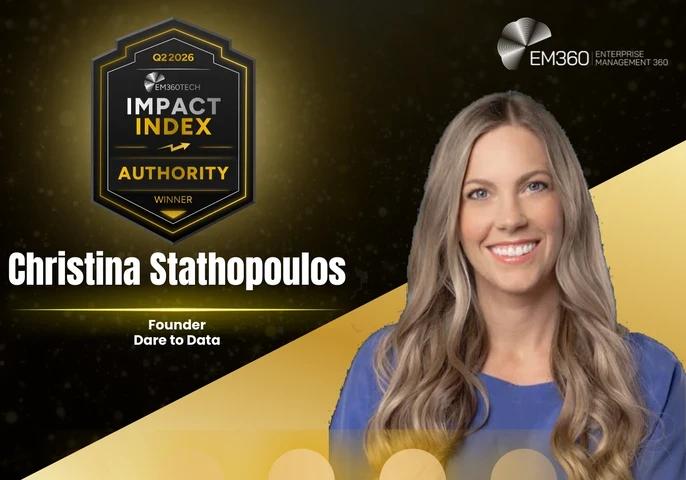
Christina Stathopoulos

Christina Stathopoulos is the founder of Dare to Data and works as an international data specialist, educator, advisor, and speaker. Her credibility is grounded in enterprise-grade experience, including leading data strategy and related work across teams at Google and Waze. She also teaches in academic settings and has built a public platform around helping organisations and individuals adopt data and AI responsibly.

When Access Isn’t Inclusion
Why digital strategies must move beyond coverage metrics to measure skills, trust, identity, and AI readiness as core participation outcomes.
Her problem space sits where strategy meets real adoption: analytics, data strategy, and data visualisation that actually lands with decision-makers.
What they’re known for and why they matter to enterprise data leaders
Stathopoulos is often most useful when an organisation has the tools but not the traction.
Enterprise leaders pay attention to voices that can bridge “we have data” and “we make better decisions because of it”. Her focus on data strategy and visualisation is not about prettier dashboards. It’s about building shared understanding, shaping how teams interpret information, and making insight usable across the business.
That matters because adoption failure is one of the quiet killers of data programmes. Not dramatic enough to trigger a crisis. Just constant enough to drain value.
Where their insights are most valuable
Christina Stathopoulos’ insights are strongest when organisations are trying to turn data and AI strategy into something people can actually use. Her recent work consistently focuses on adoption, communication, and decision-making, especially where analytics and AI need to function across the business rather than inside specialist teams.
She spends time on the practical conditions that support scale. That includes data fluency, leadership understanding, and the ability to communicate insight clearly enough to drive action. These themes show up across her speaking, advisory, and education work, where the emphasis is less on tools and more on how organisations operate around data.
One example is in the Tech Transformed podcast episode, Setting Up for Success: Why Enterprises Need to Harness Real-Time AI to Ensure Survival. That discussion looked at what enterprises need in place when AI depends on fast, reliable data, including readiness, trust, and organisational alignment. It reflects one strand of her work, not the whole of it.
When Data Governance Drives AI
A deep look at data architecture, governance and composable design as foundations for generative and agentic AI in complex enterprises.
Her perspective is particularly valuable for data and analytics leaders scaling usage beyond the data team. It also resonates with organisations building data fluency, improving executive communication, and aligning analytics and AI initiatives with how decisions are made day to day.
Check out Christina Stathopoulos on LinkedIn
Debbie Reynolds

Debbie Reynolds, known as “The Data Diva,” is a privacy and emerging technology advisor and the host of The Data Diva Talks Privacy podcast. She runs Debbie Reynolds Consulting and maintains a public platform focused on practical privacy leadership.
Her core problem space is data privacy and the operating realities of managing sensitive data in modern technology environments.
What they’re known for and why they matter to enterprise data leaders
Enterprise leaders pay attention to Reynolds’ perspective because privacy has moved upstream.
It’s no longer a compliance tick-box you bolt onto a finished system. Privacy now shapes AI governance, data sharing, retention, vendor risk, and how organisations respond when something goes wrong. Her work sits in the overlap between regulation, technology, and organisational behaviour, an area where enterprise leaders often struggle to translate policy into operating reality.
She also maintains an active public platform through her podcast, where she consistently engages with evolving privacy issues and the practical implications they carry for businesses.
Where their insights are most valuable
Debbie Reynolds brings a pragmatic lens to privacy, governance, and risk as operational realities, not abstract regulatory concerns. Her work consistently examines how privacy intersects with data governance, AI risk, and cross-functional accountability, especially in organisations where responsibility is spread across legal, technology, and the business.
She often focuses on the mechanics of making privacy workable. That includes embedding privacy-by-design into technology and data programmes, aligning privacy strategy with business objectives, and designing governance models that support innovation rather than slow it down.

AI Self-Improvement Risk Line
Mythos-class cyber tools, US–China rivalry and narrowing human oversight collide as frontier AI races beyond traditional safety controls.
Her appearance on the Don’t Panic It’s Just Data podcast episode Mastering Collaborative Financial Planning reflects that broader perspective. The conversation explored how financial planning, data governance, and collaboration across teams need to align in complex enterprises, and how privacy considerations fit naturally into those operating discussions rather than sitting off to the side.
Her insights are particularly valuable for leaders treating privacy as part of enterprise risk and value creation. That includes organisations building privacy-aware governance frameworks, teams integrating privacy into AI strategy, and data and privacy leaders who need to coordinate across legal, technical, and operational domains while maintaining trust.
Check out Debbie Reynolds on LinkedIn
Doug Laney

Doug Laney has spent decades shaping how enterprises think about the value of data, particularly at the executive level. After a long tenure advising global organisations through Gartner, he joined BARC as a Fellow, continuing that focus within analyst research and advisory work.
His core problem space centres on data value, monetisation, and the language leaders need to justify data investment in boardroom terms. Rather than treating data as infrastructure, his work pushes organisations to confront what their information is worth, how that value is realised, and what operating models are required to sustain it.
What they’re known for and why they matter to enterprise data leaders
Laney is the originator of “Infonomics,” a discipline that reframes data as an economic asset rather than a technical by-product. That shift matters because it changes the conversation enterprise leaders have about data. Instead of asking how much infrastructure costs, it forces questions about value, return, and accountability.
His work has consistently challenged organisations to move beyond treating data as something that supports the business, and toward treating it as something the business actively manages. That includes how data is valued, prioritised, governed, and protected over time. For leaders operating under budget scrutiny and board-level oversight, this framing creates a common language between data teams and finance, risk, and strategy stakeholders.
When AI Theft Meets Geopolitics
Anthropic’s claims against Alibaba show how model scraping is reshaping export controls, sanctions policy and AI vendor due diligence.

Rather than positioning data as a “nice to have,” infonomics pushes organisations to be explicit about what their information is worth, how that value is realised, and what operating model is required to sustain it.
Where their insights are most valuable
Doug Laney’s thinking is most valuable when organisations are under pressure to justify data investment in concrete terms. His work consistently focuses on the gap between technical delivery and business value, particularly where data initiatives struggle to demonstrate return, prioritisation, or accountability.
He frequently examines how poor data quality and unmanaged technical debt quietly erode value over time. That theme came through clearly in the EM360Tech podcast episode AI’s Silent Killer: Technical Debt & the Hidden Costs of Bad Data.
Here the discussion centred on how legacy decisions, fragmented ownership, and deferred data hygiene create long-term risk for AI and analytics programmes. Rather than framing this as a tooling issue, the conversation focused on cost, sustainability, and decision impact.
His insights resonate most with enterprise leaders who are trying to move data conversations into the boardroom. That includes CDOs under pressure to defend spend, executives evaluating data and AI portfolios, and organisations shifting from platform-led investment to value-led operating models. Laney’s lens helps leaders ask harder questions about what their data is worth, where value is leaking, and which decisions actually move the needle.
Check out Douglas Laney on LinkedIn
George Firican

George Firican is Director of Data Governance and Business Intelligence at the University of British Columbia and the founder of LightsOnData, a platform focused on practical data governance learning and guidance.
His problem space is unapologetically execution: data governance, data quality, and making governance workable in real organisations.
What they’re known for and why they matter to enterprise data leaders
Firican is known for taking governance out of policy land and putting it back into operational reality. His work consistently focuses on the mechanics leaders struggle with: where to start, how to structure stewardship, and how to build governance that people will actually use.
That matters because governance tends to fail in two predictable ways.
Either it becomes so heavy that teams route around it, or it stays so vague that it never changes behaviour. Enterprise leaders pay attention to practitioners who can show what “good” looks like without turning it into a bureaucracy.
Where their insights are most valuable
George Firican’s insights are strongest where data governance meets day-to-day decision-making. His work focuses on how organisations turn governance from policy into practice, particularly when accountability spans data, finance, and technology teams.
That practical lens came through on EM360Tech’s Usage-Based Magic: Turning Cloud Data Into Dollar-Saving Decisions episode. The discussion centred on how usage data and governance practices support cost visibility, financial accountability, and better decisions in cloud environments, without adding unnecessary process or friction.
His perspective is especially valuable for organisations operationalising data governance at scale. That includes teams defining stewardship models, leaders linking governance metrics to business outcomes, and enterprises trying to align governance with cost management, analytics maturity, and AI readiness.
Check out Geore Firican on LinkedIn
John Santaferraro

John Santaferraro is the CEO of Ferraro Consulting and the host of The Digital Analyst podcast. He operates as a public-facing analyst voice at the intersection of enterprise AI, analytics, and leadership decision-making.
His problem space is modern enterprise AI and the choices leaders need to make when AI becomes a business system, not an experiment.
What they’re known for and why they matter to enterprise data leaders
Santaferraro is known for analysing how AI and analytics change decision-making and leadership inside large organisations. His work focuses on the organisational and governance implications of emerging technology, not just the technology itself.
He consistently frames AI as a leadership challenge. That includes how accountability shifts as systems become more autonomous, how decision authority is redefined, and what level of AI literacy executives actually need to lead effectively. For enterprise leaders navigating AI adoption under real operational pressure, that perspective helps bridge the gap between ambition and readine
Where their insights are most valuable
John Santaferraro’s insights are valuable when organisations are trying to understand what AI adoption changes at a leadership and operating level. His work consistently focuses on how decision-making, accountability, and governance evolve as AI systems become more embedded in enterprise workflows.
He spends time on the questions executives often struggle to frame clearly. How much autonomy is too much. Where responsibility sits when systems influence outcomes. What leaders need to understand in order to steer AI initiatives without defaulting to either blind trust or excessive control.
One example of this thinking appeared in the EM360Tech podcast episode Why Unstructured Data Governance Is the Key to Scaling AI. The conversation used unstructured data as a lens to explore broader issues around governance, access, and risk when AI systems rely on information that doesn’t fit neatly into traditional controls.
His perspective resonates most with enterprise leaders moving AI beyond experimentation. It’s particularly relevant for executives reassessing decision authority, data and AI leaders aligning governance with scale, and organisations trying to expand AI use without losing clarity, trust, or control.
Check out John Santaferraro on LinkedIn
Kate Strachnyi

Kate Strachnyi is the founder of DATAcated and the host of DATAcated On Air. Her platform and professional focus centre on data storytelling, communication, and visual best practice, alongside brand growth for data and AI communities.
Her problem space is data storytelling and making insight understandable, persuasive, and actionable.
What they’re known for and why they matter to enterprise data leaders
Strachnyi’s work is a reminder that enterprise data doesn’t fail because the chart is wrong. It fails because the message doesn’t land.
She focuses on the craft of communicating insight, including how to use colour and dashboard techniques effectively, and how to build a narrative that decision-makers can follow without needing a translator.
That matters because executive attention is a finite resource. If your data story takes effort to decode, it won’t survive the week.
Where their insights are most valuable
Kate Strachnyi’s insights are strongest when organisations need to make data understandable and actionable. She consistently focuses on clarity in communication, how visualisation choices affect interpretation, and how narrative shapes decision-making.
Her recent work spans reports, workshops, and community engagement through DATAcated. She has released trends reports that map shifts in data and analytics thinking, and she leads conversations that break down complex topics into practical advice for data teams and leaders alike.
That focus on communication and clarity came through during her interview with EM360Tech at Big Data London, where she talked about how leaders and teams can bridge the gap between analysis and organisational understanding. It was one example of how she connects storytelling concepts to enterprise challenges without reducing her work to a single moment.
Her insights are most relevant for analytics teams and leaders who need to translate insight into impact. That includes organisations improving executive communication, teams refining dashboards and reports so they support real decisions, and leaders building internal capability around data storytelling and literacy.
Check out Kate Strachnyi on LinkedIn
Kevin Petrie

Kevin Petrie is VP of Research at BARC, where he leads the data management practice and writes about AI, data integration, and data governance, bringing decades of experience translating technology shifts for practitioners.
His problem space is data management as strategy infrastructure for AI and analytics.
What they’re known for and why they matter to enterprise data leaders
Petrie is known for practical analysis at the intersection of data management, data governance, and AI. His work focuses on how enterprise data foundations need to change as organisations introduce generative AI into analytics and business workflows.
He consistently connects AI outcomes back to core data disciplines such as quality, integration, lineage, and access. That perspective matters because many AI initiatives expose weaknesses in data management that platforms alone cannot fix. Petrie’s analysis helps leaders see which foundational decisions enable scale and which ones quietly limit it.
Where their insights are most valuable
Kevin Petrie’s insights are most valuable when organisations are trying to make AI dependable at scale. His recent work focuses on how data management and governance affect reliability once AI systems move beyond experimentation and into everyday operations.
He consistently examines where AI initiatives break down in practice. That includes issues around data quality, integration, orchestration, and control, especially when automation accelerates faster than foundational discipline. His analysis stays grounded in how enterprises actually run data and analytics, rather than how they are described in theory.
One example of this thinking appeared in the EM360Tech podcast episode How Do You Make AI Agents Reliable at Scale?. The conversation used AI agents to explore broader execution challenges, including governance, observability, and accountability in complex environments.
His perspective resonates with data and analytics leaders moving AI into production. It’s particularly relevant for organisations aligning data management with AI governance, and for executives who need confidence that AI systems will remain reliable, auditable, and trustworthy as they scale.
Check out Kevin Petrie on LinkedIn
Scott Taylor

Scott Taylor, known as “The Data Whisperer,” is a data storytelling and data management advocate and the author of Telling Your Data Story. His work sits at the intersection of business alignment and foundational data discipline.
His problem space is data storytelling as a leadership tool, rooted in data management and truth.
What they’re known for and why they matter to enterprise data leaders
Taylor is known for his focus on clarity in data management and communication. His work centres on “truth before meaning,” a principle that emphasises reliable, well-defined data as the foundation for analytics, storytelling, and AI.
That perspective matters because enterprise teams often struggle with shared definitions, ownership, and trust, even when the technology is in place. Taylor’s work helps leaders anchor decisions in data that can be understood, defended, and acted on.
Where their insights are most valuable
Scott Taylor’s insights are most valuable when organisations are trying to restore clarity and trust in the data that underpins critical business functions. His recent conversations continue to focus on shared definitions, governed access, and the practical realities of how data is used day to day, particularly outside the core data team.
That thinking surfaced in the EM360Tech episode Is Your Financial Reporting Ready for the Future?, where he explored the tension between finance teams’ need for flexibility and IT’s need for control. The discussion centred on data accessibility, governed real-time reporting, and the ongoing role of tools like Excel in modern financial workflows. Rather than dismissing familiar tools, the conversation examined how organisations connect them to trusted, live data so decision-makers can work faster without compromising accuracy.
His perspective resonates with leaders navigating data use in operational environments such as finance, accounting, and reporting. It’s especially relevant for organisations balancing governance with usability, aligning data management with business workflows, and ensuring that insight is grounded in data that is consistent, accessible, and clearly defined.
Check out Scott Taylor on LinkedIn
Tiankai Feng

Tiankai Feng is Global Director of Data and AI Strategy at Thoughtworks, where he leads thinking at the intersection of strategy, governance, and organisational adoption. Beyond that role, he’s an author and speaker who centres human factors in data and AI initiatives rather than purely technical architecture or tool selection.
His professional problem space goes beyond the technology itself. Feng focuses on how organisations build strategy that accounts for people, behaviour, culture, and cross-functional alignment as they operationalise data and AI at scale.
What they’re known for and why they matter to enterprise data leaders
Tiankai Feng is known as the author of Humanizing Data Strategy and Humanizing AI Strategy, where he reframes data and AI strategy as socio-technical challenges rather than purely technical ones. His work emphasises that sustainable value depends on how strategy accounts for people, behaviour, governance, and organisational context, not just architecture and tooling.
That perspective matters to enterprise data leaders because many initiatives fail during execution, not design. Feng’s work gives leaders language and structure for addressing adoption, accountability, and alignment alongside technical delivery, making strategy more resilient as data and AI programmes scale.
Current focus and where their insights are most valuable
Tiankai Feng’s insights matter to leaders who need to bring people and process together with technology. His recent commentary and talks consistently address how human understanding, collaboration, and ethical clarity affect whether data and AI strategies deliver real impact.
He often emphasises that technology alone does not create sustainable value. Instead, value tends to emerge when organisations create shared language, clear expectations, and inclusive governance that account for how humans interact with systems at scale.
That theme came up in panels and interviews around his Humanizing AI Strategy book launch, where discussions focused on how organisations balance technical ambition with human values, governance, and culture. These conversations explored how AI systems change workflow, decision authority, and accountability when they are deeply embedded in business processes, not just as experimental tools.
His perspective resonates most with enterprise leaders building comprehensive AI and data strategies. That includes teams formalising governance frameworks that span people and technology, executives integrating ethical safeguards into deployment plans, and organisations aligning cross-functional stakeholders so that strategy, practice, and outcomes stay aligned as complexity grows.
Check out Tiankai Feng on LinkedIn
Wayne Eckerson

Wayne Eckerson is a long-standing data and analytics practitioner, researcher, and advisor, and the founder of Eckerson Group. His career has been built around helping organisations understand how analytics actually works in practice, from early business intelligence programmes through to modern data platforms and operating models.
His core problem space is analytics leadership and data strategy at enterprise scale. That includes how organisations structure analytics teams, govern data effectively, and deliver insight consistently across the business, not as isolated projects.
What they’re known for and why they matter to enterprise data leaders
Eckerson is known for translating analytics complexity into leadership-level guidance. His work, including books like Secrets of Analytical Leaders and Performance Dashboards, focuses on what successful analytics organisations do differently over time, not just what tools they use.
That perspective matters because analytics maturity is rarely a tooling problem. It’s a leadership, operating model, and execution problem. Eckerson’s work helps enterprise data leaders understand how culture, structure, governance, and delivery discipline shape outcomes, especially as analytics programmes grow and expectations rise.
Where their insights are most valuable
Wayne Eckerson’s insights are something that leaders who need to connect analytics strategy with delivery reality pay attention to. He often focuses on how organisations structure analytics teams, governance, and data processes to support resilient decision-making.
For example, his contributions to EM360Tech’s The Evolution of Integrated Risk Management (IRM) report examined how risk, data, and governance must work together for enterprise resilience. That work emphasised breaking down silos so data and risk teams can share language, indicators, and controls rather than operating independently.
He also engages in conversations that explore how analytics is implemented in practice, including lessons from large organisations on dashboarding, governance, and self-service patterns. Those discussions surface barriers teams face when they try to scale analytics across functions.
His perspective resonates with data and analytics leaders aligning performance measurement with strategic goals, executives who must embed data workflows into business processes, and organisations tackling integrated governance as their data footprint grows and risk surfaces multiply.
Check out Wayne Eckerson on LinkedIn
Final Thoughts: Trusted Insight Is a Strategic Advantage
Every analyst on this list represents a different way of seeing the same underlying truth: enterprise data leadership is no longer about proving data is important. It’s about proving it works.
Not in slide decks. In governance that holds. In stories that land. In value that can be defended under scrutiny. In operating models that don’t collapse the moment priorities shift. AI has made the stakes higher, but it’s also made the shortcuts more dangerous.
Trusted analysts help you keep your footing. They don’t replace your strategy, but they sharpen it. They make it easier to name the real problem, choose the next best move, and build momentum that survives past the first wave of excitement.
If your team is doing the hard work of turning data strategy into outcomes, EM360Tech can help you package that thinking into content enterprise leaders actually trust and share, the kind that carries signal, not noise, and keeps your message intact all the way from the data floor to the boardroom.



Comments ( 0 )