

Big Data LDN has a scheduling problem, and the 411 people currently listed as speakers are partly to blame. The event returns to Olympia London on 23 and 24 September 2026, and at the time of writing, its speaker directory contains 411 people.
There are also 16 theatres, more than 200 exhibitors, various live demonstrations, community spaces and enough competing sessions to make choosing where to be feel like a minor logistical crisis. Fortunately, this isn’t EM360Tech’s first time working through it.
We were an official media partner last year too, and we’ll be back at BDL in 2026 with our own booth (F38) and people from across our content, podcast and sales teams at the event. Some of us will be there chatting with technology companies and explaining how EM360Tech’s podcast and thought leadership campaigns work.

Some will be recording planned interviews with some of our solution provider partners (and some quick one question interviews (right word) if our social media manager gets his way). And presumably all of us will at some point realise the thing we really wanted to see starts on the opposite side of Olympia in five minutes.
The simple truth is that nobody can experience everything at an event this size. But we’ve studied the programme, picked the things we’d definitely regret missing and left a little room for whatever catches our attention once we get there.
1. Seeing What’s New in the AI Layer
We write and talk about AI every day, which probably makes us harder to impress with another AI product than most. So putting a whole area of them together sounds like a very good test. The AI Layer is new for Big Data LDN 2026, giving AI vendors their own dedicated area where attendees can compare products and speak directly to the people building and implementing them.
What makes this interesting is that AI hardly needed help finding its way into BDL. It’s already everywhere. There are sessions covering agentic AI, AI governance, analytics, data foundations, context layers and practically every other point where AI now meets enterprise data.
Creating a dedicated AI Layer within an event already saturated with AI gives us a chance to see what vendors think deserves to stand on its own. More importantly, we get to see what actually catches people’s attention. Because it’s easy for five companies to sound completely different when you visit five websites on five different days.
Put them a few metres apart on the same exhibition floor though…and the differences, or lack of them, become much easier to spot. It should also give attendees a useful opportunity to ask direct questions.
- What does the product actually do?
- How much work sits behind the simple demonstration?
- What data does it need?
- Where does a human still have to get involved?
- And, perhaps most importantly, is this something a company can realistically use today or something that works best in a carefully controlled demo?
And our editorial team will definitely be looking for the ideas and companies that offer convincing answers whenever they get a chance. With an entire area to explore, we suspect they’ll find more than a few.
2. Seeing Data Put to Work for Good
Not every interesting conversation about data begins with how to make a company faster, more efficient or more profitable. The Data for Good Theatre gives more room to the places where data and AI affect people, communities and the world around them.

When Access Isn’t Inclusion
Why digital strategies must move beyond coverage metrics to measure skills, trust, identity, and AI readiness as core participation outcomes.
One session we’ll certainly be looking out for is Inspiring the Next Generation of Girls into Data, featuring Lindsay Pellow, Jenny Wilkins and Ffion Acland. Girls in Data wants to inspire one million girls to consider careers in data by 2030, giving young people a clearer view of an industry they may never otherwise picture themselves joining.
And they must be doing something right. At the time of writing, 411 speakers appear on the wider Big Data LDN programme, and seeing how many of the faces belong to women genuinely made our day, week, month and possibly year. Girls in Data can’t take credit for every woman on that page, of course, but the speaker list does offer a welcome picture of what broader representation in data can look like.
Sustainability is another thing that several members of the EM360Tech team care deeply about, and we’ve spent a lot of time examining the energy, water and physical infrastructure required to support AI and modern data centres. Those costs can disappear behind talk of cloud services and intelligent software though.
So we’re interested in conversations that treat sustainability as part of how technology is built and used rather than something to address later. Healthcare deserves just as much attention. Data can help researchers understand disease, support earlier diagnosis, improve treatment and make healthcare services work better.
It can also affect intensely personal decisions about people’s bodies and lives. That gives our sister publication, Pharmatica, a particular reason to follow what organisations such as Informatica and others have to say about using data responsibly across healthcare and the life sciences.
3. Finding Something Unexpected in the Discovery Zone
Some parts of our BDL schedule are already very specific. We know which speakers we want to hear, which demonstrations have caught our attention and which familiar faces we hope to see. At some point, though, we’re going to ignore the plan for a while and wander around the Discovery Zone.
When Data Governance Drives AI
A deep look at data architecture, governance and composable design as foundations for generative and agentic AI in complex enterprises.
The Discovery Zone is dedicated to start-ups and emerging companies working across data, analytics and AI. Some will be developing new approaches to familiar problems, while others may be trying to solve problems most attendees haven’t encountered yet. Physical events are particularly useful for this kind of accidental discovery.
Online research usually starts with a question, a company name or at least a rough idea of what you’re looking for. Walking around an exhibition lets you encounter technology that would never have appeared on your usual shortlist. A strange sign, an interesting demonstration or one overheard sentence can be enough to pull you into a conversation.
We don’t know which company will impress us most, and trying to predict it would rather defeat the point. We’re simply leaving enough room in the day to find out. And maybe we’ll even end up with a few new podcast guests before we’re done.
4. Catching Up With Hex and Its Latest Analytics Experiments
“Accuracy is overrated” is a brave thing for an analytics company to put on a conference agenda. Fortunately, Hex isn’t suggesting that businesses should become more relaxed about whether their numbers are correct.
The full session title is Accuracy Is Overrated (and other things we learned building an analytics agent). It draws on two years of work building and evaluating Hex’s analytics agent, including what the team discovered about the difference between creating something technically accurate and creating something people can genuinely use.
That practical experience is a large part of why the session caught our attention. There’s no shortage of confident predictions about what AI agents will eventually do. A team talking openly about what it learnt while building one has the potential to be far more useful, especially if it includes the assumptions that turned out to be wrong along the way.

AI Self-Improvement Risk Line
Mythos-class cyber tools, US–China rivalry and narrowing human oversight collide as frontier AI races beyond traditional safety controls.
Hex is also appearing with On for Breaking BI: Empowering the Innovators at On with Hex. Traditional business intelligence tools tend to place a technical layer between the person asking a question and the data that might answer it. This session will explore what changes when more people can investigate those questions themselves.
Then there are Hex’s generative data apps. At booth L40, the company plans to demonstrate how generative AI can be used to create interactive applications, infographics, multimedia data stories and custom controls rather than another row of fairly predictable dashboards.
Between the two sessions and the demonstration, Hex has given us three separate reasons to stop by. And it’ll be nice to catch up with Barry McCardel who appeared on an episode of our Don’t Panic, It’s Just Data podcast earlier this year.
5. Making Time for the Big Keynotes
After spending much of this year examining the enormous technology ecosystem behind the FIFA World Cup, Andy Fletcher’s Liverpool FC keynote immediately caught our attention. Fletcher is Vice President of Technology and Digital Products at Liverpool FC, where he oversees the club’s technology and global digital product portfolio.
His session, How AI Unlocks the Next Level of Fan Engagement for Liverpool FC, will explore how the club uses technology to understand and connect with supporters around the world. We already know that AI can help football organisations personalise digital experiences, understand supporter behaviour and serve different audiences more effectively.
What makes this session interesting is the chance to hear directly from the person responsible for putting those ideas into practice at one of the world’s best-known clubs. It takes the questions we explored through our World Cup coverage and brings them into the everyday relationship between a club and its global fan base.
The keynote programme travels much further than football though. Ritika Jain from AstraZeneca will look at physical AI and autonomous manufacturing, where intelligent systems don’t simply analyse information but influence machinery and activity in the physical world.
When AI Theft Meets Geopolitics
Anthropic’s claims against Alibaba show how model scraping is reshaping export controls, sanctions policy and AI vendor due diligence.

Karthik Ravindran from Microsoft will take a broader view in AI Hope: A Future Worth Building with AI, examining what a more positive and useful AI future might require. Which is something we think we need after the conversations we’ve been having lately around rogue AI and the risks they post to everything from security to humanity.
Elsewhere, speakers will move through data value, governance, storytelling and the difficult work of turning technical capability into something people can use. That range is one reason the X-Axis and Y-Axis stages are worth checking whenever a gap unexpectedly appears in our packed schedule.
6. Watching Microsoft and Various Live Demos Put AI to Work
Technology companies are very good at telling people what their products can do. Big Data LDN gives them a chance to show us. Microsoft is one of the event’s Innovation Partners, with its presence stretching across the keynote programme, breakout sessions and exhibition floor.
Chris Webb and Liam Howlett’s session, From Trusted Insight to Intelligent Action, will include a live demonstration of Fabric IQ, showing how Microsoft brings data, business context and AI agents together. That “live” part is doing a lot of useful work. Don’t just tell us the agent can do the thing.
Show us that it can do the thing. Even better, let us try it so we can experience it doing the thing for ourselves! Paradime will be doing something close to that with DinoAI at booth M130. Its demonstration will take a request written in ordinary language and turn it into a deployed dbt pipeline, taking the idea from prompt to working data process.
The interesting part won’t only be whether it reaches the end. We also want to see what decisions the system makes along the way and how much a person needs to check before trusting the result. Atlan is taking a similarly practical approach at booth J40, where it will run live agent demonstrations using real operational data.
That offers a better test than a perfectly prepared example because real organisational data comes with context, permissions, relationships and inconsistencies that a neat product description can easily overlook.
Maia by Matillion is going further by offering live demonstrations, hands-on sessions and individual opportunities to see the system understand, build and operate data infrastructure from beginning to end. Allowing visitors who don’t already know the little tricks everyone who uses AI picks up over time makes it much harder to hide awkward steps or quietly skip the parts that still need human help.
DQLabs will also be demonstrating PRIZM at booth K80. Visitors can scan a QR code and take a two-minute assessment of how complete their data context is, then see how the platform groups related alerts, identifies likely causes and handles some data-quality issues automatically.
It’s a compact way to turn an abstract promise about autonomous data management into something an attendee can examine for themselves. The products are different, but the attraction is the same. A presentation tells us what a company wants us to believe. A live demonstration gives us a peek under the hood, and an idea of what questions we need to ask.
7. Connecting With the EM360Tech Analyst Community
Working with a team of analysts spread all around the world means you can spend a surprising amount of time talking to and getting to know someone — without ever having been in the same room at the same time. Another thing we’re always excited about when we attend events like this is that there’s always a chance of running into a few familiar faces (voices?).
George Firican will present Trust by Design: Rethinking Data & AI Governance for the Agentic Enterprise. As more companies allow AI systems to perform work rather than simply produce answers, questions about governance are moving closer to everyday operations.
George’s session will examine what organisations need to build into those systems from the beginning instead of trying to bolt control on afterwards. He’ll also be conducting interviews from the exhibition floor, so we’re looking forward to seeing which conversations emerge there.
Douglas Laney is taking on a deceptively simple question: what is data actually worth? His session, Infonomics: Managing, Measuring and Monetizing Data as an Actual Asset, will explore how companies can treat data as something with measurable economic value rather than praising it as an asset while managing it as an expense.
Douglas has helped shape the field of infonomics, so this is a chance to hear the idea from someone who has spent years developing it. Another person we’re going to be very excited to see is Christina Stathopoulos.
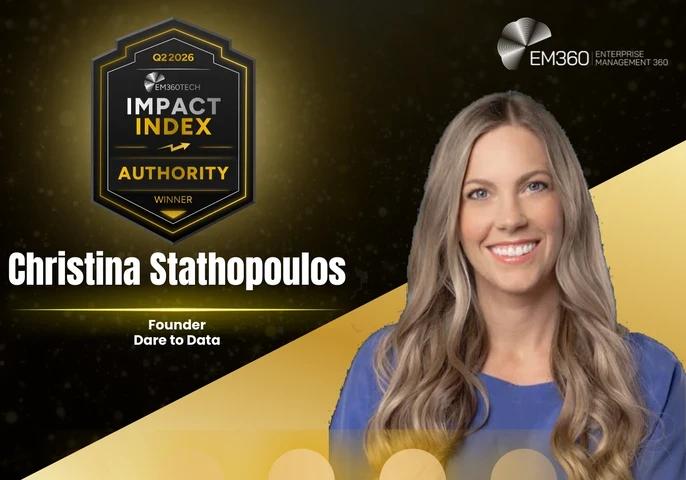
She’s the founder of Dare to Data, and also a regular host across our three podcast series who is known for her ability to make the most complicated ideas feel approachable. And this time we’ll get to congratulate her for being the Q2 2026 Impact Index Authority winner in person! We should remind Michael Lodge (our founder) to get her some flowers, and maybe a trophy? Of the chocolate variety of course!
Those are the analyst partners we currently know will be contributing to the event, but they aren’t the only people we work with across the data community. With hundreds of speakers, exhibitors and attendees moving through Olympia, we’re hoping the two days bring a few more familiar faces into the same room.
Some of the best conversations at conferences begin with the pleasant surprise of recognising someone you’re used to seeing inside a video-call window.
8. Seeing Real-Time Data in Action With Striim
Striim has built what feels like a small event within the event, covering demonstrations, customer experience, operational AI and several opportunities to continue the conversation away from a standard conference session.
At booth P80, the team will demonstrate how data can be moved and updated continuously rather than collected and processed in occasional batches. That distinction can sound technical, but the practical difference is simple. If an organisation is making decisions with information from yesterday, it may already be responding to a situation that no longer exists.
Ramboll will make that problem concrete in The Cost of Waiting for Yesterday’s Data: How Ramboll Unified Global Financial Data in Real Time. Working across 35 countries creates an obvious challenge when financial information is spread between systems, teams and locations. The session will examine how Ramboll used Striim and Microsoft Fabric to bring that information together and make it available more quickly.
Striim and ClickHouse are also tackling The Operational AI Challenge Nobody Talks About. AI systems can only respond to the information they receive, which means even a capable model can make a poor decision when it’s working with stale or incomplete data. The session will look beyond the model itself and towards the less glamorous data movement required to keep AI useful once it leaves the demonstration stage.
That partnership continues through an AI Roundtable Lunch and AI After Hours, with the latter adding food, drinks and a live DJ at the Hand & Flower after the first day. Striim is also hosting Women Shaping AI: Building What Comes Next, giving the people building and influencing these systems a place in a programme that could otherwise become overwhelmingly focused on the technology.
Between the practical demonstrations, Ramboll’s customer story and the wider programme around them, there should be enough happening to make ‘just a quick visit’ to booth P80 surprisingly difficult.
9. Making Time for the Women in Data Community
A conference can put women on its stages and still leave much of the harder work of representation unfinished. People also need access to professional networks, visible role models, useful introductions and opportunities to progress once they’ve entered the industry.
Women in Data works across those less visible parts of the problem. Its community connects women working at different stages of their careers, celebrates their achievements and helps create the relationships that often influence who gets heard, supported and offered the next opportunity.
The Women in Data Lounge at booth A10 gives that community a dedicated home during Big Data LDN. It’s somewhere for existing members to reconnect, for new people to find the organisation and for conversations to continue without being squeezed into the few minutes between one session ending and another beginning.
Events such as Big Data LDN are built around ideas and technology, but much of their lasting value comes from the people attendees meet while they’re there. A useful introduction, a candid conversation about someone else’s experience or simply discovering that another person has faced the same professional obstacle can travel much further than another page of conference notes.
10. Watching Joe Perez and Scott Taylor Take Over the X-Axis Stage
There are currently 411 people listed as speakers at Big Data LDN. Somehow, two EM360Tech analysts have ended up back-to-back on the same keynote stage. Dr Joe Perez goes first, taking the X-Axis Keynote Theatre at 12:40 on Wednesday 23 September for Leveraging Beauty & Brains for Effective Data Storytelling.
His session will explore why an attractive dashboard isn’t automatically a useful one. Data also needs to communicate a clear idea, support a decision and help its audience understand what to do next. It’s a deceptively simple problem.
Organisations have more ways than ever to visualise information, but making something look impressive doesn’t guarantee that anybody will understand what it’s trying to tell them. Joe’s focus is on bringing the “beauty” and “brains” together so the story behind the data doesn’t get lost in the presentation.
He’ll also be holding a book signing for Igniting the Data Dance during BDL, giving attendees another opportunity to continue the conversation. Then, at 13:20, things get considerably less conventional.
Fellow EM360Tech analyst Scott Taylor follows Joe with Data Puppets: SPECIAL Agentic AI with Vibe Coding and Semantic Context Layer Tokenmaxxing EDITION. Yes, that is the actual title. No, there are no typos (we checked multiple times because we didn’t believe it either).
And the Data Puppets are exactly what they sound like. Scott uses actual puppets to cut through some of the increasingly ridiculous terminology surrounding data and AI, with a cast that includes a Chief Dog Officer, IT Bee, CAT-sultants, ANT-alysts and my personal favourite, Monkey Business.
Behind the terrible puns is a serious point. Technology conversations have become remarkably good at burying fairly simple business questions beneath new terminology. Scott’s approach strips some of that away and brings the conversation back to what organisations are actually trying to achieve.
That gives us two EM360Tech analysts approaching communication from completely different directions. Joe is showing how data can tell a clearer story. Scott is apparently approaching the same problem with a Chief Elephant Officer.
Back-to-back X-Axis keynotes weren’t something we planned, but they’re an accidental coincidence we’re very happy to accept.
A Few Bonus Things Happening Around Big Data LDN
Big Data LDN may be the main event, but a conference of this size tends to create a wider orbit around itself. For anyone arriving early, the week can start on Tuesday 22 September with Data Driven LDN at the Clayton Hotel Chiswick.
It’s a separate ticketed event with a deliberately smaller format than BDL itself. Rather than trying to move thousands of people between theatres, the programme gives senior data and AI leaders more time for longer sessions, practical workshops, roundtables and discussion. Big Data LDN Chairman Mike Ferguson will chair the day, with Joe Reis hosting and mathematician, author and broadcaster Professor Marcus du Sautoy delivering the keynote.
Once BDL itself gets underway, there are options for anyone who isn’t quite ready to head home when the theatres start wrapping up.
Data Drinks begins from 17:00 on Wednesday at participating exhibitor stands, turning parts of the exhibition floor into BDL’s Happy Hour. After a day spent moving between keynotes, demonstrations, meetings, interviews and booth duty, we suspect the EM360Tech team won’t need much convincing. More importantly, it gives everyone a chance to pick up conversations that didn’t quite fit into a ten-minute gap between sessions.
And if your preferred way to unwind after an entire day of talking about data is to talk about considerably more data, the Databricks London community has you covered.
Its special BDL meetup begins at Olympia from around 18:00, so at least nobody has to cross London to get there. The evening will bring Databricks practitioners together for technical talks and lessons from real projects, offering a more focused community setting after the scale of the main conference.
Together, the three events stretch the BDL experience beyond its official opening and closing times. Anyone attempting Data Driven LDN, two full days at Olympia, Data Drinks and the Databricks meetup may, however, want to protect Friday for recovery.
Final Thoughts: Big Data LDN Is Better When You Know What You’re Looking For
At some point, you have to stop adding things to the calendar. We’ve gone through the agenda, compared notes across the EM360Tech team and established that there are already far more places we want to be than there are hours available. The sensible thing to do now is probably stop looking before somebody finds another keynote.
Because the next part is considerably more fun. We actually get to go. On 23 and 24 September, booth F38 will become EM360Tech’s temporary home at Olympia. So if you’re heading to Big Data LDN too, come and say hello. Tell us which session you think we’ve overlooked, what you’ve seen that deserves our attention or which company has surprised you most.
And if you happen to stop by while the camera is set up, there may even be time for one question. If you fancy being on screen for a little longer, our sales team will be around to chat about podcasts, thought leadership and building your own authority in the industry. The planning is done, the lists have been printed. Now we wait to see how much of it survives first contact with Olympia.



Comments ( 0 )