
With the boom in online shopping, the risk of parcel theft has scaled to an unprecedented level. According to security.org, the 2025 porch piracy data shows that 64 million Americans (one in four) have experienced package theft, with 9 million adults falling victim within the past three months alone. Cameras exist, but robbers wear masks and steal anyway; the risk grows every hour. That was United Parcel Service (UPS), an American parcel delivery company, in that position. The fix, however, was built with Striim and Google BigQuery. They came together and calculated the risk score for every delivery in real time, delivering enhanced security.
In this episode of the Don't Panic! It's Just Data podcast, recorded live at Big Data LDN in the Y-Axis theatre in front of 200 people, host Christina Stathopoulos, Founder of Dare to Data, sat down for a fireside-style chat with Alok Pareek, Founder and EVP of Product Development at Striim.
They critically examine how agentic workloads impact cost, predictability, performance, and consistency. Pareek also explains why data pipelines that simply move data can no longer keep up, and where processing should happen. Pareek, who in his early career worked on the Oracle database kernel and later served as CTO of GoldenGate, also strongly opposes zero-copy ETL.
For CIOs, CDOs, and leaders in the field of data engineering who already manage mission-critical pipelines for use in operations, analytics, and business intelligence, the fact is that a new type of consumer is now situated atop these pipelines.
“A simple question posed to an AI agent is quickly becoming a distributed computing problem,” states Pareek. “Especially when asking relatively complex inquiries such as ‘is this customer really someone I need to care about deeply?’”
So when accessing a Large Language Model (LLM) for inference, the AI agent might be accessing its own tools, going through multiple database systems, files, websites, or simple search functions. He says the agent may be exasperated and, as a result, it ends up creating a classic GPU cost problem and a distributed computing problem.
Also Watch: Can AI Agents Make Decisions Without Real-Time Enterprise Data?
What is a Distributed Computing Problem?
The problem is that when AI agents go into production and follow prompts, they attempt to resolve sophisticated inquiries to fulfill their objectives by as many means as possible. Their operational scope extends beyond basic large language model (LLM) execution, resulting in the distributed computing problem.
By concurrently or sequentially querying diverse external tools, databases, file repositories, and web services, these agents effectively transform into a full-scale distributed computing architecture.
Pareek received two figures from contacts at Databricks and Snowflake, which he shares on the stage. The first was that agents were setting up databases at four times the rate at which humans are doing so, and that nearly 50 per cent of these databases had a lifespan of less than 10 seconds.
When the agent carries out the task, it will scroll through 12-50 databases at the same time, meanwhile alsi testing different hypothesis. After conducting its analysis, it breaks the infrastructure when the task goal has been fulfilled. Databases are now being used as disposable scaffolding for code generation, and this is a type of workload that differs from the chatbot interactions that most teams had planned for.
As a result, the costs on the enterprise increase, and it doesn’t stop at GPUs. When an agent attempts to answer an ambiguous question, it uses tokens for both pre-fill and decode, and it also looks through tables, accesses indexes, and searches websites using its own tools.
When Data Outranks the Model
Why real-time, governed enterprise data will matter more than frontier models in determining which AI agents scale beyond pilots.

Pareek asks if operators have been optimised for this over the past 15 to 20 years. The second figure is from a professor from Berkeley who is now at Snowflake; he looked at the queries from Snowflake's own AI tier and found that they were scanning trillions of records in order to return two results.
“Recently, a former Berkeley professor now at Snowflake shared an interesting data point: when they analysed their own workloads through Snowflake's AI tier, some of the Coco and code work tiers, they saw that oftentimes these queries were scanning trillions of records only to return two records,” said Pareek.
He adds that if the agent is going to access a number of systems, he will receive a state from each of them. But what does that mean in terms of how the states relate to one another? Query optimisation, access methods, and predicate pushdown were all designed with a person who is expressing a query in mind.
When the agent is still working out what you meant, it behaves differently. He gives an example of a key-value lookup based on a membership ID, which takes only milliseconds, and a search that causes a scan of a table containing 10 billion records, which does not.
Where does Shift-Left Come Into Play in the Intelligence Pipeline?
Stathopoulos raises the question of whether intelligent pipelines involve more data being processed at the source. Pareek agrees and refers to this method as shift-left analytics. To exemplify, he puts a scenario ahead of the audience, for instance, the case of a payment processing application designed to detect fraud or a healthcare application that has yet to identify when a drug is prescribed to the same patient too frequently within a short time period.
In each case, the problem can be dealt with by moving all the data into an analytic system and then post-processing it, or by acting on the data as it is being transmitted, since recency is important in such situations.
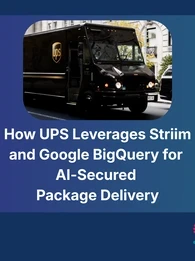
Streaming Analytics Inside UPS
Inside UPS Capital’s Striim–BigQuery stack that fuses vectorized streams, ML models, and routing data to operationalize analytics at delivery scale.
"In my opinion, agents will be dumb if you don't take this action." He refers to the problem of hallucinations and agents' tendency to please the user instead of challenging them, and then brings in outdated data as well.
To illustrate how timely this can be, he gives the example of a big online retailer that, within a 15-minute period in the evening, is able to determine which age group is buying a certain product and then offers a promotion to a partner based on that information. According to him, it is the speed of this process that determines how companies compete.
Ultimately, shift-left analytics ensures real-time timeliness, urgency, and recency for taking action. This includes detecting payment fraud or checking drug prescription patterns rather than waiting for post-processing in an analytics system. It also prevents AI agents from operating on stale data, keeping them effective and up-to-date.
What’s the Role of Data Sovereignty in Analytics?
Data sovereignty has already been included on the agendas of CIOs and CDOs as a result of cloud computing, zoning, and GDPR. Pareek says that agents introduce an additional layer since it becomes necessary to include where an inference model runs.
Data sovereignty already exists as part of your analytics systems, but the problem now is with the added AI layer. “It has become exasperated for the models,” the Founder of Striim said. “If I’m running inference in my application with my model running, but somebody pulls the plug on it, your entire business could come to a standstill.”
This is why enterprise leaders need to account for model predictability and model availability so they can accommodate both traditional and newer components of data availability and performance. “We’re transferring the same type of workload characteristics to models now,” Pareek says.
Mitigating Airline Ops Blind Spots
Why real-time visibility into fleets, crews, and maintenance is now a resilience mandate—and how a managed data hub cuts outage risk.
The governance features built into the database and lakehouse metadata layers were intended for a limited number of users. When each member of the team writes their own agents, auditability and lineage suffer. Simply bringing all the data together does not cure this problem.
Rather than having an agent access the CRM, ERP, billing, or healthcare system that operates the business, customers often copy into a separate system a selected and secured part of that system, keeping it almost in real time. The agent then queries what Pareek refers to as an agent-guarded system and never accesses the production environment.
When combined with CI/CD pipelines, a new guarded database can be set up on demand for each new agent, which is in line with the short-lived database pattern that he had previously described.
Ultimately, AI agents don’t query a database the way an analyst would. They plan as they go, issue unrelated queries, touch several systems at once, and spin up databases that live for seconds, which lands cost, predictability, performance, and consistency problems on pipelines built for something else.
Pareek recommends putting intelligence in the pipeline, acting on data close to the source, guarding production behind replicated subsets, and keeping copies of data rather than collapsing everything into one.
Key Takeaways
- Agents create databases at 4x the human rate; half last under 10 seconds.
- Snowflake saw agent queries scanning trillions of records to return two.
- One agent question becomes a distributed computing problem.
- Agents querying several systems receive states from different moments.
- Pipelines built only for data movement can't explain why they break.
- Shift-left analytics acts on data in flight, before the warehouse.
- Stale data compounds agents' hallucination and people-pleasing tendencies.
- AI sovereignty now covers where models run, not only where data sits.
- Agent-guarded replicas keep agents away from production systems.
- Zero-copy ETL moves complexity onto the source database.
- UPS scores delivery addresses from 100 to 1000 in real time.
- The four Cs: current, consistent, consumable, contextual.
Chapters
When Real Time Rewrites KPIs
Real-time analytics on BigQuery replaces batch reports with predictive operations, reshaping inventory control and customer transparency.
- 03:13 Welcome and Alok Pareek's background
- 06:17 What the agentic era demands of data pipelines
- 14:34 Moving data versus intelligent pipelines
- 18:40 Shift-left analytics
- 20:49 Data and AI sovereignty
- 25:05 Why zero-copy ETL falls short
- 28:51 UPS Defense Delivery and real-time risk scoring
- 31:26 The four Cs
Striim is the real-time data platform for enterprise AI. Striim unifies data from clouds, apps, and databases, protects data as it moves through the pipeline and delivers data in sub-second latency. The result is a trusted, integrated, real-time context layer to feed agents—all at enterprise scale.
Striim’s real-time context engine bridges the gap between enterprise systems and context-starved agents, powering enterprise AI with high availability, in-flight governance, and data integrity enterprises can rely on.

Comments ( 0 )