
Envision a fraud detection model embedded in a bank's AI system, continuously monitoring transactions for unusual activity. The warehouse behind it updates itself every 15 minutes; however, that seems like a short interval. A fraudulent transaction took place 13 minutes ago, and the model still hasn't picked it up.
The thing is, the model is not faulty. The data being fed to it had already overlooked the critical moment. But how?
In this episode of the Don't Panic! It's Just Data podcast, host Shubhangi Dua, Podcast Producer and B2B Tech Journalist at EM360Tech, sat down with guest Sundar Nathan, VP of Product Marketing, Enablement and Academy at Striim. They discuss the gap that exists between the time an event takes place in a production system and the time an AI agent becomes aware of it.
As the frontier models from companies such as OpenAI and Anthropic become more commonplace, the model ceases to be a source of competitive advantage for any enterprise. What remains then is the data beneath the model and the speed at which that data actually moves.
“I'd go even a step further and state that in 18 months the model you select will be less important to you than the data which is feeding that model,” Nathan said.
'Everybody Is Renting The Same Brain'
Alluding to his personal experience, Nathan tells Dua that his "superpower was memory,” particularly, the ability to remember circuit diagrams and organic chemistry structures as clearly as in a photograph when taking an exam. But with the introduction of Google search, that memory ceased to be an advantage since everyone had the same tool at their disposal.
Why is that experience relevant? It’s similar to the use of AI in the enterprise today. "Your competitor next door has access to the same frontier models at the same price, roughly on the same day," he says.
According to the Striim Marketing VP, what a competitor cannot rent is an enterprise’s operational data, its business insights and "the institutional knowledge accumulated over decades", in particular, how close an agent's view of production data is to the actual data.
"The time gap between the agent and where your production data is measured is the new source of competition," he adds.
Also Read Use Case: UPS Leverages Striim and Google BigQuery for AI-Secured Package Delivery
When Data Speed Decides Wins
Why payments leaders are rebuilding decision systems around live data to cut churn, contain PCI scope, and unlock AI performance.

Why AI Pilots Stall Before Scaling
Dua cites a stat from McKinsey: 62 per cent of enterprises are experimenting with AI agents, but only 23 per cent are taking them beyond the pilot phase. Nathan responds to this data, noting that the reason behind the success of the pilot is, in fact, the problem.
In a pilot, an agent carries out tasks such as summarising, drafting or making recommendations, and if it makes a mistake, a human catches it. However, the standard is completely different when an agent is asked to take action, for example by approving a payment, increasing a credit limit or rerouting a shipment.
“In the pilot, the agent summarised, it drafted, it recommended. It looks brilliant, and if something goes wrong, they can fix it pretty quickly,” he explains. “But if somebody prompts the agent to act on the data, that means approving the payment, raise the credit limit or reroute the shipment, then the question is, can I defend this decision if I'm in a regulated industry like financial services or healthcare with an auditor in six months time.”
77 per cent of people struggling to scale enterprise AI are discovering that the impressive pilot really wasn't defensible. It ultimately comes down to data was likely not up-to-date- inconsistent, lacks consistency, comprehensibilility, is it easy to consume and very importantly is the source of the data recognisable, and have it verified that the agent was not shown anything to which it did not have access?
If the data feed had really been hand-stitched and had therefore required the creation of a special data pipeline by a highly enthusiastic team, the answer to all four of those questions would most likely be unsure, and that is the reason why pilots come to a halt, he says.

Inside American’s Data Hub Build
A look at the CDC-driven streaming architecture on Azure and Databricks that gives TechOps teams live operational awareness at scale.
This leads us to the four Cs Nathan champions throughout the episode. These Cs are the solution to enterprise AI scalability problems.
Read Use Case: How American Airlines Powers Global TechOps with a Real-Time Data Hub
The Four Cs: Current, Consistent, Consumable, Contextual
Nathan's framework of what an enterprise data layer needs to provide to an AI agent can be summed up in four words, in that particular order: current, consistent, consumable, contextual.
He regards the layer as being more like a nervous system than a warehouse. "The inner warehouse is the physical or full-body scan that you might carry out once a week or once a year," he says. "The nervous system sends information to your brain within milliseconds, and you react immediately. That is precisely what an agent has to do."
What is meant by 'current' is to capture changes to the data directly from the database's own transaction log as soon as a row is altered ‘not pulled, not scheduled' with the process taking place within seconds. According to Nathan, this aspect must come first; he says, “If you get this wrong, nothing downstream can be trusted.” The rules eliminate the possibility of torn transactions.
The “consumable” takes a crude change event "codes and foreign keys that made sense to a programmer in 1994," as he puts it and converts it into something that has an answer form, such as a customer record, a patient episode, or a document ready to be embedded. "That is what the consumable does," he says, "it turns the fire hose into a drinking fountain for the agent itself."
Contextual content is the last thing that an in-flight enrichment layer adds. When combined with the historical facts stored in the warehouse, it includes the current situation surrounding them, for example, a card transaction made by a customer who is travelling internationally and using an unfamiliar phone.
Cutting Latency, Lifting Loyalty
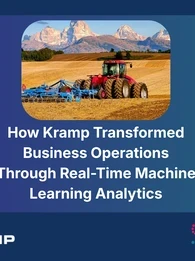
By attacking data latency and quality with real-time replication, Kramp trims service calls and turns analytics into a customer trust asset.
"If you don't have a good foundation, a very powerful punch will cause you to fall down,” Nathan tells Dua.
Striim is one of the early pioneers in the field of change data capture. Nathan explains the platform’s capabilities statting that it functions as an intelligent streaming layer capable of joining, enriching and aggregating data while transferring it in 300 to 400 milliseconds using more than 150 source adapters and 150 delivery targets.
Nathan said that the built-in governance features, which include agents within the platform that identify and mask any personally identifiable information (PII) and protected health information (PHI) before the data reaches a data warehouse or an AI agent, as well as the generation of vector embeddings and the detection of anomalies.
Additionally, access is achieved via an MCP server, so that an AI agent obtains business context. "A business order rather than selecting from the production table" without having a direct connection to the operational systems. "The streaming layer then acts as the controlled front door at which you determine what an agent can see and hide what it cannot," he says. "In this way it never really needs a back door to production."
The kind of model that an enterprise chooses is now the aspect of its AI stack with the least distinction between them. The difference between a defensible and scalable AI deployment and one that remains just a pilot confined to a demonstration lies in whether the data sent to the agent is up-to-date, consistent, easy to use and relevant. It should also be sourced via a governed streaming layer rather than through a batch job or a one-off pipeline designed for a single proof of concept.
When Data Rewrites Delivery Risk
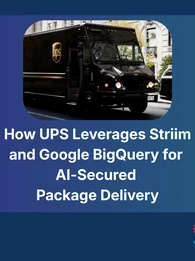
How real-time streaming into BigQuery lets UPS score delivery addresses, cut theft exposure, and turn logistics security into a data discipline.
Takeaways
- The model matters less than the data feeding it within 18 months, Viswanathan predicts.
- Four Cs of AI-ready data: current, consistent, consumable, contextual.
- Only 23% of enterprises scale AI agents past pilot stage (McKinsey).
- Change data capture reads transaction logs directly, in real time.
- Governance built for non-human users masks PII/PHI before agents see it.
Striim is the real-time data platform for enterprise AI. Striim unifies data from clouds, apps, and databases, protects data as it moves through the pipeline and delivers data in sub-second latency. The result is a trusted, integrated, real-time context layer to feed agents—all at enterprise scale.
Striim’s real-time context engine bridges the gap between enterprise systems and context-starved agents, powering enterprise AI with high availability, in-flight governance, and data integrity enterprises can rely on.



Comments ( 0 )