
For years, quantum computing has lived in a familiar place: big promises, early experiments, and a lot of “not yet.” That hasn’t changed overnight. What has changed is the shape of the momentum behind it.
Over the last week or so, a handful of developments landed across different layers of the quantum ecosystem. A public company posted unusually strong results and framed the moment as a commercial inflection point. A telecom lab demonstrated quantum teleportation over existing fibre in a real metro network.
A hardware milestone tackled one of the least glamorous, most stubborn scaling problems. And nearby, the broader compute industry poured billions into photonics technology, largely to keep AI data centres from choking on their own bandwidth.

None of these stories mean quantum is ready to replace classical computing. Together, they suggest something quieter but more useful for enterprise leaders: quantum is starting to look less like a lab curiosity and more like an emerging commercial and infrastructure category.
Commercial Momentum Is Building In Quantum Computing
The clearest “this is getting real” signal is still money. IonQ’s latest results are the headline example. In its Q4 and full-year 2025 update, IonQ reported full-year GAAP revenue of $130.0 million and positioned itself as the first quantum company to exceed $100 million in annual GAAP revenue.
Barron’s described the moment as an “inflection point” and highlighted how far the reported quarter came in above expectations. Investors.com also focused on the beat and the forward-looking signals, including the company’s 2026 revenue guidance.
On its own, revenue doesn’t prove enterprise-scale quantum workloads are here. It does prove something most enterprise buyers care about: the industry is producing enough demand to generate real commercial traction, not just research funding and grants.
IonQ also leaned into a second signal that matters in enterprise tech: stack-building. In its results and commentary, the company pointed to acquisitions and supply-chain moves designed to tighten control over key parts of its platform, including hardware and manufacturing strategy.
That’s not very exciting dinner conversation, but it’s how frontier tech becomes a product category. When a vendor starts investing in predictable delivery, integration, and capacity, it’s usually because customers are asking for more than demos.
There’s a simple takeaway here for enterprise leaders watching commercial quantum computing from a safe distance: the market is still early, but the vendors are beginning to behave like vendors in a real market.
Quantum Networks Are Moving From Theory To Infrastructure
If the IonQ story is about commercial gravity, the fibre-network story is about deployability.
Deutsche Telekom’s T-Labs and Qunnect reported a demonstration of quantum teleportation over a commercial metro fibre network in Berlin. The experiment ran across 30 km of fibre, alongside classical traffic, and reported around 90% average fidelity during January trials.
“Teleportation” is the kind of word that invites eye-rolls, so it’s worth being plain about what it means here.
No objects moved. No people disappeared. What moved was information about a quantum state. In practical terms, that means you can transfer the state of one particle to another at a different location, using a mix of entanglement plus a classical communication channel. The reason researchers care is that this becomes a building block for quantum networking, where the network is designed to share quantum states between nodes.
The enterprise value isn’t “teleportation.” It’s the fact that the demo ran on existing fibre infrastructure in a real operator environment. That’s what turns a concept into an infrastructure conversation. The more quantum communication can coexist with today’s networks, the less it looks like a separate science project that needs a new global buildout before it can matter.
That matters for three enterprise-relevant paths which are often discussed separately:

When AI Drives Cyber Strategy
Infosec leaders rethink defence as agentic AI, autonomy and quantum risk force a move from basic protection to resilient, preemptive security.
First, quantum-secure communication. Quantum networking research is closely tied to the long-term goal of stronger communication security models. It won’t replace today’s encryption tomorrow, but it can shape what “secure by design” looks like in the next wave of critical infrastructure.
Second, distributed quantum systems. A quantum computer is hard enough. Connecting quantum capabilities across sites is even harder. If quantum networking advances, it can eventually support more flexible architectures.
Third, timing and sensing. Quantum networking efforts often intersect with precision measurement and synchronisation research, which has practical roots in telecom and critical infrastructure.
The point isn’t that enterprises should start installing quantum links next quarter. It’s that the “network layer” is showing signs of moving out of the lab and into operator reality, which is one of the prerequisites for any future quantum internet conversation to become practical.
Infrastructure Investment Signals The Next Phase Of Compute
This is where the Nvidia photonics story fits, with careful wording.
Reuters reported that Nvidia will invest $2 billion each in Lumentum and Coherent, positioning the move as an acceleration play for photonics in AI data centres. Nvidia also published its own announcement around its partnership with Coherent, framing it as a way to scale next-generation data centre architecture and optics supply.
This is actually an AI infrastructure headline, but it’s one of the clearest examples of the compute industry investing in the physical layer that will underpin future architectures. Optical networking and photonic interconnects help move data using light rather than electrical signals.
That matters because the bottlenecks in modern compute aren’t only processors anymore. They’re also the pipes between processors. AI clusters are forcing a redesign of data centre networking and interconnect, and photonics is one of the ways the industry expects to scale bandwidth while managing power and heat.
The quantum link is adjacency, not causality.
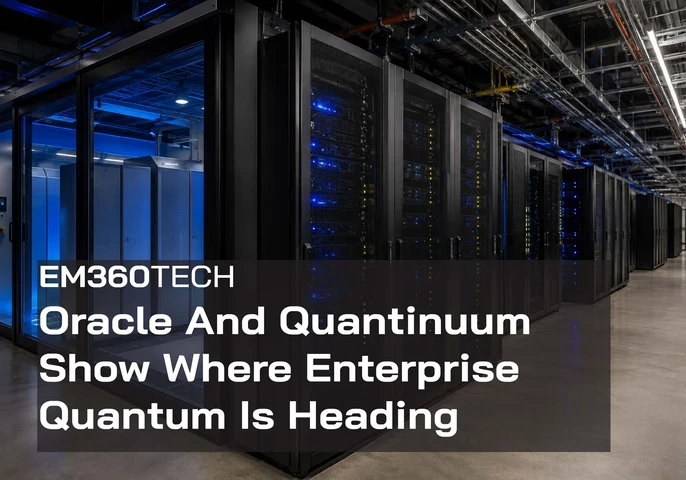
Inside Oracle's Quantum Move
Helios inside OCI hints at QPUs becoming just another managed resource, tightly coupled with AI, HPC, networking and identity services.
Quantum networking work is deeply tied to photons and fibre. Some quantum architectures also rely on photonic components. When the broader industry makes photonics cheaper, more scalable, and more available, it can influence the ecosystem around quantum networking and related infrastructure work.
Put simply: Nvidia is spending to keep AI data centres scaling, but it’s also pushing the world toward a more light-driven infrastructure stack. That’s relevant to quantum’s future, because many quantum communication approaches live on the same physical substrate: fibre, photons, and optical components.
This is what “future computing infrastructure” looks like in the real world. Not a single breakthrough, but upgrades in the plumbing that multiple next-gen technologies will depend on.
Hardware Breakthroughs Are Tackling Quantum’s Biggest Bottlenecks
Most quantum stories fixate on qubits, because qubits are the part people have heard of. But scaling quantum systems is often limited by the unglamorous parts: control electronics, wiring complexity, noise, and the practical challenge of operating at cryogenic temperatures.
A milestone announced through US national lab collaboration work focused on that problem. Fermilab described a breakthrough using ultra-low-power cryoelectronics closer to ion-trap systems, with the goal of simplifying control and reducing the complexity that comes from routing endless connections between room-temperature equipment and ultra-cold quantum environments. MIT Lincoln Laboratory also published a companion update framing this as progress toward scalable quantum systems.
Here’s the enterprise-friendly translation.
Quantum computers need extremely precise control. That control is hard when your compute environment is cold, sensitive, and easily disrupted. The more a quantum system grows, the more control complexity balloons. If you can move parts of the control stack closer to the quantum hardware and do it with very low power, you can reduce some of the wiring and integration chaos that makes scaling painful.
It’s the same pattern you see in other tech revolutions. The first era is “can we do it at all?” The second era is “can we do it reliably, repeatedly, and at scale?” Hardware control milestones belong to that second era.
The Quantum Scoreboard Problem
Highlights how vendor metrics can distort capability, and which questions boards must ask before funding utility-scale quantum pilots.
A separate, earlier-stage example of quantum effects moving toward practical outcomes showed up in materials research. Phys.org reported on work related to the nonlinear Hall effect in a topological material, discussed as a potential path toward small-scale energy harvesting concepts and battery-free device possibilities.
That isn’t quantum computing, but it is a reminder that “quantum” isn’t one thing. It’s a family of physics effects that can feed into future devices, sensors, and edge systems over time.
The core message for enterprise leaders is consistency: progress is happening in the bottlenecks that determine whether the technology can ever leave the lab.
Public Markets Are Starting To Bet On Quantum’s Future
Commercial traction is one kind of signal. Capital markets are another.
Reuters reported that IQM Quantum Computers is moving toward a public listing path through a deal at an estimated $1.8 billion valuation. The mechanics aren’t the main point for enterprise readers. The signal is.
When quantum companies start taking steps toward public markets, it suggests two things are happening at once.
First, investors believe there’s a plausible route from research-stage innovation to commercial scaling. Not a guaranteed one, but plausible enough to price.
Second, the sector is moving into a phase where scrutiny increases. Public-market timelines and expectations are less forgiving than venture timelines. That can create pressure to ship, partner, and operationalise. It can also make vendor risk easier to evaluate because disclosures tend to improve.
If you’re an enterprise buyer, that doesn’t mean you should lock in a quantum roadmap based on one listing plan. It does mean the category is attracting larger-scale capital and a more mature business posture, which tends to accelerate ecosystem development around talent, partners, and commercial offerings.
Why Enterprises Should Start Paying Attention Now
It’s worth saying clearly: quantum computing isn’t replacing classical computing in your organisation this year, and probably not for a while. That’s not the point.
Deep Tech as Enterprise Strategy
Why science-heavy ventures demand new procurement, partnership and funding models for enterprises seeking more than software tweaks.
The point is that quantum is shifting from isolated breakthroughs to an ecosystem that’s beginning to form around it. That ecosystem includes commercial vendors, telecom experiments, infrastructure investment, and the slow engineering grind of making fragile systems more scalable.
For enterprise leaders, the practical playbook is simple and boring, which is usually a good sign.
Start with experimentation. Many organisations will encounter quantum first through cloud access models and pilot programmes, not on-prem hardware. That keeps the risk contained and lets teams build internal fluency without betting the farm.
Track quantum-safe cryptography planning. Even if you’re sceptical about near-term quantum advantage, the security conversation around post-quantum readiness is already moving in parallel across standards and infrastructure planning. Your crypto inventory, key management maturity, and migration planning will matter either way.
Watch the infrastructure layer. Quantum may feel distant, but the parts it depends on are converging with other enterprise priorities: fibre networks, optical components, high-performance compute, and data centre architecture. Those are very present-tense concerns.
If there’s one takeaway that cuts through the noise, it’s this: the most meaningful shift isn’t any single milestone. It’s the convergence of research, infrastructure, and investment that makes a technology category capable of becoming real.
Final Thoughts: Quantum Is Moving From Research To Ecosystem
Quantum computing has spent decades as a research milestone race. Each announcement tended to live in isolation. A new experiment here. A new prototype there. Interesting, but rarely connected to enterprise technology strategy.
What’s changing now is the pattern behind the announcements.
Instead of isolated breakthroughs, progress is starting to appear across the commercial, infrastructure, and engineering layers that typically define a technology ecosystem. That shift doesn’t make quantum computing enterprise-ready overnight. What it does signal is that the conversation is gradually moving from theoretical possibility toward long-term strategic relevance.
For enterprise leaders, that distinction matters. The real risk isn’t that quantum arrives suddenly and disrupts everything. The real risk is ignoring the signals that tell you when a new computing paradigm is starting to organise itself into an industry.
The organisations that benefit most from emerging technologies are rarely the first adopters. They’re the ones that recognise when a technology is beginning to form an ecosystem around it and start preparing their strategy accordingly.
EM360Tech continues to track these inflection points across quantum computing, next-generation infrastructure, and emerging enterprise technologies, helping technology leaders understand when experimental innovation starts turning into something far more practical.



Comments ( 0 )