
In August of 2026, more than 2,000 robots took part in the 2026 World Humanoid Robot Games, held in China’s capital of Beijing. At these games Chinese manufacturers demonstrated machines that could run, box, play table tennis, sort parcels, handle components and perform other sophisticated tasks.
One Chinese humanoid, named Tiangong Ultra, even ran 100 meters in 8.64 seconds, breaking Usain Bolt's human world record of 9.68 seconds.
It has showcased how advanced China's humanoid robot industry has become in a short amount of time. And while it is certainly eye-catching and makes for entertaining headlines worldwide, it has exposed an important question of when does a technological capability become something that should be adopted?

Making this distinction matters because China's humanoid robotics boom is currently showing both sides of this fast spinning coin. The hardware is rapidly advancing. The manufacturing ecosystem is expanding. Investment is pouring in. Robots are entering factories and other working environments.
Yet many of these machines remain expensive, unreliable and unpredictable (as seen in some viral videos). They are also still highly constrained in what they can actually do without human intervention.
This could mean that China is already nearing the finish line in the race to manufacture humanoid robots but the industry has yet to have a plan ready for how to deal with them.
What Is a Humanoid Robot?
But first, let’s get our definitions right. A robot is, broadly speaking, a machine capable of carrying out tasks automatically or semi-autonomously. It tends to use sensors, software and mechanical systems to interact with the environment. Robots come in many shapes and sizes, from robotic arms on factory assembly lines to mobile robots transporting goods in warehouses from point A to point B.
A humanoid robot, on the other hand, is a more specific type of robot designed to resemble the human body. It typically has a torso, two arms, two legs and a head containing a sensor system (you could think of it as a brain of sorts). The idea is not simply to make a robot look human, but to create a machine capable of operating in environments that have been built with people in mind and using tools and equipment originally designed for and around human movement.
A conventional industrial robot might be built to perform one task repeatedly and efficiently. A humanoid is intended to be more general-purpose, potentially moving between different tasks without requiring an entirely different machine for each action or task.
This is also why humanoid robots are attracting so much attention. If they can become capable and reliable enough, they could theoretically enter existing workplaces without companies having to redesign every environment to accommodate a machine.
But that flexibility comes with a trade-off: the more general-purpose a robot has been created to be, the harder it becomes to make it as efficient, reliable and cost-effective as a machine designed for only one specific task.
And that brings us back to the central question surrounding China's humanoid robot boom: is the technology truly ready for adoption across many sectors, or are we still just watching a demonstration of what might eventually become possible?
No Longer a Pipe Dream
It would be a mistake to dismiss China's humanoid robotics industry as a speculative bubble ready to pop at any moment.
When it comes to industrial automation, China already has a head start. This is due to this Asian economic powerhouse’s supply chain density, which allows manufacturers in hubs like Shenzhen to be able to source robot components in under an hour.
54% of new industrial robot installations globally are done in or via China, according to recent reporting based on International Federation of Robotics data. Chinese companies have something many other robotics markets around the globe lack: an enormous manufacturing base in which to test, build and deploy machines at scale.
With this foundation supporting it, the Chinese humanoid sector has been given a major headstart.
![In the latest development, China’s government, on a broadcast on CCTV, announced earlier today [Thursday, June 18, 2026] that the country’s commercial ministry will introduce 17 measures to integrate AI applications in the consumption sector.](/sites/default/files/styles/content_card_secondary/public/2026-06/china-announces-17-ai-measures-consumer-sector.jpg.webp?h=2cb24fdd&itok=5embWPvb)
China’s AI Consumer Pivot
Beijing’s 17-point plan turns homes, retail and services into AI testbeds, with subsidies, standards and clusters to unlock new consumer demand.
In August of 2026, Reuters reported Chinese manufacturers were demonstrating robots sorting parcels, packing mobile phones for shipment and performing common household tasks. This was done in an effort to move away from mere attention-grabbing showcases and more toward practical, commercial applications.
At the 2026 World Robot Conference, more than 300 companies displayed over 2,000 exhibits and launched more than 150 products, showing the scale of the sector’s ambitions. The more important question though is whether those ambitions are translating into sustainable, real-world use.
Chinese manufacturers have reported humanoids with the ability to handle tasks such as loading and unloading materials, sorting components and connecting parts in factories. Reuters footage from August shows humanoid robots being introduced into workplaces. This comes alongside a rising demand for robot components, which suggests the wider supply chain is being prepped to support more widespread and practical deployments.
This is important to note because demonstrations do not create data in the way that deployment does. A robot performing a task one thousand times in a factory can generate valuable information about movement, manipulation, failure and environmental variations. This data can then be used to improve the robot’s movements and the models controlling the robot.
Chinese companies are creating a feedback loop in essence. The more robots there are, the more deployments can be made. The more deployments, the more data can be collected. More data leads to better models and better robots, looping all the way back to more deployments.
The creation and collection of humanoid data ultimately is China’s biggest advantage in so-called embodied AI (the integration of machine learning into physical or virtual bodies).
Demonstration Is Not Adoption
A robot completing a task as part of a demo is not the same as a business successfully deploying it for use in their operations. This is where things get interesting. The recent World Humanoid Robot Games were a great illustration of the distinction between demonstration and adoption.
Building Korea’s AI Factories
How SK Hynix, SK Telecom, Naver, LG and Hyundai plug into Nvidia architectures shaping memory, data center and physical AI capacity.

The machines did indeed achieve extraordinary physical feats. But the most commercially relevant demonstrations were not the awe-inspiring (and sometimes goofy) athletic events. They were the less glamorous challenges involving fine motor dexterity, manipulation and practical task completion.
These challenges involved robots performing tasks such as handling objects, charging electric vehicles, working in restaurants and manipulating small components. Some demonstrations showed genuine progress while others exposed just how far the technology still has to go.
Not all achievements are created equally. A robot running faster than a human is impressive. However, a robot reliably picking up the correct component, identifying where it belongs, installing it without damaging anything else and then repeating the process for eight hours is commercially useful for many industries.
Reuters' recent investigation into China's humanoid industry found that many machines still struggle with relatively basic tasks and have difficulty responding when things depart from normal, programmed routines. The investigation also found commercial demand for humanoids does not match up with how fast manufacturing capacity is growing in some parts of the sector. That gap is where the real story lies.
The Enterprise Test Is Much Harder
When it comes to implementation in the enterprise world, the question is rarely whether a technology is technically sound and impactful. It is more about whether it produces a better economic outcome than the alternatives.
This means a humanoid robot must not only prove it is better and cheaper than human labor but also than existing automation. This is a crucial distinction.
An industrial robot built for purpose does not need legs, a torso or two arms so as to resemble a human being. It simply needs to perform one task extremely well. If a manufacturer wants a robot to move boxes from one conveyor to another, a robotic arm is already a cheaper, faster and more reliable option than a humanoid.
When AI Demand Outruns Memory
Korea ties fiscal strategy to a potential chip shortage, balancing windfall spending with structural budget reviews.
If a warehouse needs to move products across a facility, an autonomous mobile robot would make more sense. If a company needs to inspect equipment in the real world, a drone, camera system or quadruped robot may be a better option.
The humanoid idea becomes more compelling when machines have to enter an environment that has been designed around human movement. If it contains infrastructure, tools and workflows for humans, it would be difficult to redesign. It’s best to have a machine that has been made to fit into what is already there instead of the other way around.
That is where a general-purpose machine could eventually have an advantage. A humanoid could theoretically walk into an existing workplace and use the same doors, tools, shelves, vehicles and equipment as a human employee. But that’s the thing, it’s all theoretical at this point.
Building Infrastructure Before the Use Case Is Fully Mature
This is where China's approach becomes a particularly interesting case study for enterprise technology leaders to examine.
China has repeatedly used government-backed industrial goals to build the manufacturing capacity early, drive down costs through competition and then practical applications emerge around that infrastructure. Robotics seems to be following this template. China seems to be taking a page out of Field of Dreams’s playbook, “If you build it, they will come.”
The country's humanoid industry is definitely getting substantial government support. Reuters estimates that more than $230 million in government subsidies have been pushed directly into this sector during the first months of 2026 alone. State-backed demand is also emerging, including plans by State Grid to spend around $1 billion on robots.

However, this support does not automatically make humanoid robots commercially successful. But it does make it less financially risky for companies to experiment with humanoid robots before being taken to market, reducing the barriers to success.
When Robot Hype Meets Policy
Regulators push humanoid robot makers to prove real demand, forcing a reset on valuations and revenue narratives in China.
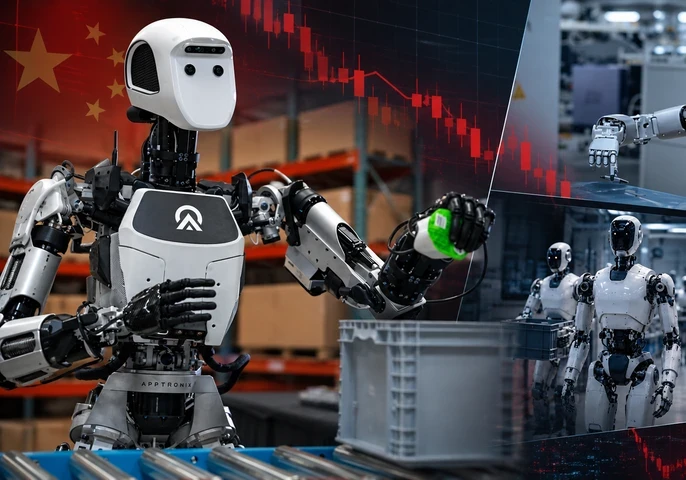
It ultimately means companies can manufacture more machines, researchers can gather more physical-world data, suppliers can produce components at greater scale and startups can repeat experiments faster. Eventually, all of this combined could make today's expensive, unreliable humanoids substantially cheaper and more capable.
China's existing experience with electric vehicles and solar manufacturing offers a useful parallel. The country has shown how making aggressive investments, whipping up domestic demand and large manufacturing scale can transform an emerging technology from an expensive product into a globally competitive commodity.
The same outcome is not guaranteed for humanoids but it’s clear there is a method to the madness.
A Warning Sign In the Form of Investment Frenzy
The gap between technological promise and commercial reality is most visible when you look at the financial markets.
Unitree Robotics, one of China's best-known robotics companies, became the first mainland-listed humanoid robot manufacturer when it launched its Shanghai IPO in 2025. The company sought to raise around $900 million and its IPO price was valued at approximately $9 billion. Its retail offering was reportedly more than 8,000 times oversubscribed, showing higher demand but lower supply.
The enthusiasm did not last. First Unitree shares jumped by approximately 460% before promptly crashing. This sparked concerns about whether investor expectations were too high and the company’s commercial performance could not match up. Reuters has since reported that the company's adjusted net profit had fallen 53% in the first quarter of 2026.
That does not mean Unitree is a bad company or that humanoid robotics is doomed. It rather demonstrates something more useful: A technology can be strategically important and technically impressive but also commercially immature at the same time.
Those three things are often treated as interchangeable. They are not.
How Enterprises Are Making the Same Mistake With AI
The lesson extends beyond robotics and humanoids. Enterprise technology has spent the last few years learning the difference between AI availability and AI adoption. A company can have access to a powerful large language model (LLM) but not have a successful AI strategy to go with it.
It can deploy an AI assistant without changing how employees work. It can launch an AI agent without giving that agent the permissions, data access and governance required to accomplish anything meaningful. And it can invest millions in AI infrastructure without producing a measurable business return.
Humanoid robots are merely the physical representation of this dilemma. The robot represents the technology and the workflow is the use case. The adoption is thus the measurable improvement in cost, speed, quality, safety or revenue.
This distinction should become increasingly important as physical AI moves from research laboratories and into enterprise environments.
A Lull in the Action
The most important humanoid robotics developments over the next few years may not involve robots doing backflips or breaking sprinting records. They may look almost boring.
- A robot that loads a machine for an entire shift without intervention.
- A robot that reliably moves inventory through a warehouse.
- A robot that can switch between several tasks without being reprogrammed.
- A robot that reduces workplace injuries.
- A robot that costs less to operate than the human or automated alternative.

Those milestones will probably attract considerably less attention than the viral-worthy 8.64-second robot sprint. But those mundane achievements will matter much more to enterprise buyers and real-life applications.
That is why China's humanoid boom should not simply be viewed as evidence that humanoid robots are about to take over the workplace. It should be viewed as an enormous industrial experiment.
China is putting capital, manufacturing capacity, government support, AI models and physical robots into the same feedback loop and testing what happens when they collide with the real world to see what the outcome is.
Some companies will fail. Some business models will collapse. Some valuations will prove to be absurdly high.
But the survivors of this experiment could emerge with something more valuable than awe-inducing prototypes: a scalable robotics ecosystem with years of real-world deployment data to back it up.
So, What’s the Humanoid Race Really About?
For those enterprises watching the sector with curiosity, it’s important to recognize that these developments are much more nuanced than a single country winning or dominating the race to create humanoids.
What China’s actually done up until now is focus on the right foundations, namely manufacturing, deployment capacity and the ability to iterate at scale. It has invested in the infrastructure and supply chains needed to develop the technology, put robots into real-world environments and learn from what happens next.
Now comes the delicate refinement process.
- Can humanoid robots become reliable enough to operate outside controlled demonstrations?
- Can embodied AI understand unfamiliar, built-for-humans environments?
- Can companies collect enough high-quality physical-world data to train more capable models?
- Can humanoids outperform cheaper, specialized machines?
- Most importantly of all, can they generate enough economic value to justify the large investment made thus far?
That question is particularly important for enterprises studying China's approach because there’s a broader lesson to be learnt. Adoption does not always begin with a perfectly proven use case. Sometimes, the foundations have to come first.
China’s investment in manufacturing capacity, supply chains, components, data and deployment environments that could eventually make humanoid robots cheaper, more capable and easier to adopt. The immediate return on that investment may not always be obvious from the get-go, but building that foundation gives the industry room to experiment, learn and scale when commercially viable use cases emerge.
For enterprises, that does not mean investing in every emerging technology simply because it MIGHT become important. It simply means developing the ability to distinguish between building capacity and buying into hype
Developing the infrastructure, skills, data and processes needed to support an emerging technology may prove more valuable than rushing to deploy it before a business use case is clear.
If humanoid robots can overcome the aforementioned challenges and demonstrate a compelling economic case for their existence, today's boom could become a genuine industrial success story.
If they can't, it risks becoming another technology bubble that produced extraordinary demonstrations but limited adoption. For enterprise technology leaders, that distinction is the one worth watching.
The future of robotics and humanoids will, in the end, not be decided by how impressive a robot looks on stage. It will be determined by what happens when somebody puts one on a factory floor and expects it to successfully do a real job on a random Monday morning. And as that shift from spectacle to substance plays out, EM360Tech will continue to follow the latest AI developments, insights and trends shaping what comes next.



Comments ( 0 )