
Think of a robotic prototype that functioned well in March. Its robotic arm sorts through parcels flawlessly on the lab bench. It runs on a power-demanding compute module with a fan attached to the side. Finally, the production specifications are announced: battery power, a sealed case, a budget of 10 watts at most, and no connection to the cloud. Porting the application to hardware that fits those limits is the part of the roadmap nobody put on the slide.
This is where many physical AI projects stall between demo and shipment.
In the recent episode of the Tech Transformed podcast, host John Santaferraro, CEO and Head Research Analyst at Ferraro Consulting, sat down with Krishna Rangasayee, Founder and CEO of SiMa.ai, and Manuel López Roldán, GenAI Product Manager at SiMa.ai.
They break down everything you need to know about physical AI, why it’s taking machine intelligence out of the data centre and into the device itself, and explain the changes that SiMa.ai has made to its software so that AI agents and human engineers can build complex AI applications for that hardware in days and hours, making imagination the limit.
"You could run very high accuracy models entirely on device. You don't need the cloud at all,” the CEO of SiMa.ai states, setting the agenda for this episode.
Rangasayee says that we’re living through what is likely to be the largest upheaval of experiences. “AI is completely overhauling everything we know. We've gone through the social media revolution; now we're going through the cloud AI revolution.”
He believes that everything will be AI-enabled in some form or another, from the infrastructure enabling it in manufacturing, or in robotics, or in automotive, to everything we experience in our home, in our work, in medical.
Should Machines Have AI-Driven Reasoning Capabilities?
Machines will have reasoning capabilities for the first time, according to the SiMa.ai founder. In the past, machines lacked judgment. When it comes to physical AI, machines perceive, reason, and act in the real world as opposed to merely carrying out fixed instructions.
Additionally, physical AI will have a much larger economic impact, in addition to having an impact on the lifestyle of human beings.
When looking at the core aspect of why people demand AI enablement in the first place on all classically available devices, Rangasayee says, “You're bringing in new capabilities, new possibilities that we could have never comprehended before,” he says. “Second, it brings productivity and a total cost of ownership experience that's much cheaper, much more affordable. That means more people can benefit from it.”
“Classic compute has run out of its capacity to really live up to expectations. The only way to bridge it is through AI," said Rangasayee.
SiMa.ai is bringing productivity and accuracy to a wide range of applications, such as customers in manufacturing deploying the tech to quality inspection or factory floor automation. The CEO says it’s a “total cost of ownership change that’s never been seen in the industry before.”
“We’re seeing lots of customers adopt us in gripper robots, automated mobile robots, lawn mowers,” he adds. “We are seeing a lot of drone customers that used to do rule-based compute for drones. Today's new-age drones are AI-based. They are autonomous. They're sometimes GPS-denied. They're really self-navigating and work in swarms together.”
Is Investing in Physical AI Justified?
Reshaping Physical AI Delivery
Why abstracting edge hardware unlocks days-not-months delivery cycles for drones, robots and real-time multimodal AI workloads.
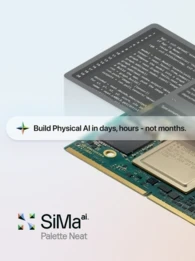
From an economic standpoint, energy consumption is a key factor. SiMa.ai's clients typically operate under 10 watts when powered by the company's silicon. This efficiency spans a variety of sectors, including robotics, automotive, drones, smart vision, manufacturing, and healthcare.
SiMa.ai has consistently reaffirmed this power efficiency ceiling, most recently in its 2026 edge AI product of the year announcement regarding the Modalix Machine Learning System on Chip (MLSoC) system-on-module (SoM). Pin-for-pin compatible with NVIDIA's Jetson Orin module form factor, the module allows engineering teams to swap hardware without modifying the existing carrier board.
When Santaferraro asks how software teams should be accelerating the design for physical AI capabilities, Roldán states that SiMa.ai was one of the first to create an agentic platform and that most vendors deal with it the wrong way round.
“If you just get your software, put an agentic layer on top, and you try to utilise the software as you have it, you will probably fail,” Roldán says. The agent might help, but it won’t be able to achieve the true capabilities.
SiMa.ai took a different approach. "We completely redesigned our software and SDK end-to-end to assume you are working with an agent," Roldán explains. "When you build software specifically for agents to use, the agent becomes significantly smarter and faster, and the software automatically becomes much easier for humans to use as well."
People have "days, months, and years" of context. An agent has, let’s say, a million tokens, and all the information it needs to know about the task must fit within that amount. By breaking the software down and making it accessible to meet that limit, it’ll become easier for people to use, provided that "the right knobs and the right complexity" are made available as the project develops.
For instance, SiMa.ai’s Palette Software Suite, an open-source agentic development environment for its Modalix Machine Learning System on Chip (MLSoC), was launched in June 2026.

Inside Physical AI for Drones
Break down the sensing, compute and software stack that turns small UAVs into resilient, GPS-independent assets for defense and industrial use.
Physical AI’s roadblock is no longer whether a model is accurate but transitioning between a successful lab demo and real-world deployment. As small models become efficient enough to run on chips in drones and robots, the challenge lies in engineering. Physical AI must handle complex architectures and migrate code to specialised hardware, a process that once required large, expensive teams. Now, it can run on battery power within a 10-watt budget, without cloud connectivity.
Where is Physical AI already deployed?
Physical AI customers are involved in quality inspection and factory floor automation, and in the field of robotics, those include warehouse logistics robots, gripper sorting robots, automated mobile robots, and lawn mowers. Alluding to drones, Rangasayee states that rule-based computing is being replaced by AI-based systems that can navigate without GPS and work in swarms.
He always comes back to the example of cars. According to the CEO, voice assistants in cars have trouble with accents, on the basis of his own experience. "Today's cars are going to turn into AI cockpits," he says.
SiMa.ai’s September 2026 funding announcement cites a Counterpoint Research projection of 145 million cumulative physical AI device shipments across robotics, automotive, and drones by 2035, as reported by Unite.AI. The same announcement carries Rangasayee's description of humanoids, automotive, and drones as the "gateway to a $50 trillion market".
As for how listeners should proceed, Rangasayee says they should "go straight in and begin", adding that SiMa.ai has designed its software for both expert and novice users.
Takeaways
- Physical AI transfers reasoning from the cloud to the device itself.
- Rule-based control is replaced by systems aware of context & memory.
- Majority of physical AI customer applications require a sub-10 watt power envelope.
- Smaller & more optimised models operate on-chip with high accuracy.
- SiMa.ai carried out a complete rebuild of its industry-first agentic Palette Software Suite for use by agents.
- Palette lets developers explain and build systems in plain English.
- Current builds now take days or even hours, not "six to nine months".
- Humans retain the ideas & the decisions while the agents execute.
- Current use cases involve inspection, warehouse robots, drones & cars.
For more information, visit sima.ai.

SiMa.ai is a leader in Physical AI, delivering a purpose-built, software-centric platform that brings best-in-class performance, power efficiency, and ease of use to Physical AI applications. The company is focused on scaling Physical AI across robotics, automotive, drones, industrial automation, aerospace and defense, smart vision, and healthcare. Learn more at www.sima.ai.



Comments ( 0 )