
Buying a robot sounds like the kind of procurement decision that should come down to the machine. What does it do? How fast can it work? How reliable is it? How much will it cost to deploy and maintain? But enterprise robotics doesn't always fit neatly inside those questions anymore.
A robot may come from one manufacturer, be implemented by a systems integrator, use software or AI from another provider and depend on maintenance expertise somewhere else. The business itself may own the machine outright, lease it or pay for the capability through a subscription.
And more organisations are having to make those choices. The International Federation of Robotics (IFR) recorded 542,000 new industrial robot installations globally in 2024, more than twice the number installed 10 years earlier. North American demand is also spreading beyond the automotive companies that have historically dominated industrial automation.

Association for Advancing Automation (A3) figures released in August 2026 show orders increasing across semiconductors and electronics, automotive components, food and consumer goods, metals and life sciences. So the question isn't only which robot to buy anymore. It's what the organisation is actually buying into.
There is an important distinction here. Asset ownership tells you who owns the physical machine. Capability ownership tells you who retains the knowledge, authority and control needed to keep that machine useful to the business. Those can be two very different things.
Buying The Robot Is Only The First Ownership Decision
There are already enterprise robotics models where buying the machine isn't necessary at all. IFR's 2025 service robotics data found the global Robot-as-a-Service (RaaS) fleet grew by 31 per cent in 2024 as more companies chose subscription or rental models rather than making a large upfront investment. Within transportation and logistics, RaaS grew by 42 per cent.
That changes the economics of robotics adoption, but it also makes ownership more complicated. An organisation can depend heavily on a robotic capability without owning the equipment responsible for it.
The reverse is just as possible. A company can have a robot sitting on its own factory floor and still depend on someone else to understand how it has been configured, make significant changes or recover it when something goes wrong.
This is where asset ownership stops being a useful shorthand for control.
Imagine a robot that performs an important step in a production process. The company owns it. But the systems integrator designed the implementation, an external provider maintains a critical software layer and a specialist contractor handles changes that internal teams can't make themselves. If that network of support disappears, ownership of the metal doesn't get production moving again.
The more useful question is therefore: what does the enterprise need to remain capable of doing without any single supplier?
Answering that means looking beyond the purchase agreement and at the wider robotics ecosystem the organisation is entering.
One Robotics Capability Can Have Several Owners
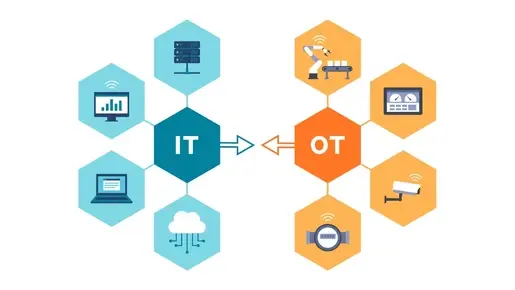
Modern industrial robotics increasingly sits between information technology (IT) and operational technology (OT), which includes the equipment and control systems that make physical processes happen. A single robotics deployment may involve an original equipment manufacturer (OEM), a robotics systems integrator, software or model providers, specialist suppliers, maintenance partners and several internal teams.
They aren't all doing the same job. One company may supply a component. Another may operate or maintain it. Someone else may have the authority to change how it behaves.
Then there is the organisation relying on the outcome.
Those distinctions become particularly important when businesses assume that handing work to a supplier also transfers responsibility. It doesn't always. A maintenance company may perform an update, for example, but the enterprise may still carry the operational consequences if the system subsequently becomes unavailable.

10 Technologies Reshaping Value
AI, quantum and IoT are converging into a new enterprise baseline. See which 10 bets are setting the agenda for the next decade of value creation.
Research suggests external knowledge will remain an important part of this picture. A 2026 study published in Technological Forecasting and Social Change analysed 15,231 innovative UK small and medium-sized enterprises using a “make, buy or ally” framework. It found that buying external knowledge strongly predicted AI robotics adoption, while collaboration with external partners also increased adoption. Internal research and development decisions were themselves influenced by access to external knowledge.
That doesn't mean businesses should outsource robotics expertise as far as possible. It means the opposite extreme, trying to recreate every specialist capability internally, doesn't make much sense either.
The practical challenge is deciding where expertise can safely sit outside the organisation without leaving the business unable to control something it depends on.
What Should An Enterprise Actually Own?
There isn't one correct build-versus-buy formula for robotics strategy. A manufacturer running hundreds of robots across several facilities will make very different choices from a logistics operator introducing its first autonomous system.
A better test is what happens if a capability disappears.
If losing a supplier would leave the organisation unable to understand what its system is doing, respond when it fails, approve important changes or move to another provider, the company may have outsourced more than specialist expertise. It may have outsourced control.
Own the knowledge you need to stay in control
An enterprise doesn't need enough internal robotics expertise to rebuild every system itself. It does need enough understanding to make informed decisions about something that affects its operations.
Teams should know what business process the robot supports, what other activities depend on it and what happens when it becomes unavailable. They also need enough documentation and organisational knowledge to understand operating limits, recognise when specialist help is required and know who has authority to make different decisions.
This is partly about resilience. It's also about being an intelligent customer.
Without sufficient internal knowledge, the enterprise can't easily judge whether a proposed change is sensible, whether a recurring problem is being addressed properly or whether a supplier's recommendation is the best option available.
Inside Converged IT OT Networks
Break down architectures, protocols and lifecycles that separate IT stacks from industrial control systems as they merge into IIoT estates.
The knowledge doesn't have to live with one robotics expert either. Some of it may belong with operations, some with IT or OT teams and some with risk, procurement or engineering. What counts is whether the organisation itself can still understand and govern the capability it depends on.
Source expertise that doesn't create unacceptable dependency
Specialist knowledge is one of the reasons robotics ecosystems exist in the first place. Systems integration, engineering, machine vision, maintenance and increasingly AI can require expertise that many organisations won't need often enough to justify maintaining internally.
Outsourcing those capabilities can be entirely rational.
The question is what happens when useful specialisation becomes supplier dependency.
A good starting point is to consider how strategically important the capability is, how frequently the expertise is needed and how difficult it would be to replace. The consequences of losing access also count. Waiting several weeks for a new specialist might be manageable for one process and disastrous for another.
This changes how businesses should think about external robotics expertise. The aim isn't maximum independence. It's avoiding dependencies the organisation hasn't deliberately chosen and couldn't realistically unwind.
Keep accountability where the business risk sits
Execution and accountability aren't the same thing.
A supplier might carry out maintenance. An integrator might modify the application. A software provider may issue an update. But someone still needs to decide who can approve significant changes and who accepts the operational consequences.
That includes areas such as safety, security, system access, performance, recovery and regulatory obligations.
Europe's incoming Machinery Regulation gives this distinction some practical weight. Regulation (EU) 2023/1230, which generally applies from 20 January 2027, defines a “substantial modification” as certain physical or digital changes made after machinery enters service that weren't foreseen by the manufacturer and affect safety. Depending on the circumstances, changing a system can therefore carry responsibilities that go well beyond routine technical work.
For enterprises, the broader lesson is simpler. If several parties can change a robotic system, responsibility for those changes can't be vague.
Edge Vendors Reshaping Workloads
Assess the strengths, gaps and lock-in risks across leading edge partners before committing critical operations to the periphery.
That becomes even more important once the system has been running for a few years and the original deployment team is no longer the group looking after it.
Ownership Has To Survive The Robotics Lifecycle
Robotics procurement can look perfectly sensible on deployment day and become much less comfortable five years later.
People leave. Software changes. Components reach end of life. Suppliers get acquired, change strategy or stop supporting products. The production process itself may also change, forcing the robot to change with it.
The latest industrial robot safety standard already reflects this longer view. ISO 10218-2:2025 covers industrial robot applications across design, integration, commissioning, operation, maintenance, decommissioning and disposal. It is explicitly intended for manufacturers, integrators and users rather than treating robot safety as the responsibility of a single participant.
The same lifecycle thinking is useful beyond safety.
An enterprise robotics operating model should still work when performance starts deteriorating, an AI model needs updating, an integrator is replaced or a critical component is no longer available. It should also account for the rather less exciting end of the technology lifecycle, when the company eventually wants to retire or replace the system.
This is where exitability becomes part of operational resilience.
Exitability is simply the organisation's ability to leave a supplier, platform or deployment model without losing everything required to keep operating. Waiting until the relationship is already failing to find out whether that is possible is a fairly expensive way to learn about vendor dependency.
The easier approach is to ask before the contract is signed.
Five Questions To Ask Before Signing A Robotics Contract
A robotics procurement process can quickly become dominated by technical specifications and expected return on investment. Those are necessary, but they don't tell you whether the organisation will still control the capability once the implementation team has gone home.
Five questions help expose that risk early:
Inside the IIoT Platform Race
How leading industrial giants are building data-driven platforms to control machines, cut costs and lock in long-term digital advantage.
- What capability are we actually becoming dependent on? Look past the machine and identify the business process and outcome it supports. The more important that outcome is, the more carefully ownership needs to be designed.
- What knowledge would we lose if this supplier disappeared? Work out what documentation, internal understanding and knowledge transfer would remain if the relationship ended unexpectedly.
- Who can change the system, and who approves those changes? Establish who has technical access, who can alter behaviour and who carries authority for changes with operational consequences.
- What remains ours if the commercial relationship ends? Clarify access to the programmes, configuration, operational data, documentation, models and other assets required to continue operating or migrate elsewhere.
- Can we recover, replace or exit without rebuilding from zero? A dependency isn't automatically a problem. A dependency that can't be replaced, recovered or even properly understood is much harder to accept knowingly.
These questions don't eliminate supplier reliance. Nor should they. Robotics increasingly benefits from knowledge spread across specialised organisations.
They make that reliance visible before the business becomes dependent on it.
Final Thoughts: Own The Capability You Can't Afford To Lose
The strongest robotics operating model isn't necessarily the one that keeps the most technology in-house. Building every specialist capability internally can add cost and complexity without giving the business any more meaningful control.
But the other extreme has its own problem. If everything important lives with the OEM, integrator or service provider, the enterprise may discover that it owns a robot without truly owning its ability to use, change or recover it.
That brings us back to the distinction at the beginning. Asset ownership answers whose machine it is. Capability ownership answers whether the organisation can continue making informed decisions about something its operations now depend on.
As robots become more autonomous, software-defined and connected to wider enterprise systems, those decisions are likely to involve more organisations rather than fewer. The companies best prepared for that shift won't necessarily be the ones that own the most technology. They'll be the ones that know exactly what they can safely entrust to someone else, and what they can't afford to hand away.
As physical AI and enterprise automation continue to change that boundary, EM360Tech will keep following what those shifts mean for the technology, operating models and decisions behind them.


Comments ( 0 )