
Many organisations assume a cyber incident will happen eventually. The real differentiator is not whether attackers get in. It’s how prepared the organisation is when they do.
Cyber incidents are no longer only for data security and IT teams to scramble to fix behind the scenes but something that should be on the mind of all enterprise employees.
A ransomware attack can easily bring business operations to a standstill and a data breach can expose sensitive customer information. Even a compromised employee account can give cyber attackers the opportunity to sneak in the back door and cause damage.
Aside from the loss of stakeholder trust, cyber incidents also carry a significant financial cost. According to IBM’s Cost of a Data Breach Report, the global average cost of a data breach reached USD $4.4 million in 2025.

The same report also found that faster identification and containment has helped reduce the average breach costs from the previous year. This is where cyber incident response comes in.
Cyber incident response is a structured way for organisations to detect, manage and recover from cybersecurity incidents. The effectiveness of such a response is about much more than just having the right security tools. It requires clear leadership, defined responsibilities and a plan that’s been tested before an incident occurs.
So, what does the cyber incident response lifecycle involve and how can enterprise leaders ensure their organisation is ready for online battle?
What is Cyber Incident Response?
Cyber incident response is a coordinated process an organisation uses to detect, investigate, contain and recover from a cybersecurity incident.
It allows the organisation to answer four important questions:
- What exactly happened?
- Which systems, data and services are affected by the incident?
- What can and must be done to contain the threat?
- How can normal operations be restored both safely and quickly?
Not every security-related alert is automatically classified as a cyber incident. A security alert is commonly an observable occurrence involving a network, system or device.
A security alert only becomes notable when it threatens the confidentiality, integrity or availability of information or technology resources. This is known as the CIA triad.
For example, an employee entering the wrong password several times and being locked out of their account may trigger a security alert. This could merely be an innocent mistake and no cause for alarm.
However, a security alert becomes a cyber incident when, for example, stolen credentials are used to access customer records, a cyber attacker alters financial records or ransomware makes critical systems unavailable.
Cyber incidents don’t always need to involve a data breach or data exposure to cause harm. Attacks that disrupt critical systems or compromise the accuracy of data can have equally serious operational consequences.

Since types of cyber incidents can affect far more than just an organisation’s technology, incident response should extend beyond mere technical investigation.
It also involves executive decision-making, legal and regulatory considerations, communication with employees, customers, suppliers and other stakeholders, and more.
Why Cyber Incident Response Matters to Enterprise Leaders
The success or failure of a cyber incident response can have a direct impact on revenue, operations, compliance and organisational reputation so it’s clear to see its importance.
When cybersecurity incidents occur, leaders often have to make difficult, on the spot decisions with incomplete information. Leaders have to decide:
- Should a critical system be taken completely offline?
- Should customers or regulators be notified and if so, what is the time threshold?
- Can the organisation continue to operate safely under this circumstance?
- Should external forensic investigators, law enforcement or a cyber insurer be contacted?
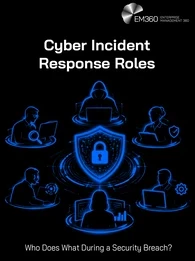
Cyber Incident Response Roles: Who Does What During a Breach?
A cyber breach is not just a security problem. Here’s how different teams coordinate, make decisions and keep the organisation moving during an incident.
Without an established cyber incident response plan, these decisions can often be delayed or there may be inconsistencies on how it’s handled.
This disparity is not good because it can lead to security teams working on containing a technical threat while business teams are left uncertain about how it’s impacting operations. Also, the communications team may be preparing statements before all the facts are known. Legal and compliance teams might also only be pulled in when it’s too late.
Additionally, third-party risk makes preparing this plan even more complicated. Verizon’s 2026 Data Breach Investigations Report found that third parties were involved in 48% of online security breaches.
This means the organisation has to handle or “fix” an incident that is not directly within their control but rather now the responsibility sits with an outside supplier, software platform or cloud service provider.
Cyber incident response ultimately matters because it creates a shared structure for making decisions quickly and efficiently, containing disruptions as much as possible and coordinating activities across the organisation and beyond.
Top Roles and Responsibilities in Cyber Incident Response
Cyber incident response is a shared enterprise responsibility. The security teams may lead the technical investigation but they cannot be expected to manage the wider consequences alone. Key participants in cyber response include:
Resilient Infra For Ransomware
How 24/7 detection, MDR partners, verified offline backups and identity-aware monitoring reshape ransomware readiness and recovery speed.

- Executive leadership: Provides strategic direction, allocates resources and approves high-impact decisions (for example, shutting down a critical service).
- Incident commander: Coordinates the overall response, assigns actions, records key decisions and keeps teams aligned throughout the process.
- Security operations and incident responders: Detect and investigate malicious activity, collect evidence and recommend containment and eradication measures.
- IT and infrastructure teams: Isolate affected systems, implement technical fixes and restore services.
- Legal, privacy and compliance teams: Assess regulatory, contractual and notification requirements and advise on evidence preservation.
- Communications and public relations teams: Manage messages to employees, customers, partners, media and other stakeholders.
- Business continuity and operational leaders: Assess the effect on critical activities and determine which services must be prioritised during recovery.
- Human resources: Supports investigations involving employees, contractors, insider threats or workforce communication.
- Third-party specialists: Cyber insurers, forensic investigators, security providers and technology suppliers may provide additional expertise or support during a major incident.
Each critical role in this list should have a named alternate. In other words, a designated backup specialist or other individual who can step in when the primary person is unavailable.
What Does the Cyber Incident Response Lifecycle Include?
The cyber incident response lifecycle is designed to be repeatable to guide an organisation from preparation and detection straight through to recovery and continuous improvement.
The NIST SP 800-61 (Revision 3) connects the cyber incident response lifecycle to the NIST Cybersecurity Framework 2.0. When it comes to practical implementation, the response process can be divided into six key stages.

The first three focus on preparing for and reducing risks, while the remaining three focus on detecting, managing and recovering from the cyber incident. Here’s what the six lifecycle stages look like:
1. Preparation
The preparation stage involves establishing the people, processes and tools required to respond BEFORE an incident occurs. A key part of this stage is creating an enterprise incident response plan that explains exactly how the organisation will identify, manage, escalate and recover from a cyber incident.
Before you go in-depth, first define the purpose and scope. This should tell whoever reads the document what it intends to achieve as well as the types of incidents, systems, and organisational areas it applies to. The other items to include are:
- Definitions of security events, incidents and breaches.
- Incident categories and severity levels for each.
- Roles, responsibilities and decision-making authority.
- Escalation and notification thresholds.
- Internal and external contact details.
- Secure communication procedures.
- Evidence collection and preservation requirements.
- Third-party and cyber insurance procedures.
- Links to business continuity and disaster recovery plans.
- Post-incident review requirements.

Inside Effective SOC Governance
Explores how mandates, metrics and authority enable SOCs to act on high‑risk alerts without legal overreach, gaps in cover or ownership clashes.
The main plan does not need to cover every possible threat in detail. Organisations can create supporting playbooks that provide step-by-step guidance for specific scenarios, including ransomware, compromised accounts, data theft, cloud incidents, denial-of-service attacks and supplier breaches.
According to CISA’s Incident Response Plan Basics, the plan should clearly define roles and identify the key people who must be contacted. This prevents teams from having to establish ownership and responsibilities during an active security incident.
Preparation also involves identifying the most critical systems, testing backups, training employees and conducting response exercises. It is not something that happens once-off. As we all know, technology, employees, suppliers and regulatory requirements constantly change, which means plans and playbooks must be reviewed and adjusted accordingly on a regular basis.
2. Detection and analysis
During this stage, security teams are tasked with identifying suspicious activity and determining whether a genuine incident has occurred that warrants action.
This can involve analysing security alerts, network traffic, system logs, threat intelligence and individual employee reports to understand what has happened. The ultimate aim is to determine what type of security incident it is, the scope of it and how severe it is as quickly as possible.
For example, a failed login attempt may require monitoring but does not justify full incident escalation. However, repeated login attempts that are followed by access from an unfamiliar location could indicate that an employee’s account has been compromised.
Clear classification criteria for this stage is extremely important as it helps teams distinguish between minor events and high-impact security breaches that require executive involvement and higher ups to make important decisions.
3. Containment
Containment focuses on limiting the spread and impact of a security incident. Actions in this stage can include isolating infected devices, disabling compromised accounts, blocking malicious network traffic or temporarily taking a service offline.
When Clean Updates Mislead
Explores the move from snapshot integrity checks to auditable delivery histories so leaders can assess real exposure from vendor updates.
These decisions require a delicate balance between security and operational continuity. Disconnecting an affected system may prevent further damage but it may also interrupt critical services or even remove valuable evidence of an attacker’s movements prior to the incident.
Response teams should therefore have clear guidelines on which actions to take based on the information they have as well as which actions to take independently and which require business or executive approval.
4. Eradication
Once the incident has been contained through the chosen avenue, the organisation must now remove the threat and address its root cause. This can involve:
- Removing malware.
- Closing exploited vulnerabilities.
- Resetting compromised credentials.
- Removing unauthorised accounts.
- Rebuilding affected devices from scratch.
- Correcting insecure configurations.

The first visible sign of a cyber attack does not always reveal the full extent of the incident. If teams only remove the malware but fail to identify HOW the attacker entered the environment, the same weakness could be exploited again in the future.
5. Recovery
The recovery stage involves safely restoring any and all affected systems, data and business operations.
Systems should be brought back online according to the overall business’ priorities in order of importance and tested before returning to normal operations. Teams must confirm that the threat has been removed, vulnerabilities have been addressed and restored systems will not reintroduce the incident.
Recovery is closely linked to business continuity and disaster recovery. Cyber incident response contains and removes the threat, business continuity keeps essential activities running and disaster recovery restores technology and data. These plans should support one another rather than operate separately.
6. Post-incident review
The final stage focuses the spotlight on what can be learnt from the incident. It’s like a post-mortem of sorts. It should assess:
- How the incident occurred.
- Whether it was detected and escalated quickly enough.
- Which response actions worked.
- Where delays or communication gaps occurred.
- Whether the correct people were involved.
- How long operational recovery took from start to finish.
- Which controls, plans or processes need to be changed (if any).
The ultimate purpose is not a finger pointing exercise but to prevent similar incidents from occurring and strengthen future responses. Each improvement step should have a clear owner and completion date so that lessons are translated into action.
How to Assess and Improve Enterprise Incident Response Readiness?
A written plan can only take you so far when it comes to cyber incident response readiness. Enterprises must also determine whether the plan is drafted in such a way that all involved employees can carry out their individual responsibilities under pressure.
Enterprise leaders should ask:
- Do we know where our critical systems and sensitive data are located?
This ensures you have visibility over where the risk is concentrated and how quickly systems can be prioritised during an incident.
- Are primary and backup owners assigned to every essential response role?
Clear ownership prevents confusion during a crisis and ensures every action taken as a response is accounted for.
- Can the response team be contacted outside normal working hours?
This confirms the organisation can mobilise a response team immediately when incidents inevitably occur outside of business hours.
- Are severity and escalation criteria clearly understood?
Consistent decisions are made when there are well-defined criteria, specifically when it comes to urgency and escalation under pressure.
- Can affected systems be isolated without unnecessarily disrupting critical operations?
The capability sequester impacted systems reduces the spread of an attack while simultaneously maintaining essential business operations.
- Can teams communicate securely if email or collaboration platforms are unavailable?
Having alternative communication channels set up ensures coordination continues even when primary systems are compromised.
- Are notification deadlines and legal obligations documented?
This action helps the organisation meet regulatory requirements and avoid penalties during time-sensitive incidents.
- Do supplier contracts define incident reporting responsibilities?
Clear contractual obligations ensure third parties promptly report incidents and cooperate in coordinated response efforts.
- Are backups protected, accessible and regularly tested?
Reliable backups are crucial to enabling rapid and accurate recovery, and reduces the impact of data loss or system downtime.
- Has the incident response plan been exercised during the past year?
The plan has to work in practice so it’s good hygiene to ensure all team members participate in regular exercises and everyone understands their roles.
- Are weaknesses identified during previous incidents and exercises being addressed?
To strengthen resilience and prevent repeat failures in future incidents, identified gaps must be acted on.

Executives should also cross-check whether their response plan reflects the organisation’s current environment and it has made provision for upcoming changes, such as a cloud migration, acquisition or change of supplier.
Organisations should create step-by-step procedures that address their greatest known cyber risks and clearly define when decisions must be escalated to senior management and how.
Any gaps identified during a readiness assessment, exercises or real-life incidents should lead to practical improvements. A senior leader should oversee this process, ensure that resources are made available and address weaknesses that cross departmental boundaries.
Lessons learnt should inform cybersecurity governance, employee cybersecurity training, technical controls and future response planning.
Cyber incident response readiness is an ongoing enterprise responsibility, not a document reviewed once a year for the sake of ticking a box.
How Should Enterprises Test Their Incident Response Plan?
It is recommended for enterprises to test their incident response plan at the very least annually and especially after major changes to systems, suppliers, business structures or regulatory requirements.
Cybersecurity tabletop exercises are discussion-based simulations wherein key stakeholders walk through hypothetical scenarios to clarify roles and responsibilities, and identify operational gaps. It’s a practical way to conduct testing without disrupting live systems.
If you want to go a step further, you can try technical simulations. This option uses certain mathematical tools and the like to copy how your real systems work. In this controlled environment you can test out security tools, procedures and integrations without the real-life consequences.
These recovery exercises can help organisations determine whether clean backups are available and whether critical systems can be restored within the required timeframes.
Useful scenarios to test can include:
- Ransomware affecting a critical business service.
- A compromised cloud account.
- Sensitive information being stolen through a third-party (like a supplier).
- A distributed denial-of-service attack.
- An incident that disables normal email and communication channels.
CISA’s Tabletop Exercise Packages provide adaptable scenarios and questions organisations can use to test their response capabilities.
Remember that testing is only valuable if the findings are acted upon. Identified gaps should be documented, assigned to specific owners and tracked until they have been resolved.
Incident Response Metrics Executives Should Track
Incident response metrics help enterprise leaders to see whether, with each test and incident, the organisation is getting faster and more effective at managing cyber threats. Some important metrics to consider:
- Mean time to detect: How long does it take to initially identify an incident?
- Mean time to respond: How quickly are investigation and response activities initiated?
- Mean time to contain: How long does it take to prevent the incident from spreading?
- Mean time to recover: How long does it take to restore affected services?
- Operational downtime: What is the duration and business impact of service disruption?
- Escalation accuracy: Were incidents classified and reported to the correct people?
- Exercise performance: How often plans are tested and which gaps have been identified?
- Remediation rate: The percentage of post-incident actions completed by their deadlines.
Keep in mind that faster is not always better. Quickly containing an incident is great but if evidence is lost along the way, the root cause may remain unresolved or stakeholders may not be notified correctly.
Metrics should, ideally, measure response quality, operational impact and continuous improvement alongside speed so that teams are rewarded for quality instead of just how fast they can close incidents.

Build an Enterprise That Is Ready to Respond
No organisation can prevent every cyber incident, but it can control how prepared it is to respond.
Effective incident response begins long before that security alert is triggered. It requires thorough planning, informed leadership, reliable information, clear role allocation, collaborative teamwork and a tested recovery process.
When these foundations are in place, organisations don’t need to stress about thinking on their feet during a crisis. They can simply follow the steps that have been laid out months or years before. Teams know their responsibilities and leaders understand the decisions they need to make. This can mean the difference between a prolonged business crisis and a quickly contained security incident that is merely a blip in day-to-day operations.
With over 600 million hostile signals or cyber attack attacks occurring daily, it’s crucial to stay on top of all security threats. For further insight into how you can strengthen your organisation’s security posture, follow the EM360Tech Security feed.



Comments ( 0 )