
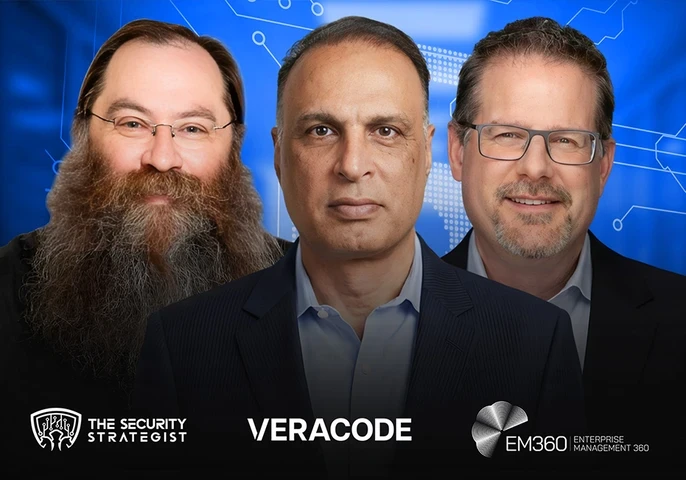
AI is changing how software is developed, creating new challenges for security teams tasked with managing vulnerabilities and securing increasingly complex software supply chains. In this episode of the Security Strategist Podcast, host Richard Stiennon speaks with Anthony Barkley, Chief Strategy Officer at Veracode, about the implications of AI-driven software development for application security and vulnerability management.
Drawing on more than 30 years of cybersecurity experience, Barkley discusses why traditional approaches to vulnerability management are no longer sufficient as AI agents, traditional developers and citizen developers contribute to software development. He also explains Veracode’s move from a broad marketplace towards a vetted partner ecosystem.
Why AI Software Supply Chain Security is a Priority
For years, the software supply chain meant open-source libraries and third-party code. Barkley states that definition is now far too narrow. Agentic development adds AI agents, foundation and private models, Model Context Protocol (MCP) services, and a growing set of development tools. Each is a new place where risk can ultimately enter.
“I don’t personally believe we ever had a problem finding enough issues,” Barkley says. Security teams have always had plenty of security debt. The real problem is deciding which findings are exploitable and fixing them without breaking the application.
Stiennon adds that finding 140,000 vulnerabilities and turning them into 140,000 tickets helps no one. Barkley agrees that a human-in-the-loop approach to every fix is not sustainable. For him, the biggest challenge is understanding what goes into your code and its provenance, not just how fast you can write it. His longer-term goal is ambitious: “I want the models to not have problems.” Frontier Labs will build the base models, he says, but reducing vulnerabilities at the source will take partners working closely with each company’s own standards, processes, and code.
Veracode’s Ecosystem Strategy
Customers told Veracode that no single vendor can build every solution they need. They also described a flood of venture-backed startups, with 20, 40, or even 60 vendors claiming to solve the same problem in each category. Even after choosing one, they still faced procurement, security reviews, legal terms, and financial checks.
Veracode’s answer is to move from a marketplace to an ecosystem. While a marketplace offers customers a range of options, an ecosystem provides a curated shortlist of trusted vendors the company is prepared to stand behind
The first partner is DryRun Security. The partnership combines traditional deterministic scanning with AI-based probabilistic scanning, then helps customers with reachability, exploitability, and remediation. Barkley reports six proofs of concept so far, with two customers already moving forward with deployment. Veracode is evaluating five more vendors, though not all will join.
Barkley’s vetting criteria are:
- Customer-driven need: Start with the gaps customers actually describe.
- Durable technology: Look for real architecture, not “just some fancy UI on a bunch of prompts.”
- Enterprise readiness: Check scale, integrations, and support for traditional developers, agentic workflows, and citizen developers.
- Workable licensing: Make buying easy as the industry moves beyond per-seat pricing.
His advice for startups hoping to join is to get your shared customers to make the introduction.
When AI Outcodes Security
AI-written code is flooding pipelines faster than teams can fix it, forcing CISOs to rethink funding, staffing and risk ownership.
Assure Loop for Secure AI Software Development
Barkley’s central framework is a continuous security loop with four stages, which are:
- Govern: Gain visibility into the environment where code is created, whether through agent hooks, deterministic scaffolding, gateways, or a combination, without stifling innovation.
- Guide: Keep developers, AI agents, and citizen developers within corporate standards using application specifications, skills files, and secure-by-design guidance.
- Verify: Go beyond finding flaws. Understand the code’s context within the broader application so a fix doesn’t cause cascading breakage, which Barkley says has long been a problem with open-source library fixes.
- Assure: Collect evidence at every step, run regression tests against the original specification, and confirm software is safe before it reaches production.
Adoption follows a crawl-walk-run path. Humans review checks at first, then organisations automate more as trust grows. Eventually the human role becomes an audit rather than a bottleneck.
The most important part is the feedback. If teams repeatedly generate the same kinds of vulnerabilities from certain languages, packages, or tools, that data should go back to the start of development. Over time, the flywheel prevents vulnerabilities instead of chasing them. Barkley also stresses that large enterprises will live with traditional code for years, so security has to cover legacy and AI-driven development together.
Inside GenAI’s Secure Code Gap
Benchmark data from 80 GenAI coding tasks and 11 models exposes a flat 56% pass rate, reshaping how leaders judge AI dev tooling.
What Security Leaders Need to Know
- Map your AI software supply chain, including agents, models, MCP services, tools, and code provenance.
- Pair vulnerability detection with prioritisation, reachability, and validated fixes.
- Build visibility and guidance for every kind of builder in your organisation.
- Use security data to stop recurring vulnerabilities at the source.
For more information on Veracode’s approach to application security, visit its website. Alternatively, follow Anthony Barkley on LinkedIn.
Takeaways
- No single vendor can deliver every solution customers need.
- A connected ecosystem brings complementary technologies together.
- A marketplace offers options; an ecosystem provides a trusted shortlist of solutions.
- Customer feedback should shape priorities and identify the biggest gaps.
- AI model reliability, visibility and governance must be priorities.
- AI agents, traditional developers and citizen developers must operate within clear guidelines.
- Continuous monitoring and verification are essential to managing AI risk.
- Human oversight is shifting from direct involvement towards auditing and validating AI decisions.

Veracode’s Application Risk Management Platform identifies risks across your software development lifecycle, automates flaw fixes, and simplifies governance and compliance, empowering you to reduce risk and deliver secure software faster, with confidence.

Comments ( 0 )