
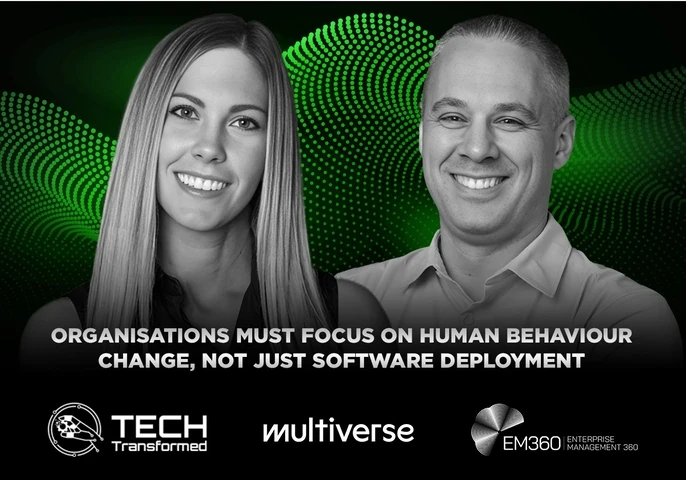
Every enterprise leader has heard the numbers by now as billions poured into licences, seats and tokens, with productivity gains still trailing well behind the promise. On a recent episode of Tech Transformed, host Christina Stathopoulos sat down with Jay Richman, Chief Product and Technology Officer at Multiverse, to unpack why so many organisations remain stuck in what he calls "tinker mode" and what it actually takes to move past it.
Richman's view is shaped by a career spent at the sharp end of three separate technology shifts. A decade at Spotify saw him build out the company's advertising business and early subscription platform from scratch. Roughly four years at Amazon followed, working on agentic AI systems within the advertising division, effectively rebuilding the old-fashioned creative agency model using specialised generative media tools. Four months ago, he relocated from New York to London to join Multiverse, drawn by a mission he sees as almost the reverse of his previous work. Rather than using people to make machines smarter, the task now is training machines to make people smarter. That framing sits at the centre of this conversation.
The AI Adoption Gap
Richman suggests that the widely reported gap between AI spend and AI-driven output isn't really a technology failure; it's a human one. Tools sit unused, licences go unopened, and organisations struggle to move employees from curious onlookers to confident, habitual users. Multiverse's answer is what it calls the "adoption layer", which is a diagnostic approach that pinpoints where skill gaps actually sit across a workforce, builds tailored learning paths around them, then embeds coaching directly inside the tools people already use, whether that's Claude, Gemini or ChatGPT.
Crucially, Richman distinguishes between what he wryly terms "token maxing" and value creation. Blunt incentives, leaderboards, usage dashboards and mandates to switch from manual coding to AI-assisted development. All this can help people over that first hurdle, and he admits to having used some of these tactics himself. But the real measure of success has to be defined customer by customer, tied to a specific business outcome, not simply how many prompts someone fired off in a week. As he puts it, the value of any given AI initiative can only be judged against what that particular organisation set out to solve in the first place.
Human Skills AI Can't Replace
One of the most interesting parts of the discussion explores how generative and agentic AI are reshaping team structures. Richman describes a flattening of traditional boundaries: product managers writing code, designers contributing to technical documents, and engineers drafting strategy papers. Functions that were once tightly specialised, such as a dedicated user-research team and a standalone copywriting role, are increasingly being absorbed as skills within more generalist, multi-hatted employees. At the same time, he notes, the opposite is happening at the model layer, with AI agents becoming ever more specialised. The result, in his telling, is smaller teams working with far greater autonomy and considerably less coordination overhead than in years past.
Asked what he prioritises when hiring now, Richman is candid that mastery of a single discipline matters to him less than certain behavioural traits: curiosity, high agency, sound judgment. He shares an interview technique he relies on, asking candidates how they spent their time during the pandemic lockdowns, as a rough proxy for whether someone tends to seize initiative or simply wait for circumstances to dictate their next move.
Moving Fast Without Cutting Corners
AI Strategy Demands New Skills
Shift AI investment from tools to people by tying skills-first training to clear metrics like productivity, revenue per head and time saved.
On responsible deployment, Richman insists culture has to start at the top. Leaders, he argues, need to be visibly hands-on and honest about their own gaps in knowledge rather than issuing mandates from a distance. At Multiverse, that meant lifting caps on AI coding tools, resetting the expectation that new work should be AI-generated by default, and investing heavily in quality assurance and evaluation frameworks so that human reviewers still hold a meaningful checkpoint before anything reaches customers. He contrasts this with the slower, more cautious approach he sees at many other organisations — one he believes is not only less efficient but also less likely to stick once the initial push fades.
Measuring What Actually Matters
Tying this back to the earlier point about value over volume, Richman suggests the real test of an AI initiative is how closely it maps to a business's own stated objective, not adoption figures in isolation. That means starting with what a customer or team is actually trying to achieve, building learning around the specific gaps standing in the way, and only then judging success by whether the resulting behaviour change shows up in the metrics that organisation already cares about.
The conversation closes on a personal note, with Richman sharing the advice he'd give his own children as they weigh careers in a fast-shifting landscape: run towards disruption rather than away from it. Having entered the workforce at the tail end of the dot-com boom, he sees clear parallels with the present moment, a period, in his words, where nobody can credibly claim expertise, which makes it as good a time as any to jump in. For organisations still puzzling over why their AI investment hasn't translated into measurable returns, Richman's message is simple: the technology was never really the difficult part. If you would like to find out more, please visit multiverse.io or connect with Richman on LinkedIn.
Takeaways
- Successful AI adoption hinges on people, not just technology.
- The AI adoption layer helps bridge the gap between investment and productivity.
- High agency and curiosity are key traits of successful AI practitioners.
- Leadership must lead by example and foster a culture of experimentation.
- Rapid technological change requires teams to be flexible and multi-skilled.

Multiverse is the upskilling platform for AI and tech adoption. Multiverse has partnered with over 1,500 companies to deliver a new kind of learning that’s transforming the workforce through tech skills.
Multiverse apprenticeships are for people of any age or career stage and focus on critical AI, data and tech skills. Multiverse learners have driven $2bn + ROI for their employers, using the skills they’ve learned to improve productivity and measurable performance.
For more information, visit www.multiverse.io




Comments ( 0 )