
AI investment is growing fast, but proving its value remains one of the biggest challenges facing data leaders today. Dashboards are built, models are deployed, and yet when the budget question arrives, most teams still can't clearly demonstrate return on investment.
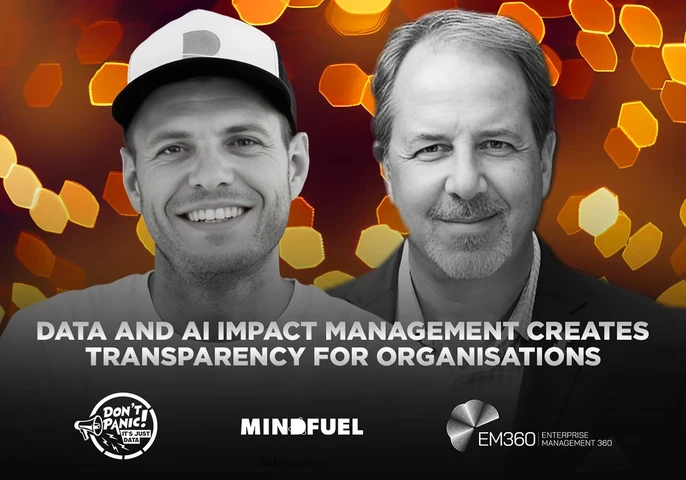
Speaking on Don't Panic, It's Just Data with host Christina Stathopoulos, Nadiem von Heydebrand, CEO and co-founder of Mindfuel, identified where most organisations go wrong: the interface between data teams and the business. According to von Heydebrand, the reason is straightforward: no use case, no value.
"We get a demand, we believe we've understood it, and we start executing immediately," he explained. Months pass, and nobody can answer why the project exists or what problem it was supposed to solve in the first place. The fix isn't more technology. It's better use case management.
The 3 Pillars of Effective AI Use Case Management
One of von Heydebrand’s core principles is straightforward: before you build anything, you need to really understand the business challenge you're trying to solve. "You have to fall in love with the problem, not with the solution," he said. This matters more than ever in the era of generative AI. With token costs attached to every AI interaction, building the wrong solution isn't just a wasted effort; it's an ongoing financial drain. Use case management has moved from being a nice-to-have to an operational necessity. Good use case management, according to Nadiem, rests on three pillars:
- Demand exploration: Don't assume you understand the problem. Engage stakeholders, ask deeper questions, and uncover the real business challenge before a single line of code is written.
- Value management: Every use case needs a value hypothesis. What outcome is expected if this problem is solved? As Nadiem puts it: "The solution itself has a value of zero. Value lives in the problem space."
- Value tracking: Once live, track performance against the original hypothesis. Define a realistic ROI timeframe and review it consistently.
Adoption Metrics Are Not Proof of Value
One of the most common mistakes? Measuring AI success through usage and adoption data alone. "I have enough examples where usage is high, and value is zero or even negative," Nadiem warned.
Clicks and logins are a proxy. Business outcomes are the goal. If there's no correlation between the two, the metric is misleading.
Output vs. Outcome: The Shift That Matters
The most important distinction in the conversation was the difference between output and outcome. Data teams have historically been measured on output like model accuracy, number of dashboards, and features delivered. But output without impact is just activity. Outcome means the value created for the recipient of your work. Organisations that make this mindset shift from measuring what they produce to measuring what they change are the ones that change their data functions from cost centres into genuine value generators.
For leaders under pressure to prove ROI from AI initiatives, Mindfuel’s CEO advises a pragmatic approach: start now, start small, and be honest. As Stathopoulos summarised: "It all comes back to being intentional about what you build and why." For more information, visit mindfuel.ai, the platform built to help data and AI teams demonstrate, manage, and maximise business value.
Connect with the guest:
When Data Work Becomes Value
How a value layer and product mindset turn scattered data and AI projects into aligned, measurable business outcomes.
Takeaways
- The importance of structured use case management
- Linking AI initiatives to business value
- The impact layer and value tracking in AI projects

Mindfuel is a data and AI impact management platform that gives data, analytics and AI teams a single source of truth to prioritize high-impact use cases, connect initiatives to business outcomes, and demonstrate ROAI. It replaces scattered tools and reactive, manual processes with a structured approach to managing use cases and data and AI products. This enables organizations to reduce business case bias, eliminate inefficiencies, and clearly communicate the value of your AI initiatives, driving enterprise-wide trust, transparency, and impact. To learn more, visit www.mindfuel.ai.



Comments ( 0 )