
As AI systems move rapidly from experimentation into production, organizations are discovering that adoption alone is not the hard part; understanding, governing, and trusting AI in live environments is.
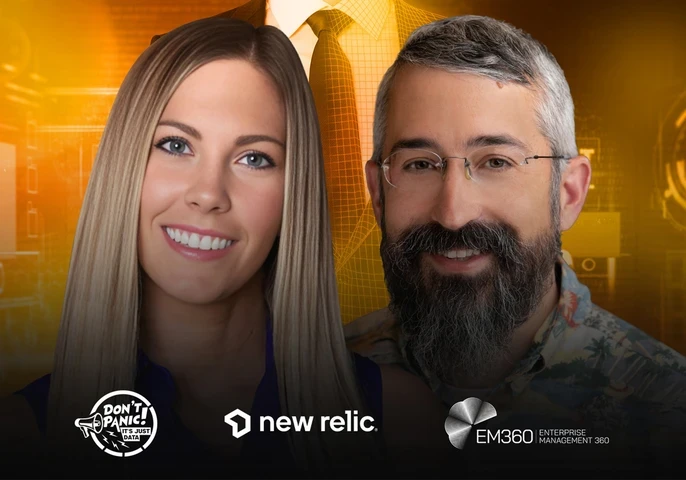
In this episode of Tech Transformed, Shubhangi Dua, Podcast Producer, Host and B2B Tech Journalist, speaks with Camden Swita, Head of AI, New Relic, about why AI observability has become a critical requirement for modern enterprises, particularly as agentic AI and AI-driven operations take on increasingly autonomous roles.
The discussion explores how traditional observability models fall short when applied to probabilistic systems, why many AI ops initiatives stall at proof-of-concept, and what security and IT leaders must prioritize to safely scale AI in production.
Be the first to see how intelligent observability takes you beyond dashboards to agentic AI with business impact at New Relic Advance, February 24, 2026.
Why AI Adoption Is Outpacing Operational Readiness
While AI adoption is accelerating rapidly, most organisations still lack visibility into what their AI systems are actually doing once deployed. Generative AI is already widely used for natural language querying, coding assistants, customer support bots, and increasingly within IT operations and SRE workflows.
As these systems move into production, new challenges emerge around cost control, governance, performance quality, and trust. Leaders recognise AI’s potential value, but without deep observability, they struggle to determine whether AI-enabled systems are delivering consistent outcomes or introducing hidden operational and security risks.
How Observability Must Evolve for Agentic AI and AI Ops
The episode then examines how observability itself must evolve to support agentic and autonomous AI systems. While core observability principles still apply, AI introduces a new layer of complexity that requires visibility into model behaviour, agent decision-making, and multi-step workflows.
Modern AI observability extends traditional application performance monitoring by capturing telemetry from large language model (LLM) interactions, agent orchestration layers, and automated evaluations of output quality against intended use cases.
Without this visibility, teams are effectively operating blind, unable to diagnose failures, validate compliance, or confidently deploy AI at scale. At the same time, AI is increasingly being embedded into observability platforms to reduce noise, accelerate root cause analysis, and improve incident response.
Making Agentic AI Work in Practice
Successful adoption starts with low-risk, high-friction tasks such as incident triage, dashboard interpretation, and runbook summarisation, rather than fully autonomous remediation. These use cases deliver immediate productivity gains while preserving human oversight. Over time, stronger feedback loops, better context management, and human-in-the-loop learning allow agents to become more reliable and useful. Looking ahead, Camden predicts that 2026 will be a turning point for agentic AI in production, driven by maturing AI observability platforms, richer semantic data, and knowledge graphs that connect technical telemetry to real business outcomes.
When AI Code Becomes Liability
AI coding agents are shipping clean code that hides failure paths, driving up incidents and forcing costly refactors across enterprise stacks.
Key Takeaways
- AI adoption is accelerating in enterprise environments.
- Organisations face complexities in productionising AI features.
- Natural language querying is a common AI application.
- AI agents are increasingly used in IT operations.
- Observability is crucial for understanding AI systems.
- Traditional observability solutions are evolving to include AI monitoring.
- Incident response teams struggle with alert noise and context gathering.
- AI can assist in incident management and root cause analysis.
- Future trends include more reliable AI agents and monitoring solutions.
- Organisations need to invest in AI observability to succeed.
Chapters
01:20 The Current State of AI Adoption
02:28 Purposeful AI Usage in Organizations
04:40 Observability in the Age of AI
08:05 Evolving Observability Solutions
11:36 Challenges in Incident Response
16:04 Integrating AI in Operations
23:33 Future Trends in AI Monitoring
30:29 Investment Strategies for AI Solutions

The New Relic Intelligent Observability Platform helps businesses eliminate interruptions in digital experiences. New Relic is the only AI-driven platform to unify and pair telemetry data to provide clarity over your entire digital estate. We move your problem solving past proactive to predictive by processing the right data at the right time to maximize value and control costs.

Comments ( 0 )