
Disaster recovery and business continuity are the backbone of enterprise resilience. Disaster recovery is about restoring systems and data after disruption, while business continuity ensures critical operations can keep running while recovery takes place. Together, they help organisations withstand disruption, maintain essential services and get back to normal operations.
The need for both is clear. Data breaches can cost organisations millions, complex IT systems create more ways for outages to affect operations, and extreme weather can disrupt everything from data centres to supply chains. Regulators are also placing greater emphasis on how organisations prepare for disruption and whether their recovery plans actually work.

For enterprises, disaster recovery and business continuity aren't simply technical exercises. They're part of how an organisation protects its data, meets its obligations and maintains the trust of customers and partners when something goes wrong.
Why Disaster Recovery and Business Continuity Matter More Than Ever
Disruption can be expensive, even when an organisation manages to recover. According to IBM's 2026 Cost of a Data Breach Report, the global average cost of a data breach reached $4.99 million. Downtime carries its own costs. Uptime Institute's 2026 outage analysis found that 57% of respondents to its 2025 survey said their most recent major outage cost more than $100,000.
Physical risks add to that financial pressure, with Munich Re estimating global natural disaster losses of $224 billion in 2025. Cyber threats are also making recovery more complicated. Ransomware attackers can target the backups and systems organisations depend on to restore operations.
Meanwhile, Mandiant's M-Trends 2026 report found that attackers remained undetected for a median of 14 days in the incidents it investigated during 2025, up from 11 days the previous year. Third-party risk is another concern. Verizon's 2026 Data Breach Investigations Report found that 48% of breaches involved a third party, showing how problems with suppliers and service providers can expose organisations to risks beyond their own systems.
Regulatory requirements are adding another layer of responsibility. Europe's Digital Operational Resilience Act (DORA) sets resilience requirements for financial entities within its scope, while NIS2 includes business continuity and disaster recovery obligations for covered organisations.
In the US, the Securities and Exchange Commission's disclosure rules require covered public companies to report material cybersecurity incidents within specified deadlines. NIST's Cybersecurity Framework 2.0 also provides guidance for managing cybersecurity risk, including governance and recovery.
For enterprise leaders, disaster recovery and business continuity are closely tied to financial risk, regulatory obligations and cybersecurity. A disruption can affect far more than the systems directly involved, especially when essential services, suppliers or customers depend on them.
Organisations need to know which operations they must protect, how they'll keep them running and whether their recovery plans can deliver when they're needed.
Business Continuity vs Disaster Recovery vs Resilience
Business continuity planning is about keeping operations running when something goes wrong. Its purpose is to make sure essential business functions can continue, even when systems are down, facilities are unavailable or normal processes have been disrupted.
Disaster recovery planning is more focused on restoring IT systems, applications and data after an incident. Recovery time objectives (RTOs) define how quickly a service needs to be restored, while recovery point objectives (RPOs) establish how much data an organisation can afford to lose, measured in time. Together, they help determine what recovery needs to achieve.
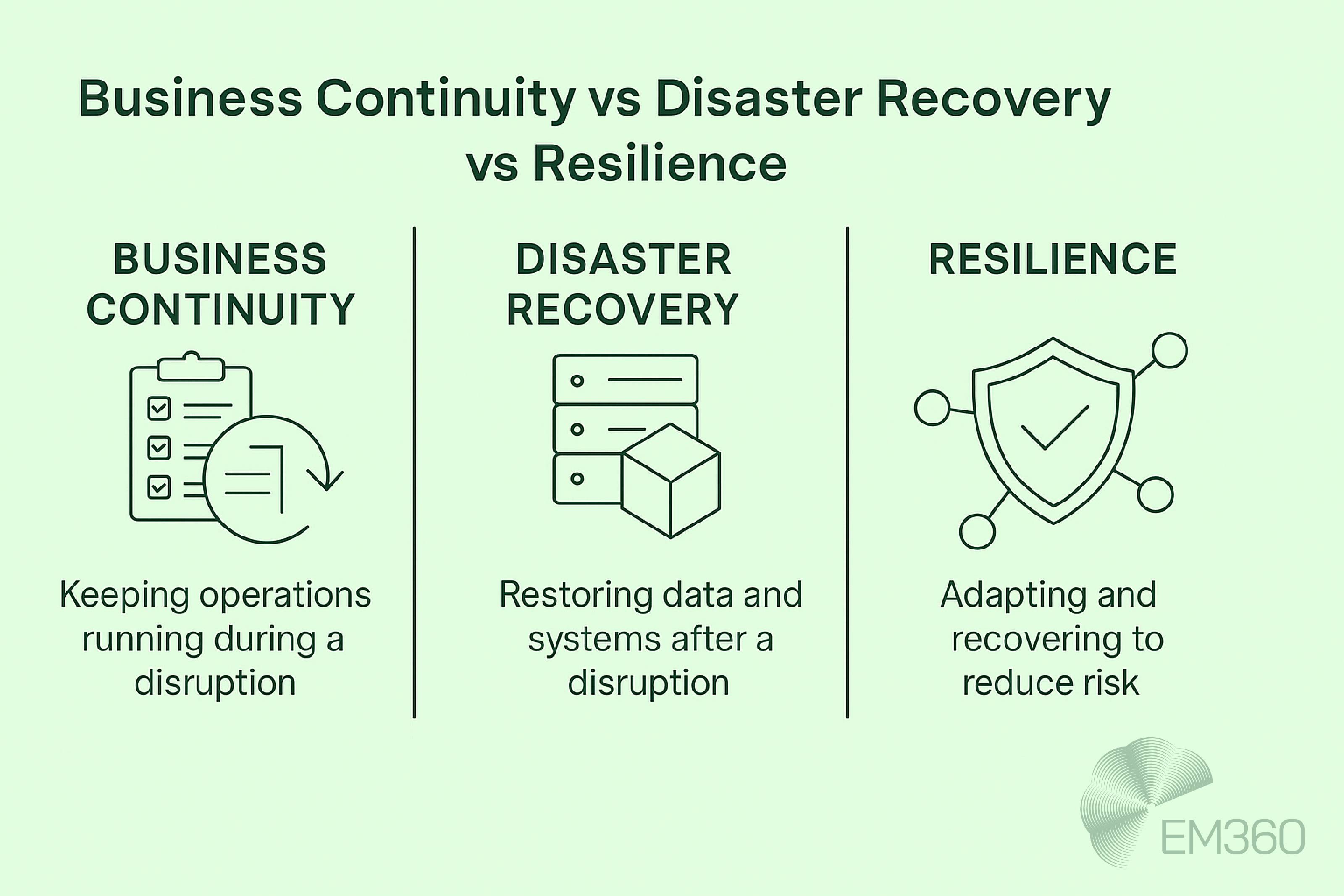
Organisational resilience goes further. It brings continuity and recovery together with the ability to anticipate risks, adapt to disruption and recover from its effects. A resilient organisation can absorb the impact of an incident while protecting its essential operations, rather than relying entirely on getting everything back to normal afterwards.
Stopping the Ransomware Spiral
Why boards must pivot from payout decisions to tested recovery, identity resilience, and RTOs that prevent repeat ransomware incidents.

A ransomware attack makes the distinction easier to understand. Business continuity planning helps keep customer-facing services available, perhaps through manual processes or alternative systems. Disaster recovery planning deals with restoring encrypted systems and data from clean backups, using the organisation's recovery objectives to guide how quickly those services need to return.
When both plans work together, the organisation can contain the attack, maintain essential services and recover without allowing the disruption to spread further than necessary. Governance and regular testing help make sure those plans work in practice, including when the organisation is under pressure.
For enterprise leaders, business continuity and disaster recovery provide the processes needed to manage disruption. Resilience is the broader capability they support, allowing the organisation to keep functioning, adapt when circumstances change and recover with as little lasting damage as possible.
The Core Framework for Enterprise Continuity
Enterprise continuity depends on having a clear, repeatable approach to managing disruption. Standards and guidance such as ISO 22301, NIST CSF 2.0 and CISA's Cybersecurity Performance Goals all support structured planning, defined responsibilities and regular testing.
They provide different levels of guidance, but each can help organisations build and improve their continuity and recovery capabilities.
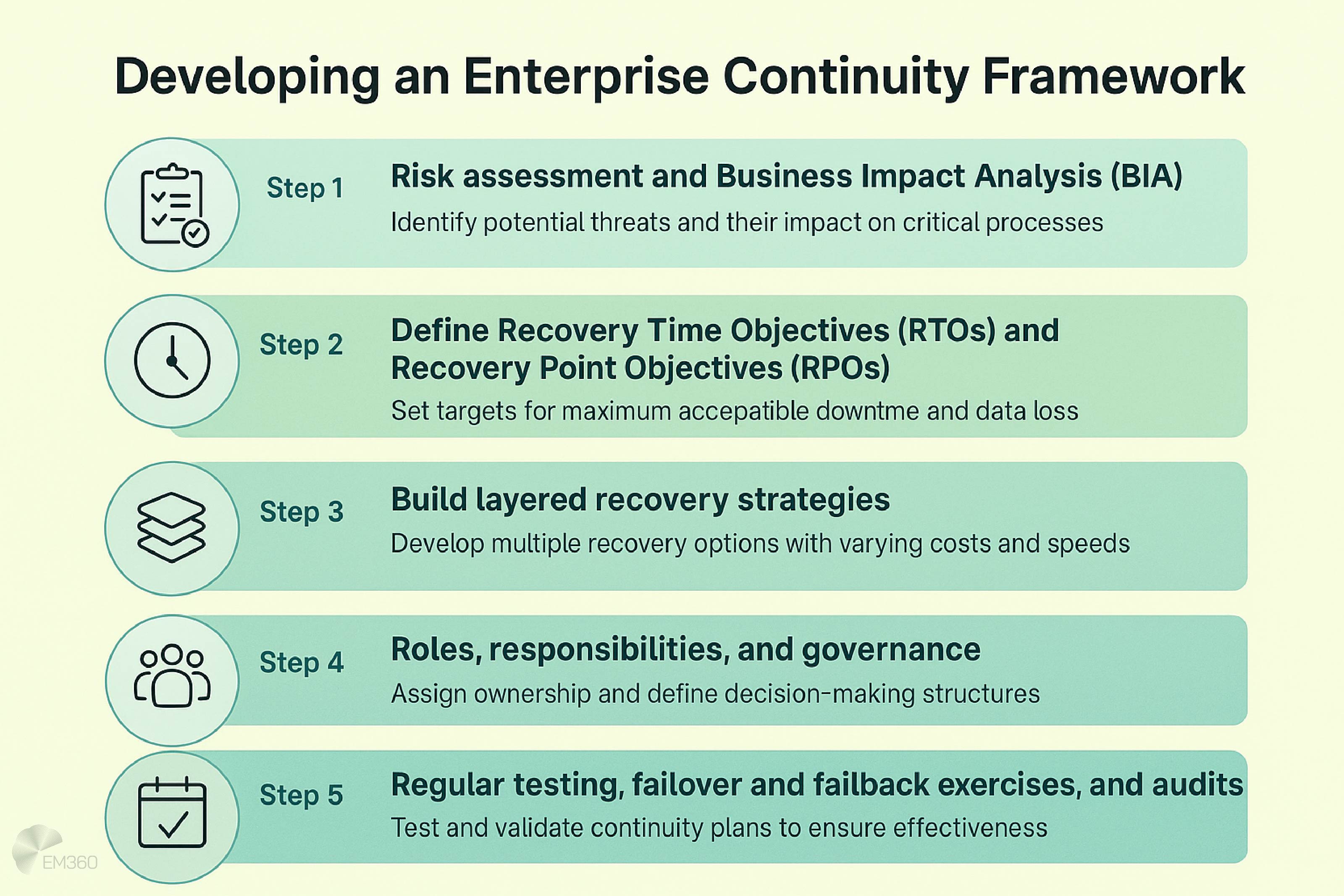
Step 1: Risk Assessment and Business Impact Analysis (BIA)
A risk assessment identifies the threats that could affect the organisation, from cyberattacks and system outages to natural disasters and supplier failures. A Business Impact Analysis (BIA) then examines what would happen if critical processes were disrupted, including the financial, operational and reputational consequences. It also helps identify which systems and suppliers those processes depend on.
Step 2: Define Recovery Time Objectives (RTOs) and Recovery Point Objectives (RPOs)
Every critical service needs clear recovery targets based on what the business can tolerate. An RTO defines the target time for restoring a service after disruption, while an RPO sets the maximum acceptable period of data loss. These objectives help organisations decide which services to prioritise and what technology, resources and processes they'll need to recover them.
Step 3: Build layered recovery strategies
Inside FlexAnywhere Fabric
Examine the backbone of Flexential’s platform powering colocation, high-density compute, and interconnection across hybrid IT estates.

Organisations need recovery options that match the importance of their services. Hot, warm and cold recovery sites offer different balances of cost, readiness and recovery speed. Cloud disaster recovery can provide additional options for restoring services or switching operations to another location. However, having multiple recovery paths doesn't automatically remove every single point of failure. Each option needs to account for shared dependencies and be tested to make sure it works.
Step 4: Roles, responsibilities, and governance
Business continuity management needs clear ownership across the enterprise. Teams must know who's responsible for maintaining plans, making decisions and coordinating recovery when an incident occurs. Governance also helps ensure that continuity strategies reflect the organisation's wider risk priorities, rather than being managed separately by individual departments.
Step 5: Regular testing, failover and failback exercises, and audits
Plans need regular testing to establish whether they'll work during a real disruption. Tabletop exercises help teams practise their responses, while simulated outages and failover drills test whether systems can be restored within their recovery objectives. Failback exercises check that services can return safely to their normal environment, and audits help identify weaknesses that need attention.
Enterprise continuity isn't something organisations can complete once and forget about. It requires structured planning, measurable recovery objectives and regular reviews to keep pace with changes in systems, operations and business priorities. That's how business continuity management and disaster recovery become part of a coordinated approach to resilience.
Technology Shaping the Future of BC and DR
Technology is changing how enterprises approach business continuity and disaster recovery. Cloud services, AI and automation give organisations more ways to detect problems, respond to incidents and restore operations. However, their effectiveness still depends on how well they're integrated into the organisation's continuity and recovery plans.
Cloud-native disaster recovery
Cloud disaster recovery gives enterprises more flexibility in how and where they restore their systems, but it also introduces new dependencies. A multi-cloud strategy can help reduce reliance on a single provider, provided critical services can actually run elsewhere when needed. SaaS applications also need to be included in continuity planning, with clear responsibilities and tested processes for restoring access to essential services.
Immutable storage and cyber vaulting

Hardening Endpoints Against BSOD
Malware-driven crashes blur the line between reliability and security. Use BSOD patterns to strengthen cyber hygiene and protect critical data.
Immutable backups are an important part of recovering from cyberattacks. Features such as AWS S3 Object Lock and Azure Blob Storage's immutability policies can prevent protected data from being changed or deleted during a defined retention period. However, the level of protection depends on how these features are configured.
Combined with isolated cyber vaults, they can help organisations protect recovery copies from ransomware, although backups still need to be checked to make sure they're clean and can be restored successfully.
AI in detection and response
Artificial intelligence is changing how organisations detect and respond to threats. Machine learning tools can analyse large volumes of activity and flag unusual behaviour that might otherwise take longer to identify. This can help security teams investigate potential incidents earlier and limit their impact on operations.
However, AI-generated alerts and automated responses still need appropriate oversight, particularly when mistakes could interrupt critical services.
Observability and automation
Complex IT environments can make it difficult to identify where a failure started and which services are affected. Observability tools help teams understand what's happening across their systems, while automation can carry out predefined recovery tasks without waiting for every step to be performed manually.
This can speed up failover and recovery, but automated processes need regular testing and safeguards. Some decisions, particularly those involving failback to normal operations, may still require human approval.
Technology can make disaster recovery and business continuity faster and more reliable, but it can't replace the planning behind them. Enterprises still need clear recovery priorities, tested processes and people who understand what to do when something goes wrong.
Preparing for Ransomware and Cyber-Driven Disruptions
Ransomware can leave enterprises unable to access the systems and data they need to operate. Attackers may also target backups and connected systems, making recovery more difficult.
Business continuity planning needs to account for the possibility that an attacker has already gained access and that some of the organisation's usual recovery options may no longer be safe to use.
Immutable and offline backups
Why Europe Is Leaving Hyperscale
Boards confront cloud waste, sovereignty mandates and ESG pressure as workloads shift back to owned and European data centre infrastructure.

Recovering from ransomware depends on having backups that attackers can't easily change, encrypt or delete. Immutable backups and offline copies offer different ways to protect recovery data, but neither guarantees that the data is free from infection. Organisations also need to check that their backups are usable and regularly test how quickly they can restore critical systems.
Segmentation, privileged access, and supplier monitoring
Technical controls can help contain an attack before it disrupts more of the business. Network segmentation limits how easily attackers can move between systems, while privileged access management helps protect accounts with powerful administrative permissions.
Monitoring suppliers can reveal risks in connected services, but organisations also need plans for maintaining operations if a critical provider becomes unavailable.
Lessons from the CrowdStrike incident
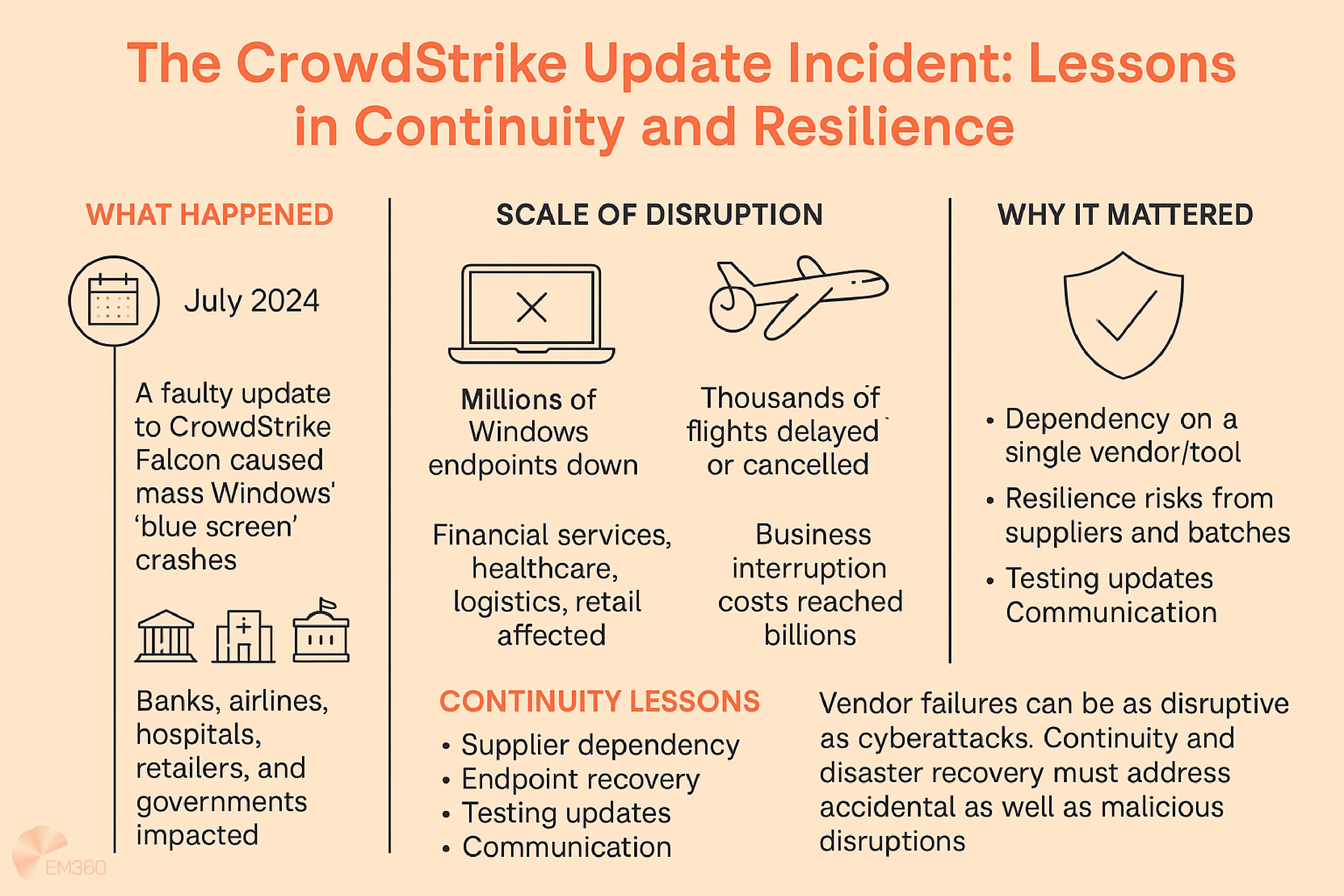
The global outage caused by a faulty CrowdStrike software update in July 2024 showed how quickly a technology failure can affect organisations across different industries. The incident wasn't a cyberattack, but it disrupted Windows systems that depended on the affected security software.
It also exposed the risks of shared technology dependencies and highlighted the importance of recovery procedures, controlled software updates and alternative ways to keep essential services running.
Testing under assume-breach conditions
Recovery testing needs to account for what happens when an attacker has already compromised part of the environment. Simulated ransomware incidents can help organisations establish whether their backups are usable, whether compromised systems can be restored safely and whether essential business functions can continue during recovery.
These exercises also reveal gaps in coordination between security, IT and operational teams before a real incident puts those plans under pressure.
Preparing for cyber-driven disruption means planning for more than the initial attack. Organisations need to be able to contain the damage, maintain essential operations and restore affected systems safely. Business continuity and disaster recovery have to work together for that to happen.
Addressing Physical and Climate Risks
Cyber risks may dominate the headlines, but natural disasters and facility outages can be just as disruptive to business operations. Storms, floods, extreme heat and power failures can damage infrastructure, interrupt transport and leave critical services unavailable.
Even when an organisation's IT systems are unaffected, physical disruption can prevent employees, suppliers and customers from accessing the services they depend on.
Facility redundancy and power resilience
Business continuity depends on physical infrastructure as much as digital systems. Alternative facilities, backup power and failover capacity at the data centre level can help organisations maintain essential operations during power failures or damage to a primary site. However, these arrangements need regular maintenance and testing to confirm they'll work when needed.
Data-centre continuity
Enterprises with on-premises or hybrid infrastructure need to consider the risks associated with where their systems are located. Geographic separation between primary and secondary sites can reduce the chance of a single event affecting both.
However, separate facilities may still depend on the same power networks, communications providers or other infrastructure. Recovery testing should establish whether workloads can be moved and restored within the organisation's recovery targets.
Supply chain continuity
Physical disruptions can also affect operations well beyond the location where an incident occurs. Flooded roads, damaged transport infrastructure or a supplier's facility outage can delay essential goods and services.
Mapping these dependencies helps organisations understand where they're vulnerable, while alternative suppliers, transport routes and contingency arrangements provide options for keeping operations running.
Building resilience against physical and climate risks means understanding how a disruption in one location could affect the rest of the business. By including facilities, infrastructure and supply chains in their continuity plans, enterprises can prepare for these dependencies and reduce the impact of events they can't prevent.
Regulatory and Compliance Readiness
For many enterprises, business continuity and disaster recovery are also part of meeting regulatory obligations. The requirements vary by industry and jurisdiction, but organisations covered by resilience and cybersecurity regulations need to show how they manage disruption, protect critical services and prepare for recovery.
Having a continuity plan on paper isn't always enough to meet those obligations.
EU DORA and ICT third-party risk
The Digital Operational Resilience Act (DORA) has applied since 17 January 2025. It requires financial entities within its scope to manage information and communication technology (ICT) risks, including those involving third-party service providers.
This means organisations need to understand which external services their operations depend on, manage the associated risks and maintain arrangements for responding to ICT disruptions.
US SEC disclosure rule
In the US, the Securities and Exchange Commission (SEC) requires covered public companies to disclose material cybersecurity incidents, generally within four business days of determining that an incident is material. The deadline doesn't automatically begin when an incident is discovered.
Although this is a disclosure requirement rather than a disaster recovery mandate, it makes clear incident assessment, internal reporting and coordination between technical, legal and leadership teams especially important.
ISO 22301 and NIST CSF 2.0
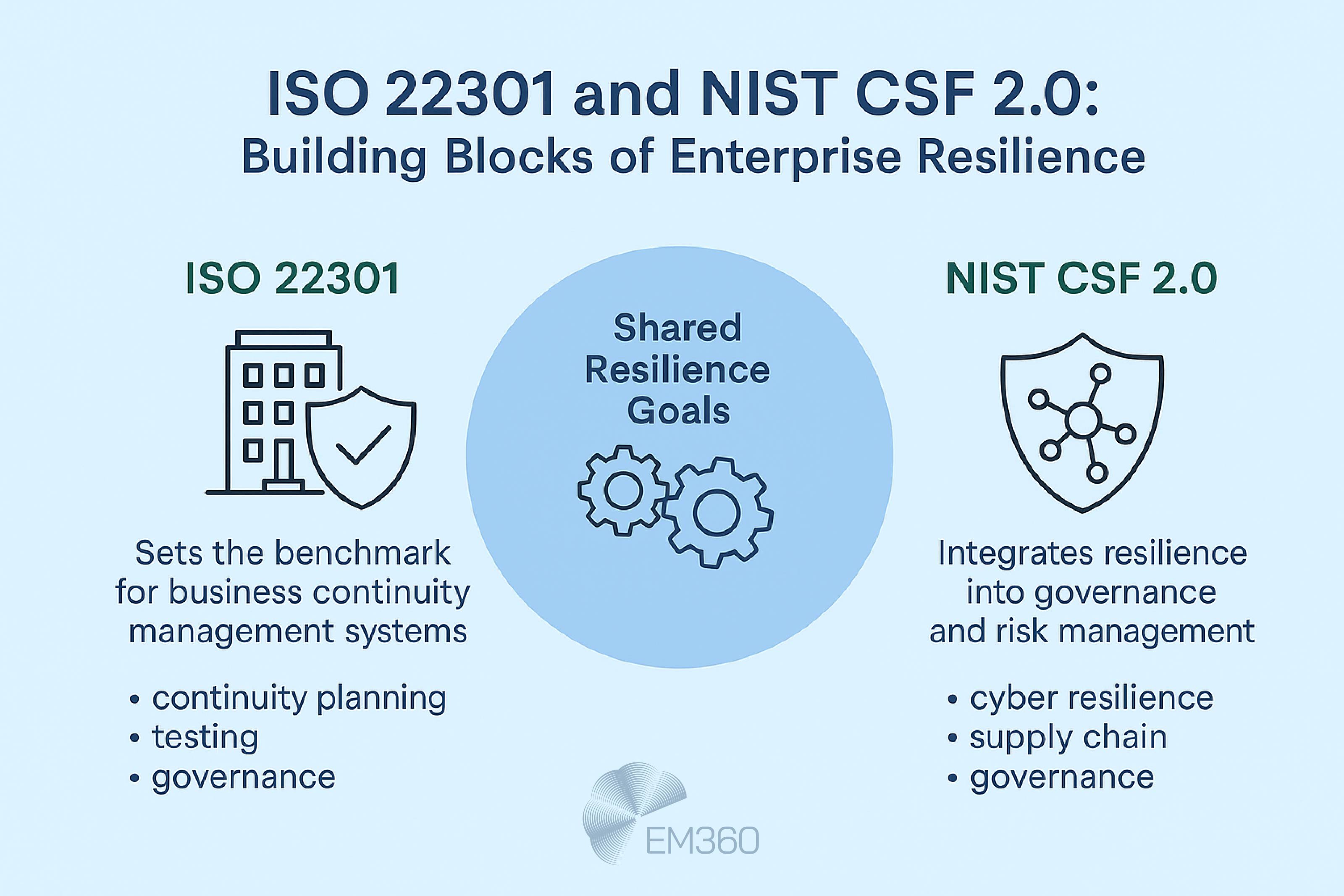
International standards and frameworks can help enterprises organise their continuity and recovery efforts. ISO 22301 sets requirements for a business continuity management system, covering how organisations prepare for, respond to and recover from disruption.
NIST's Cybersecurity Framework 2.0 provides guidance for managing cybersecurity risk, including governance and recovery. Both can support regulatory readiness, but using them doesn't automatically establish compliance with applicable laws.
Proving resilience posture
Organisations also need evidence that their continuity and recovery arrangements work in practice. Depending on the applicable requirements, this may include documented recovery objectives, test results, assigned responsibilities and records of improvements made after exercises or incidents.
These records help leaders assess whether critical operations can be maintained and recovered, while giving auditors and regulators evidence of the controls they're required to evaluate.
Compliance can provide a reason to strengthen resilience, but meeting a regulatory requirement doesn't necessarily mean an organisation is ready for every disruption. Enterprises still need to test their plans, address weaknesses and make sure their recovery arrangements reflect how the business actually operates.
Testing, Governance, and Continuous Improvement
Continuity and recovery plans need to be tested, reviewed and improved as the organisation changes. A plan that worked a year ago might no longer reflect the systems, suppliers or processes the business depends on. Without regular testing and clear ownership, organisations risk discovering these gaps when they're already dealing with a disruption.
Types of testing
Different types of testing help organisations understand how well their recovery plans work. Tabletop exercises allow teams to practise decision-making and escalation procedures, while simulations test how people and systems respond to realistic incidents.
Full failover tests go further by checking whether services can be recovered within their recovery time objectives (RTOs) and recovery point objectives (RPOs). However, a successful test only confirms what worked under those specific conditions, so different scenarios still need to be tested.
Governance structures
A business continuity management system (BCMS) needs clear ownership across the organisation. Crisis management teams must understand who's responsible for leading the response, escalating problems and making decisions when time is limited.
Defined governance also helps keep business continuity and disaster recovery aligned with enterprise risk management, rather than leaving individual departments to manage their own plans without coordination.
Feedback loops and lessons learned
Testing is only useful if organisations act on what they discover. After-action reviews, incident debriefs and lessons learnt from other organisations can reveal weaknesses in recovery procedures or gaps in responsibilities.
Those findings need to lead to changes in plans, processes or technology, followed by further testing to confirm that the improvements actually work.
By combining regular testing with clear governance and ongoing improvements, enterprises can keep their continuity strategies relevant as risks and business requirements change. This helps turn business continuity and disaster recovery into capabilities the organisation can depend on, rather than plans that are only reviewed after something goes wrong.
Practical Steps to Strengthen Your BC and DR Strategy Today
Resilience takes time to build, but there are practical steps enterprise leaders can take now to improve their continuity and recovery readiness. The priority is to understand what the business needs to keep running, where its biggest risks lie and whether existing recovery plans can deliver when they're needed.
Reassess your BIA and update RTO/RPO
A Business Impact Analysis (BIA) needs to reflect how the organisation operates today. Review critical services, their dependencies and the impact of losing them, then check whether recovery time objectives (RTOs) and recovery point objectives (RPOs) still match what the business can tolerate.
Invest in immutable and offline backups
Immutable and offline backups can help protect recovery data if attackers compromise live systems or connected backup environments. However, protected copies are only useful if the data can be restored. Regular recovery tests should confirm that backups are usable and that critical services can be recovered within their required timeframes.
Map dependencies across third-party and SaaS platforms
Continuity risks can be difficult to spot when critical services depend on external suppliers and software-as-a-service (SaaS) platforms. Mapping these dependencies helps organisations identify single points of failure, understand the impact of a provider outage and decide where alternative arrangements are needed.
Run at least one enterprise-wide test every year
An annual enterprise-wide exercise is a useful starting point for checking how well business continuity and disaster recovery plans work together. It should test coordination between teams, recovery procedures and the organisation's ability to maintain essential operations.
However, higher-risk services may need more frequent testing, depending on their importance and any applicable regulatory requirements.
Integrate BC and DR into board-level reporting
Business continuity and disaster recovery should be part of regular enterprise risk reporting. Boards need a clear picture of recovery readiness, significant dependencies, outstanding risks and whether recovery objectives are being met during testing. This also helps establish accountability for addressing weaknesses before they lead to disruption.

These five actions won't replace a complete continuity strategy, but they give organisations a practical way to identify weaknesses and improve recovery readiness. Regular reviews, testing and reporting help make sure those improvements keep pace with the needs of the business.
Final Thoughts: Resilience Requires Accountability
Business continuity planning and disaster recovery strategy are no longer IT checkboxes. They're board-level priorities that play a critical role in enterprise resilience. The ability to keep operations running, recover systems and demonstrate compliance with applicable requirements is now closely tied to business performance, reputation and trust.
Leaders can't delegate resilience down the stack. They have to take ownership of it, make sure it's properly governed and invest in it as a core business capability. Doing so helps organisations meet their regulatory obligations, protect their reputation and strengthen their ability to withstand disruption.
Resilience is now a measure of leadership. Explore EM360Tech resources to stay ahead of how enterprises are building continuity and recovery strategies fit for today’s risks.




Comments ( 0 )