

Businesses invest significant time and resources in developing expert knowledge, drawing on experience, research and lessons learned to solve complex problems. Yet much of this useful thinking remains tied to the projects, people and conversations in which it first emerged.
Executives share their perspectives in interviews. Analysts interpret market changes. Subject-matter experts explain complex technologies. Researchers uncover new data. Webinars and podcasts bring specialist experience to wider conversations.
But, what happens once that content has been published? How can that expertise be retooled and inform future work?
A webinar can generate clips. An interview can become an article. A research report can produce social posts, sales material and presentations. Those are all useful forms of content reuse.
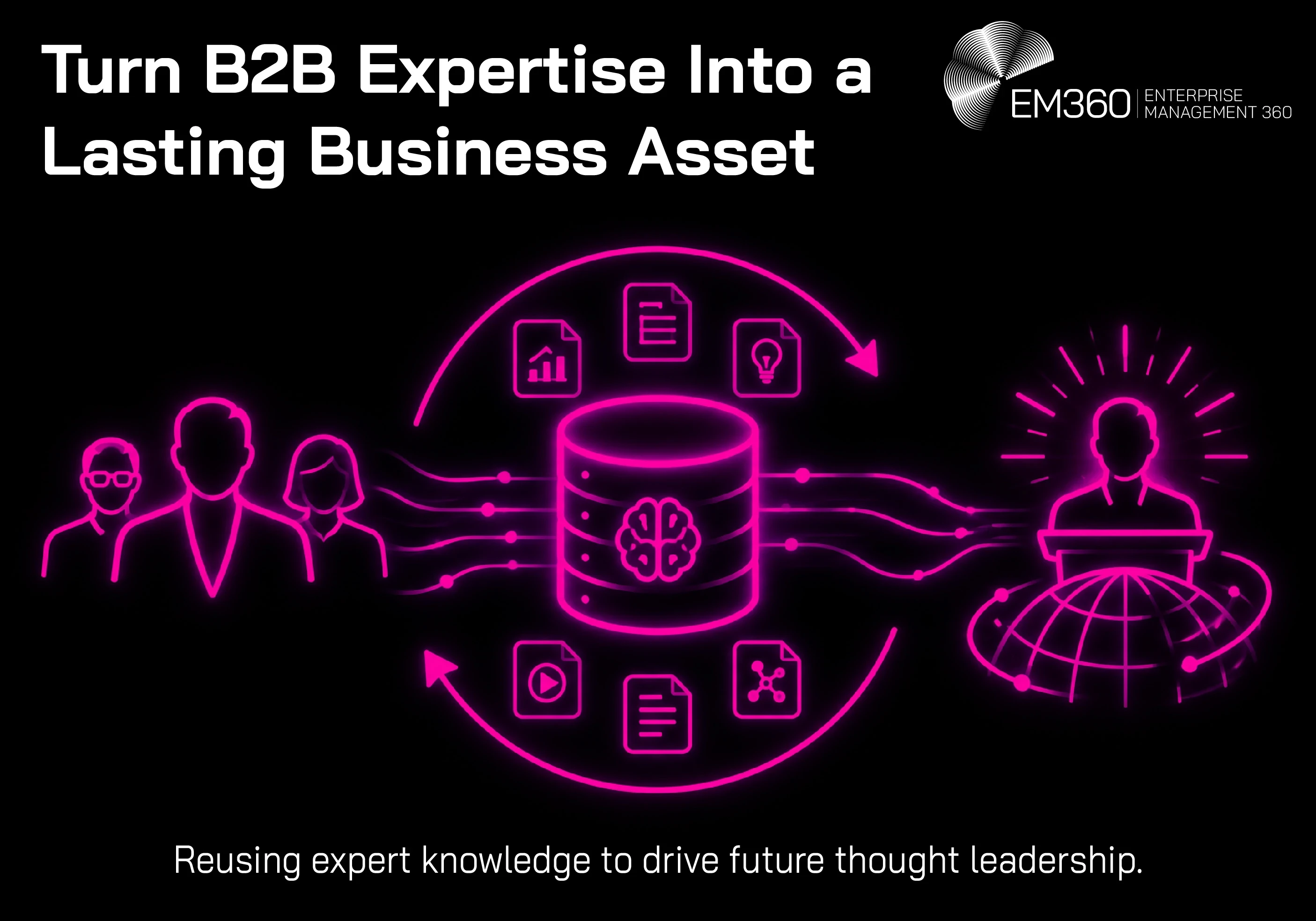
However, reusing content isn’t necessarily the same as reusing the thinking behind it.
A company can produce large volumes of expert-led content yet each new campaign is started from the same blank page. The previous asset may have performed well, but the knowledge it contained is no longer informing the organisation’s work.
B2B expertise becomes more valuable when useful ideas can be questioned, tested, developed and applied to new problems or challenges. That is when expertise starts to function as a reusable business asset.
Expertise Is More Than Content
It’s easy to treat expertise and content as equivalent. An expert gives an interview, an analyst appears on a podcast, or a research team produces a report, and the resulting asset becomes the focus.
But the underlying expertise isn’t the article, recording or PDF. It might be an observation about how a market is changing, guidance for understanding a recurring problem, an unexpected research finding, a prediction that proves accurate or a connection between issues usually discussed separately.
Content captures and shares that thinking, but it has a limited lifespan. A webinar ends, a report gets old and an article eventually loses relevance. The ideas behind them can remain useful for much longer.
Knowledge may need to be interpreted and adapted before it can help in a new context. For B2B organisations, that raises a more useful question than how long a piece of content will remain relevant: can the thinking inside it help the business understand something else later?
Repurposing Content Isn’t the Same as Reusing Knowledge
Imagine a company runs a webinar about the challenges of deploying AI across a large enterprise. The marketing team turns it into a blog post, a newsletter segment, a short video clip, a sales presentation and several social media posts.
This can help valuable ideas reach people who never watched the original webinar. But consider what happens six months later, when the company is preparing a campaign about AI governance. If the team simply extracts another quote from the old webinar, it has reused the content without necessarily developing the thinking.
A different approach would be to revisit a useful observation, test whether it still holds, add new evidence and explore what it means for AI governance. The result could be a new argument built on the knowledge produced by the original discussion.
That’s a different form of value.
What Makes Expert Thinking Reusable?
Not every expert statement will have a useful second life. Some insights are tied to a specific event or news story; others are too general to support meaningful development. Reusable expertise tends to share several characteristics:
It explains rather than describes
A statement such as: “AI adoption is increasing”, has limited value on its own. By contrast, an explanation of why organisations struggle to move AI projects from the experimentation stage into production offers a stronger starting point because it explores the causes behind the trend.
It connects evidence to interpretation
Research provides evidence of a statement while expertise helps interpret what that evidence means.
For example, original research might reveal that organisations are struggling with AI skills. The reusable insight isn’t simply the percentage reporting the problem but what the finding means for technology leaders, why the problem persists or how it might affect AI investment.
That interpretation can inform future articles, research questions, customer conversations and executive commentary without merely repeating the original statistic.
It can be applied to another problem
An idea becomes more valuable when it helps explain more than one situation.
Guidance developed to explain cloud complexity, for example, might simultaneously help a business examine infrastructure resilience or security. Applying it elsewhere should develop the thinking, not simply duplicate it.
It can be challenged
An idea that can only be repeated is less useful than one that can evolve. Later evidence might confirm, refine or contradict an earlier conclusion. That progression shows how the organisation’s understanding has changed.
Research Can Create a Starting Point, Not Just a Finished Product
Original research can have value beyond the campaign in which it first appears. Research conducted by Ascend2 and TopRank Marketing in 2026 found that 93 per cent of B2B marketers using original research-based content considered it effective at driving engagement and generating leads.
That finding supports the value marketers place on original research. The further argument here is that research can also provide a basis for developing new questions and interpretations over time.
Suppose a survey identifies a gap between AI investment and successful AI deployment. The first report explains the finding and a later project investigates why the gap exists. Another article explores its organisational consequences and a webinar tests whether the problem differs across industries.
The progression isn’t simply one report → many pieces of content. It’s one insight → further questions → deeper evidence → more developed understanding. Now it’s closer to compounding expertise.
What’s the Difference Between Copying an Idea and Developing It?
Consider an analyst who argues that enterprise AI projects often fail because organisations underestimate the importance of data infrastructure. A company could repeat that argument across a webinar, article, social post and presentation. The message would reach more people, but the underlying thinking would remain the same.
To develop the idea, the company could ask what follows from the original argument. Does the problem look different for organisations using real-time analytics? Does it create new governance requirements? Does data infrastructure become a limiting factor as AI workloads scale? Has new research changed the original conclusion?
These questions turn an existing idea into a starting point for new thinking.
What Gets Lost When Every Expert Conversation Starts From Scratch?
An interview, research project, webinar or customer conversation can produce more than the finished asset shows. It may surface unresolved questions, emerging patterns, useful distinctions, customer objections, unexpected findings, predictions worth revisiting, guidelines to test elsewhere, changed assumptions or ideas that were mentioned but never fully developed.
These points don’t all need to immediately become content. Their value is that they give future work something useful to investigate or build on. The goal isn’t to preserve every sentence an expert has said, but to avoid losing the thinking those conversations produced.
Knowledge from an earlier situation may need context and interpretation before it becomes useful in another. That is why an observation should not simply be copied into a new campaign; its relevance needs to be examined against the new question or problem.
Expert Interpretation Can Add Value Beyond the Original Asset
An analyst may bring decades of experience to a 30-minute conversation, but the recording doesn’t necessarily capture the full value of that contribution. A useful observation might connect a current technology development with a longer-running market pattern, or explain why a widely accepted assumption no longer holds.
That interpretation gives the business something specific to investigate later. It might prompt a new research question, invite comparison with another market development or provide a hypothesis to test as more evidence emerges. The value lies not in repeating the expert’s words, but in following the implications of the insight.
A Useful Test: Identifying Reusable Expertise
Set aside the original format (the webinar, podcast or article) and ask: what do we know now that we did not know before?
If the answer is only “we have a 40-minute recording”, there may be very little to build on. But perhaps the work has revealed:
- A new pattern in customer behaviour.
- Evidence that challenges an existing assumption
- A guide for understanding a recurring problem
- A prediction worth testing later
- A question that deserves deeper investigation
These are useful starting points because they can travel beyond the original format. The next question is: what could we understand better because we know this? That helps distinguish simply retaining information from developing the thinking it contains.
From Content Library to Intellectual Continuity
Businesses don’t need to turn every content programme into a formal knowledge-management initiative, and not every webinar needs to generate a series of new assets. The useful shift is to see expert-led content as a record of how understanding is developing, rather than as a collection of finished outputs.
A previous article, report or conversation may contain an idea that can still be examined in light of new evidence, new problems or new conversations. This can be especially useful as producing generic content becomes easier: previous expert thinking can offer a more informed starting point for future work.
The 2026 Ascend2 and TopRank research highlights the reported effectiveness of original research-based content. Building on research findings over time is a further opportunity for organisations, rather than a result established by that statistic alone.

When Does B2B Expertise Become a Reusable Business Asset?
B2B expertise becomes a reusable business asset when it gives future work something useful to build on.
A webinar can inform a new discussion, research can raise better questions, and an analyst’s interpretation can help explain a later market development. Lessons from customer conversations can also shape how a business approaches future challenges.
The aim isn’t simply to make yesterday’s content work harder. It is to make yesterday’s thinking useful to tomorrow’s work.
For more insights into the technologies and ideas shaping enterprise innovation, explore EM360Tech’s Emerging Technologies coverage.