

Most B2B companies have a fairly clear process for finding new customers. Marketing gets people interested, demand generation helps turn that interest into enquiries, and sales works to turn those enquiries into paying customers. There's a lot more involved, of course, but a lot of the process is built around helping people move towards a purchase.
Thought leadership doesn't fit quite so neatly into that process. Research, expert opinions and useful industry insights can all help people make business decisions, even when they aren't looking to buy anything yet. And while this kind of content can support marketing and sales, its value isn't always tied to a particular campaign or potential customer.
The challenge is working out how these activities can support each other without expecting them to do exactly the same thing. Thought leadership and demand generation should work towards the same business goals, but they each have a different role to play.
Why Thought Leadership Doesn't Fit Neatly Into Traditional GTM Systems
A traditional B2B go-to-market (GTM) strategy is essentially a plan for how a company will reach potential customers and sell its products or services. Marketing helps attract interest, sales follows up with potential buyers, and the teams involved use shared processes and tools to keep everything moving.
These processes also help companies understand how well their efforts are working. They can track enquiries, responses to campaigns, potential sales and completed purchases, then use that information to decide what needs more attention. But thought leadership works a little differently.
A company might publish a research report that helps people understand a problem in their industry. Someone could read it today, share it with a colleague next month or use its findings to help make a decision much later. That research has been useful, even if nobody filled in a form or contacted the company afterwards.
According to 2026 research from Harvard Business Review Analytic Services on GTM execution, sponsored by LeanData, 83% of the B2B professionals surveyed considered their GTM strategy very important, but only 38% said their organisation was very effective at putting it into practice.
The study also found that 78% believed their companies needed better coordination between the systems used by marketing and sales. The research isn't specifically about thought leadership, but it does show how difficult it can be to get different parts of a business working together.
Adding thought leadership to the mix creates another challenge. Companies need to think about how they develop useful knowledge, where people might need it and how it can support their wider business goals. That gets much easier when everyone understands what thought leadership and demand generation are each there to do.
Give Demand Generation and Thought Leadership Different Jobs
It's easy to see why demand generation and thought leadership often get grouped together. Both can help companies reach new audiences, build relationships and attract potential customers. But they don't work in quite the same way, and expecting them to deliver the same results can make both less effective. The first step is understanding the difference.
Demand generation responds to commercial interest
Demand generation is the work a company does to get people interested in its products or services and encourage them to take the next step. That might include advertising campaigns, events, webinars or content aimed at people who could benefit from what the company offers.
Part of this work is known as demand capture, which simply means recognising when someone is already interested and giving them a way to get in touch. They might request a demonstration, register for an event or contact the company to ask about a particular solution. Those actions give marketing and sales something they can respond to.
They can find out what the person needs, whether the company can help and what should happen next. This is still an important part of how B2B companies find customers and generate revenue. Because it helps them recognise when someone is interested in buying and respond while that interest is there.
Thought leadership develops expertise the market can use
B2B thought leadership has a different job. It's about developing and sharing knowledge that helps people understand an issue, think through their options or make better decisions. That knowledge might come from original research, years of experience in a particular field or an expert's understanding of changes happening in an industry.
The point is to offer something genuinely useful, rather than simply explain why people should buy a product. Companies can also share this knowledge in different ways, depending on what they're trying to achieve. In its 2026 research into how companies share thought leadership, iResearch Services found that 48% of the professionals surveyed used a mixture of gated and ungated content.
That means some research was freely available, while other material required people to provide their contact details before accessing it. For example, a company might publish a research report that anyone can read, then invite interested readers to register for a related webinar.
The report helps people understand the subject, while the webinar gives those who want to learn more an opportunity to engage directly. Both activities can support the business without needing to achieve exactly the same result.
Connect Thought Leadership to Commercial Priorities
Once the different roles are clear, the next step is working out how they fit into the company's wider plans. One approach is to look at research or thought leadership content that's already been published and find ways to use it in marketing campaigns or sales conversations.
There's nothing wrong with that, but it means the company is only thinking about how the work could help the business after it's already been created. A better approach is to make that connection earlier, when the company is deciding what it wants to research and why.
Start with the market questions that matter
Every B2B company works with customers who are dealing with problems, changing requirements, and decisions they don't always have easy answers to. These are often good starting points for research because they give the company an opportunity to investigate something people genuinely need help understanding.
Take a cybersecurity provider, for example. It might notice that customers are struggling to understand how new AI security requirements affect the systems they already use. That could be a useful subject for research involving security experts, people who understand the regulations and businesses dealing with the problem themselves.
The subject is relevant to the company's work, but the research still needs to be fair and thorough. If the findings challenge something the company has been saying, that shouldn't be a reason to ignore them. This is an important part of building a credible thought leadership strategy.
Sales and marketing teams can help identify the questions customers are asking, but they shouldn't decide what the answers need to be before the research begins.
Decide where that expertise belongs in the GTM strategy
Once the company has developed that knowledge, it needs to think about where people could benefit from it. Some findings might help a wider audience understand a new problem. Others could be useful when speaking to existing customers, planning a marketing campaign or working with companies in a particular industry.
The Content Marketing Institute's 2027 B2B marketing research offers some useful context. Among marketers who considered their organisations' content marketing effective, 47% said content quality and relevance contributed to their success, while 26% pointed to better alignment with sales.
These were the marketers' own views about what helped their work, rather than proof that those factors directly caused better results. For companies, the practical question is where their research and expertise could be most useful. For example, a marketing campaign aimed at companies in the financial sector might use research about a problem affecting that industry.
But the same findings could also help businesses that aren't part of the campaign. Thinking about these different uses gives the company more ways to share what it knows, without limiting the research to a single campaign or sales goal.
Build a Two-Way Connection Between Expertise and Revenue Activity
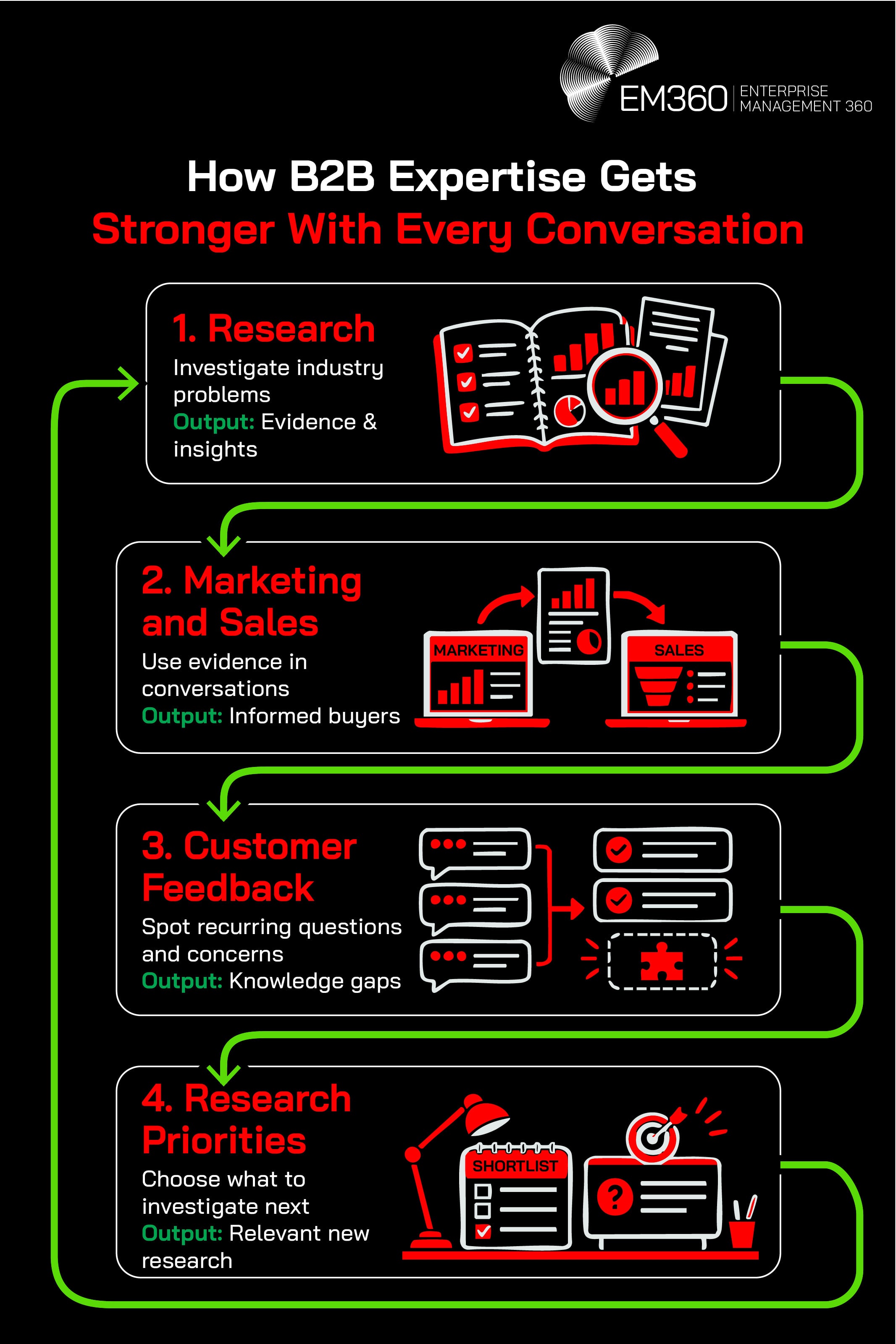
Connecting thought leadership and demand generation isn't just about giving marketing and sales teams access to research. Those teams also have information that can help the company decide what it should investigate next. This is where the relationship becomes particularly useful.
Research can help marketing and sales teams understand the problems their customers are dealing with, while the experience those teams gain from working with customers can help the company identify new questions worth researching.
Make established expertise available where it's useful
Imagine a company publishes a report about a major challenge facing its industry. It might initially share the findings through an event, a marketing campaign or an article aimed at people interested in the subject. A few months later, someone in sales might speak to a customer dealing with that same challenge.
If the research is still relevant, they can use it to help explain the issue, share useful evidence or give the customer something to consider. Instead of another conversation about products, the customer gets information that could help them understand their options.
The 2026 Edelman-LinkedIn B2B Thought Leadership Impact Report, published in November, gives us a useful idea of how buyers use this kind of content. Among the B2B decision-makers surveyed, 76% said thought leadership shared or discussed within their buying group had helped them judge whether a company understood their needs and priorities.
Another 52% said it had helped their group decide which company to buy from. These findings tell us how buyers say they've used thought leadership. They don't prove that any particular marketing or sales approach caused those decisions. But they do show why it's worth making useful research available to people across the business.
Marketing might use the findings to help explain an industry problem, while sales could share them with customers asking about the same issue. The research doesn't need to become a sales pitch to be useful in a sales conversation.
Feed commercial knowledge back into the authority programme
The relationship works the other way, too. Sales teams and people who work directly with customers hear questions and concerns that don't always appear in formal research. They might notice that several customers are confused about the same technology, or that businesses are starting to question an approach they've used for years.
These conversations can help a company identify subjects that deserve a closer look. For example, if customers keep asking about the long-term costs of a particular technology, the company could investigate how businesses are calculating those costs, what they're worried about and how they're deciding whether the investment is worthwhile.
Of course, hearing the same concern from a few customers doesn't mean everyone in the industry feels that way. The company still needs to do the research and find out whether the problem is more widespread. But those conversations can provide a useful starting point.
They help the business notice questions it might otherwise have missed and decide where its expertise could be put to better use.
Keep the connection useful without forcing attribution
When thought leadership becomes more closely connected to sales and marketing, companies naturally want to know whether it's helping the business. The difficulty is that different activities give us different kinds of information. A demand-generation campaign might produce enquiries, webinar registrations or potential sales that the company can track.
A research report might help customers understand a problem or give them information they later use in a decision. Both can be useful, but they aren't necessarily measured in the same way. That doesn't mean companies should stop trying to understand how their thought leadership is performing.
They just need to be careful about what the evidence actually tells them. For example, a research project might not generate many enquiries, but it could reveal a problem that several important customers are dealing with. That might be a good reason to investigate the issue further or change how the company approaches those conversations.
On the other hand, a report getting plenty of readers doesn't automatically mean it's helping the company make more sales. The aim is to learn from what's happening and use that information to make better decisions, rather than trying to prove that every piece of content has directly contributed to revenue.
Make the Connection Part of How GTM Decisions Are Made
There's a difference between teams occasionally sharing useful information and a company actually using that information to guide its plans. A marketing team might regularly send research to sales, for example, without anyone asking whether the questions customers are raising should influence future research.
Or a company might produce excellent thought leadership while continuing to plan its marketing campaigns without considering how that knowledge could help. For the connection to work properly, the information needs to influence what the business decides to do.
That could mean looking at the problems customers are facing before choosing new research topics. It could also mean considering what the company already knows when deciding which marketing activities deserve more attention. The same thinking applies to investment.
If a research project is still helping people understand an important industry issue, it might make more sense to develop that work further than to start something completely new for the next campaign. Of course, that decision should depend on whether the research is still relevant, what the company has learnt and whether there's a good reason to continue.
A subject being commercially interesting doesn't automatically mean the company has something valuable to say about it. This is what GTM alignment should look like in practice. Marketing, sales and the people responsible for thought leadership don't need to make every decision together.
But the information they gather should help the company understand where to spend its time, money and expertise. Over time, that can change which subjects receive more research, how the company approaches particular customer problems and where existing knowledge could be useful.
What a Connected GTM Strategy Should Be Able to Do
A connected GTM strategy doesn't mean every team needs the same targets or every research project needs to help close a sale. It means the company understands what each activity is supposed to achieve and how they can help each other.
There are a few questions worth asking when looking at how well this works: These questions aren't meant to introduce another complicated marketing framework. They're simply a way to see whether the company is making good use of what it knows and what it's learning from its customers.
If the answers reveal gaps, they also give the business a clearer idea of what needs to improve.
- Does everyone understand the different roles? Is it clear what the company expects from demand generation and what it wants its thought leadership to achieve?
- Are they working towards the same goals? Does the research focus on relevant industry problems while still allowing experts to investigate them properly?
- Can teams use the knowledge the company already has? Is useful research easy to find and share when customers need it?
- Are customer conversations helping guide future research? Does the company pay attention to recurring questions, concerns and problems that could be worth investigating?
- Is the company learning from the results? Does what it discovers influence where it invests, what it researches and how it approaches customers?

Final Thoughts: A Stronger GTM Strategy Connects Expertise With Demand
B2B companies still need demand generation. They need to attract potential customers, recognise when someone is interested and give sales teams the information they need to respond. Thought leadership doesn't replace any of that. What it can change is how much the company learns from the work it's already doing, and how it puts that knowledge to use.
When thought leadership and demand generation work together, research can help marketing and sales teams have more informed conversations, while customer experience can help the company decide what it needs to understand better. Each activity still has its own purpose, but both contribute to a business that knows its market and customers more deeply.
And as buyers continue using research and expert opinions to help make decisions, companies have good reason to think beyond individual campaigns and consider how they're building and sharing knowledge over time. That's also where EM360Tech's work with industry analysts and enterprise technology experts comes in.
By bringing expert perspectives, original insights and B2B audiences together, EM360Tech helps keep those conversations going and gives organisations more opportunities to build authority that lasts beyond their next campaign.