
The EM360Tech Q1 2026 Impact Index recognises the content, campaigns, and expert-led conversations that created meaningful enterprise impact across the quarter.
The Catalyst Award is focused on campaign-level momentum. It recognises a campaign that performed strongly across connected touchpoints, not because it simply reached an audience, but because it gave that audience a reason to keep engaging.
A Catalyst campaign can take different forms. Some may include multiple podcasts. Others may combine podcasts, articles, lead generation activity, and supporting content across several formats. For Q1 2026, the winning campaign centred on one focused podcast episode: Island’s conversation on protecting sensitive enterprise data across browsers, SaaS platforms, and AI tools.

Island won because the campaign did what strong enterprise content is supposed to do. It took a complex, fast-moving security issue and turned it into a clear conversation with practical relevance for the people now trying to secure how work actually happens.
The Campaign That Drove Impact
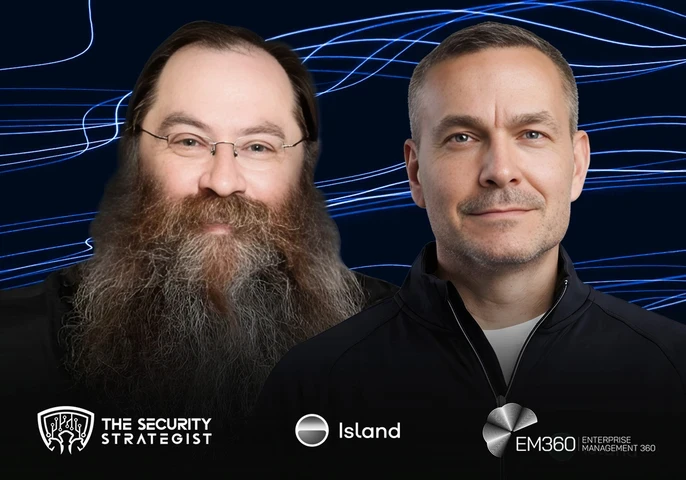
Island’s winning campaign was built around a single episode of the Security Strategist podcast.
The episode featured Michael Leland, Field Chief Technology Officer at Island, in conversation with Chris Steffen, Vice President of Research at Enterprise Management Associates. The discussion focused on one of the most urgent challenges in enterprise security: how organisations can protect sensitive data when knowledge workers are operating across browsers, SaaS applications, desktop tools, and AI platforms.
That topic gave the campaign a strong foundation. It wasn’t trying to cover every possible angle in enterprise security. It stayed close to a specific problem: the browser has become a core workplace environment, but many organisations are still trying to secure it with controls designed for an older model of work.
From there, the conversation expanded naturally into AI sprawl, data governance, browser extensions, presentation-layer controls, and the practical need for visibility. Each of those ideas supported the same central message. Enterprise security teams can’t protect sensitive information properly if they can’t see where it moves, how it’s used, and which tools are touching it.
That focus is what made the campaign work. It didn’t need a large asset set to create impact. It needed a clear problem, a strong expert perspective, and a message that could carry across every supporting touchpoint without losing its shape.
Rethinking Browser Data Control
CISOs are shifting from perimeter tools to interaction-level controls as sensitive data moves through SaaS, browsers and shadow AI assistants.
How the Campaign Held Together
A strong campaign doesn’t feel like scattered content. It feels like one idea moving through different formats with discipline.
That’s where Island’s campaign stood out. The core message translated cleanly because it was specific from the start. The podcast wasn’t positioned as a broad conversation about AI or cybersecurity in general. It centred on the security gap created when enterprise work moves through browsers, SaaS tools, and AI systems that weren’t always built with enterprise governance in mind.
That gave every related touchpoint a clear anchor.
Short clips could pull from practical points around AI sprawl, browser-based risk, and data boundaries. The landing page could frame the episode around enterprise security strategy. Email and social distribution could focus on the same concern from different angles, without turning the campaign into a loose collection of messages.
That matters because enterprise buyers don’t usually engage with content in one neat sequence. They may see a clip first, then visit the landing page, then listen to the full episode later. Or they may come through email and only engage with a short excerpt. If the message shifts too much between those moments, the campaign loses force.
Island’s campaign avoided that. It stayed focused enough for the audience to understand the point quickly, but substantial enough to reward deeper engagement.
Hardening The Enterprise Browser
Position the enterprise browser as a managed security surface, with visibility into extensions, permissions and data access paths.
Signals of Cross-Channel Impact
The Catalyst Award doesn’t reward noise. It rewards signs that a campaign carried across channels and held audience attention.
Island’s campaign showed that kind of movement. Engagement appeared across several surfaces, including podcast platforms, the website, social content, and email-supported touchpoints. The important point isn’t volume for its own sake. It’s the pattern.
The campaign showed clear signs of continued engagement, not just one-off interaction. People didn’t stop at a single touchpoint. They moved between formats, whether that meant starting with a short clip and continuing to the full episode, or arriving at the landing page and spending time with the broader context.
That kind of movement matters. It shows the topic held attention long enough for the audience to follow it, not just notice it.
The subject itself carried weight, but it wasn’t doing all the work. The message was tight, the examples were practical, and the framing made it easy to understand why the issue mattered now. That made it easier for the campaign to hold its message as it moved across different formats.
That’s what allowed a single podcast-led campaign to extend beyond its original format without losing impact.
Managing Campus Risk via Browser
Why a distributed university moved sensitive access into a hardened browser layer to tighten audits, compliance, and data protection.
From Engagement to Momentum
Engagement matters, but Catalyst is about what happens after attention is earned.
Island’s campaign moved beyond awareness because it gave the audience a practical reason to keep the conversation going. The episode spoke directly to problems security teams are already facing: shadow AI, browser extensions, unmanaged data movement, and the difficulty of applying consistent policies across modern work environments.
Those aren’t abstract concerns. They sit close to buying conversations, risk reviews, governance planning, and security architecture decisions.
Where lead generation is part of a campaign, this kind of content has a clear role. It helps qualify interest by giving the audience something more useful than a sales message. It creates a stronger bridge between education and action, because the conversation is built around a real operational problem.
Island’s campaign showed that momentum doesn’t always come from having more assets. It comes from having the right message, aimed at the right audience, at the right point in the market conversation.
Inside Jon Arnold’s Impact
How sustained, operations-first analysis is shaping enterprise choices on AI, CX and converged communications platforms.

The Enterprise Takeaway
Enterprise campaigns succeed when they’re structured, not just distributed.
That means the message needs to be clear before it’s pushed across channels. A podcast, article, clip, newsletter mention, or lead generation email can only work as part of a campaign if each piece is carrying the same strategic thread.
Island’s campaign is a useful example because it proves scale isn’t the only measure of campaign strength. A single strong asset can do meaningful work when the topic is timely, the argument is focused, and the supporting content knows exactly what it’s reinforcing.
For enterprise teams, the lesson is simple. Don’t start by asking how many channels you can use. Start by asking what the campaign needs to make clear.
What problem is the audience already trying to solve? What’s the strongest point of view you can bring to that problem? Where does the content need to meet them? And how do you make sure every touchpoint deepens the same message instead of diluting it?
That’s where campaign momentum starts. Not with more content. With better alignment.
Final Thoughts: The Role of the Catalyst Award in the Impact Index
The Catalyst Award plays a specific role in the Q1 2026 Impact Index.
Where the Vanguard Award recognises the quality of thinking behind a standout podcast, the Apex Award recognises the strength of audience response. The Authority Award recognises analyst influence across the quarter. Catalyst looks at the campaign as a whole.
That distinction matters.
Island’s win shows that campaign impact doesn’t depend on a fixed format or asset count. Future Catalyst winners may look very different. Some may be built around several podcasts. Others may combine expert conversations, articles, social content, and lead generation activity into a broader programme.
What matters is whether the campaign holds together and creates momentum.
For Q1 2026, Island did exactly that. Its campaign turned a complex enterprise security challenge into a focused, practical conversation that moved across channels without losing clarity. As enterprise content strategies become more connected, that kind of coordination is no longer a nice extra. It’s becoming the difference between content that gets published and content that actually moves the market.



Comments ( 0 )