
Enterprise technology decisions are often made around a relatively immediate set of requirements. A system needs to perform a particular function, meet current demand, integrate with existing infrastructure and fit within the organisation's available budget and capabilities. If it satisfies those conditions, it may be considered suitable for adoption.
But what happens when the organisation expects to depend on that technology for considerably longer than the conditions under which it was originally evaluated are likely to remain unchanged?
A platform selected today might become part of an organisation's operations for the next decade. A database could support business-critical applications long after its original implementation team has moved on. An infrastructure component might remain essential even as its manufacturer changes direction, its software dependencies evolve or the skills required to maintain it become harder to source.

The problem isn’t necessarily that these technologies will become outdated or stop functioning. It’s that the conditions required to keep them operating may gradually change or disappear.
This creates a time horizon problem for enterprise technology. Organisations can make decisions based on present-day technological fitness without adequately considering how long that fitness needs to remain true.
Technological Fitness Needs A Longer Time Horizon
Technology is generally evaluated against its ability to meet a defined set of requirements. Can it perform the necessary tasks? Is it reliable? Does it meet security requirements? Can the organisation implement and support it?
These are important considerations, but they tend to concentrate on whether a technology is suitable for its intended purpose at the point of adoption. Long-term dependence introduces the question of how long the organisation will need this technology to remain usable, as well as what will be required to make that possible?
This is due to technological fitness not necessarily being a permanent characteristic but rather being dependent on a continuously changing environment.
Software receives updates, operating systems evolve, hardware reaches the end of its supported life and suppliers change their products or commercial arrangements. Integration requirements shift as organisations adopt new platforms and services. Even technologies that remain fundamentally sound can become harder to operate when the surrounding ecosystem changes.
The organisation's own circumstances are also part of this equation. Employees with specialist knowledge move on, internal responsibilities change and documentation can become disconnected from the systems it was intended to describe. A technology can therefore remain technically intact while becoming increasingly difficult to understand, maintain, modify or recover.
This isn’t simply an ageing infrastructure problem. A relatively new system can create the same exposure if the organisation adopts it without considering the duration of its dependencies. Your organisation needs to ask whether the technology can remain fit for the period during which the organisation intends to rely on it.
Digital Preservation Offers A Different Way To Think About Longevity
Digital preservation provides a useful parallel for understanding why continued existence should not be confused with continued usability.
World Digital Preservation Day, organised by the Digital Preservation Coalition (DPC), took place on 5 November 2026. It is to raise awareness of the importance of protecting digital information and making it available over time.
One of the key problems in digital preservation is that just because information is preserved doesn’t mean it’s still usable. This is a distinction made by the Library of Congress in its guidance on bit-level preservation and long-term usability. The original bits are still there, so there is still an authentic copy of the digital content available. But that alone doesn't ensure that users in the future will be able to render it or interact with it as intended.
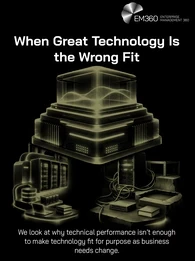
When Best Tech Is Wrong
Why high-performing platforms still fail when costs, skills and workflows don’t align with evolving enterprise needs.
A file might survive perfectly intact while the software needed to open it becomes unavailable. Its format could become obsolete, its codec might no longer be supported or the hardware required to interpret it could disappear. Licensing restrictions can also prevent access to software that would otherwise make the content usable.
The Library's Sustainability of Digital Formats guidance considers factors such as format transparency, adoption, self-documentation, external dependencies, patents and technical protection mechanisms. These factors affect how cost-effective and feasible it is to maintain access as the technology landscape changes.
The underlying lesson extends beyond archived information. Enterprise systems also depend on conditions that exist outside their immediate code or physical components. Their continued usefulness can depend on compatible software, available hardware, supported interfaces, licensing arrangements, technical expertise and the ability to understand how the different elements work together.
Keeping the system intact isn’t necessarily enough. An organisation might retain its application, database and associated data, but still find that it cannot safely modify the software, reproduce its original operating environment or move its information into a replacement platform.
Digital preservation therefore offers a valuable conceptual distinction: preserving the thing itself and preserving the conditions that make it usable are related, but different responsibilities.
The Dependencies That Make Technology Operable Can Change
Enterprise technology rarely exists in isolation. Even a seemingly self-contained application can depend on multiple layers of infrastructure, software, services and specialist capabilities. Some of these dependencies are visible during procurement. Others become more apparent as the technology is integrated into the wider operating environment.
Vendor support is one example. A supplier might provide a product that meets an organisation's requirements, but that doesn’t mean the same level of support will be available throughout the organisation's expected period of dependence.
Products reach end of life, support arrangements change and companies discontinue services or redirect investment towards different technologies. An organisation may then need to maintain an existing environment with fewer updates, less assistance or limited access to specialist expertise.
Software dependencies introduce another dimension. Applications are built upon operating systems, libraries, APIs, frameworks and other components that evolve independently from each other. Changing one element can impact compatibility elsewhere and an unsupported dependency can make future maintenance or migration more difficult.
These issues become particularly important when a system is deeply integrated into business operations. Replacing one component may require changes across several connected applications, data flows and processes.
There is also a difference between a technology being theoretically portable and an organisation being able to move it successfully.
Data might be exportable, but the information may rely on proprietary formats, undocumented relationships or application-specific logic. An organisation might have access to its source code but lack the expertise or supporting infrastructure needed to rebuild and operate the system elsewhere.
The ability to leave a technology, therefore, depends on more than whether an alternative product exists. It also depends on whether the organisation can understand what it needs to transfer, preserve the functionality on which its operations rely and manage the transition without unacceptable disruption.
These dependencies do not necessarily make a technology unsuitable. They do, however, influence how long an organisation can reasonably expect to operate it and what resources will be needed to maintain that capability.
Operational Knowledge Is Part Of The Technology's Long-Term Conditions
The technical components of a system are only part of what allows an organisation to keep using it. People also contribute to technological continuity through the knowledge they develop while implementing, operating and maintaining systems.
This includes understanding configuration decisions, integration requirements, dependencies, workarounds, recovery procedures and the reasons particular architectural choices were made.
Some of this information is documented. Some exist in formal processes and technical records. Other knowledge develops through experience and familiarity with the operating environment.
Over time, the people who understand these details may leave, change responsibilities or move to other projects. New employees may inherit systems without having participated in their original implementation. Documentation may still exist, but no longer accurately reflect the current environment.
The risk isn’t simply that an organisation loses historical information. It’s that it gradually loses some of the practical capability required to operate, modify or recover its technology.
The Open Archival Information System (OAIS) reference model, standardised as ISO 14721, provides another useful perspective. It recognises that long-term preservation involves more than retaining information. Its framework considers the hardware, software, information, processes and organisational responsibilities needed to preserve information and make it available to a defined community over time.
Importantly, the model also acknowledges that the knowledge base of the intended users can change.
Although OAIS is designed for digital information preservation rather than enterprise application management, the broader principle is relevant: continued usability depends on the relationship between information, technology and the people and processes capable of interpreting and maintaining them.
Enterprise systems face a similar challenge. An organisation needs to retain enough operational understanding to manage the technology as its environment changes.
This doesn’t mean every technical decision needs to be documented indefinitely or that every original team member must remain involved. It means that the organisation should recognise operational knowledge as one of the conditions that supports long-term technological fitness.
Technology Lifecycles Need To Reflect The Duration Of Dependence
Technology lifecycle management isn’t a new discipline. Established systems engineering frameworks already recognise that a system's life extends beyond its initial development and deployment.
For example, ISO/IEC/IEEE 15288:2023 establishes processes covering the full system lifecycle, including conception, development, production, utilisation, support and retirement. Its scope also recognises that systems can include hardware, software, data, people, processes and procedures.
This is important because it demonstrates that long-term supportability and retirement are already recognised parts of responsible technology management. The remaining challenge is making the expected duration of organisational dependence sufficiently explicit when evaluating technological fitness.
A system intended for a short-term project doesn’t necessarily need the same support arrangements as a platform expected to underpin core business operations for the next 15 years. Similarly, an application that can be replaced relatively easily presents a different long-term commitment from one embedded in complex operational workflows.
The expected duration of dependence should therefore influence how organisations evaluate technology before adoption. This doesn’t require businesses to predict every technological development or guarantee that a particular system will remain usable indefinitely. Such expectations would be unrealistic in an environment where platforms, suppliers and technical standards continue to evolve.
Instead, organisations need to understand the assumptions behind their intended period of use. How long is the technology expected to remain in service? Which components and suppliers will need to remain available? What happens if a critical dependency is discontinued? Will the organisation retain the expertise needed to maintain the system? Can its data and functionality be transferred if the original platform becomes unsuitable?
These questions help distinguish between a technology that works under current conditions and one that the organisation has a credible basis for continuing to operate.
They also make future migration and replacement part of the original technology decision, rather than issues that only become urgent when support is withdrawn or performance deteriorates.
Preserving Future Options Is Part Of Technological Fitness
There is an important difference to acknowledge between the act of planning for longevity and the act of expecting technology to remain unchanged.
A system doesn’t necessarily need to retain its original configuration, architecture or components throughout its entire operational life. In many cases, remaining fit for purpose will require updates, modifications, replacements and migration to newer environments.
The objective isn’t to preserve every technology in its original form. It’s to preserve the organisation's ability to continue using, adapting or replacing it as circumstances change. This is where future optionality becomes important.
An organisation that understands its dependencies, retains appropriate documentation, maintains access to operational expertise and plans for the movement of data and functionality has more choices when its technological environment changes.
It can assess whether to extend a system's useful life, replace individual components, migrate to another platform or retire the technology altogether.
Without these conditions, even relatively straightforward changes can become difficult. The organisation may find itself dependent on a supplier it can no longer rely on, a format it cannot easily interpret or a system that only a diminishing number of specialists understand.
These constraints can turn what should be a planned technology decision into an urgent operational problem. The ability to change direction is therefore not separate from long-term technological fitness but rather one of the things that helps preserve it.
How Long Does Technological Fitness Need To Last?
Enterprise technology is often assessed according to what it can deliver at the point of adoption. Yet the consequences of those decisions can extend considerably further.
A system may become deeply embedded in business operations, support important processes and accumulate dependencies that make it difficult to replace. Its continued operation can depend on suppliers, software, hardware, formats, specialist capabilities and organisational knowledge that were never intended to remain static.
Digital preservation demonstrates why retaining something isn’t the same as ensuring it remains usable. Enterprise technology faces a comparable challenge, even if the practical requirements and responsibilities differ.
The broader challenge isn’t whether organisations should attempt to make every technology last longer. Nor is it whether every system should be designed for indefinite operation. It’s whether the expected duration of technological dependence is being considered when fitness is first established.
If an organisation intends to rely on a system for years, it needs a reasonable understanding of what will allow that system to remain operational across that period. This includes not only the technology itself, but also the dependencies, capabilities and knowledge that make continued use possible.
The responsibility doesn’t end when a system is successfully deployed. It extends across the period during which the organisation chooses to depend on it.
Technology should not be considered fit for long-term enterprise use simply because it works today. Its fitness also depends on whether the organisation can preserve the conditions required to operate, understand, modify, recover or replace it tomorrow.
From technology lifecycles to long-term technology management, explore EM360Tech’s Infrastructure Management feed to discover the newest issues shaping how organisations manage their technology.

Comments ( 0 )