
Attackers are getting help from artificial intelligence. Defenders, for the most part, are still stitching together disconnected tools and working through growing queues. On a recent episode of the Security Strategist Podcast, host Trisha Pillay asked Monzy Merza, co-founder and CEO of Crogl, what agentic AI actually changes for the analysts doing the work. Merza has worked in nuclear weapons labs, at Splunk and at Databricks, and his answer is more measured than the hype. AI can shrink the time it takes to investigate a threat, he states, but only when teams can see, test and control what it is doing.
Why Critical Infrastructure Needs Sovereign AI in Security
When Merza started Crogl back in 2023, the pitch he presented raised eyebrows from some investors. There was no model training and no standard SaaS offering. The product was deployed on-premises and targeted the most demanding customers first. The reasoning for this came from experience. Merza noticed that the organisations most in need of sophisticated security tools, particularly in critical infrastructure, were often the least able to adopt them. Newer startups tended to skip the enterprise features those buyers require. "We thought we're gonna work on the hard thing," he says. The bet he believes has held up best is sovereign AI, giving organisations full control over how models operate within their security environments. Customers choose the language model, decide where it is deployed and decide how it is monitored. Merza says the wider industry is now catching up to that position.
Regulated buyers, he adds, judge AI on three things: sovereignty, extensibility and predictable pricing.
- Sovereignty: Secure software is the baseline. The customer picks the model and works within its own hardware limits.
- Extensibility: No normalising data first; new sources plug in. "We have a patent on our ability to analyse data regardless of the schema types."
- Predictable pricing: One license per team, no matter how many investigations or people.
Will AI Replace Security Analysts?
Merza breaks analyst effectiveness into three barriers. The first is domain competency, such as knowing what a malicious PowerShell script looks like. The second is tool competency, meaning fluency in the data lake, the SIEM or the cloud posture platform. The third is access, where the permissions and policies limit what any one person can do.
Attackers, he says, have already flattened all three. AI agents help them build malware on the fly and learn unfamiliar systems quickly, and they never wait for sign-off. "The attacker has an advantage across all three of those things," he says. Defenders have to compress the same barriers, and he sees AI as the way to do it.
This, of course, raises the concern about jobs, and Merza is clear in his stance. "I believe there are going to be more security analysts in the future than there are today." His logic is that AI lets people build more software and deploy more agents, which widens what needs defending. Organisations with thousands of human users may soon have tens of thousands of agents moving through their systems too. Each person can do more, but the total workload grows as well. He compares the moment to earlier turns toward cloud and mobile, which enlarged IT departments rather than emptying them.
When AI Belongs in the SOC
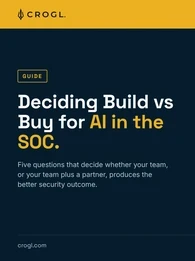
Use coverage, quality, and durability to decide where to own AI in the SOC and where a partner delivers better security outcomes.
What changes is the nature of the work. Years ago, learning a new data lake meant reading documentation and pestering a colleague. Today, he says, you connect an AI agent and ask how many emails Bob received. Merza points to a US Department of War team as evidence. A full threat hunt there once took eight to ten analysts roughly eight to ten hours each. One analyst on an overnight shift recently finished one in about two hours. He is careful to note that the analyst was highly skilled and wasn't simply pressing a button. The gain came from removing friction around tools and data, not from removing the human from the process.
How to Build Trust in AI-Driven Security Investigations
Speed is easy to claim, Pillay noted. How does a team know the results are better? Merza ties the answer back to sovereignty. Without transparency and observability, he says, nobody can build operational trust. A system has to be repeatable, predictable and consistent, and it has to survive being tested again and again. Opaque cloud services make that difficult. Logging happens on someone else's infrastructure, and customers may not know how their alert data is used or which model is doing the analysis. Crogl's approach is to document each step as the work happens, so a human analyst can review it. The analysis runs on "skills," which can be scripted or written as plain prose for a language model to interpret.
How Security Leaders Should Start Using Agentic AI
For teams just starting, Merza recommends taking a small first step. Choose one use case, run it, and confirm the system behaves as expected. Then move on to the next. His broader advice for security leaders comes in three parts:
- Commit to bringing AI into operations. "You can't wait in the wings because the threats are moving really, really fast."
- Find partners whose philosophy matches yours. Look at sovereignty, extensibility and pricing.
- Be realistic about building in-house. Merza says the market has swung from "we don't trust AI" to "we'll build our own," and is now settling somewhere more realistic. On the build-it-yourself instinct, he is blunt: "After the first demo, everything breaks."
Inside the Air-Gapped SOC
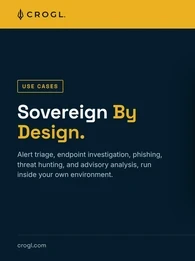
How on-prem AI spans EDR, identity, network, cloud, and posture tools to run continuous investigations across data lakes without exporting logs.
Merza shares that agentic AI will not hollow out security teams, because the same technology that speeds up investigations also expands the number of systems, agents and users that analysts must defend. The teams that benefit most will start with one focused use case, insist on transparency and human review, and choose partners who give them control over how AI runs in their environment. For more on Crogl's approach to sovereign AI in security operations, visit its website.
Takeaways
- Why Crogl prioritises customer control and on-prem deployment.
- The three barriers limiting analyst effectiveness.
- How AI is expanding security workloads and opportunities.
- A Department of War case study showing faster threat hunting.
- Why transparency and human oversight matter in AI investigations.
- Key requirements for securing critical infrastructure.
- Merza's advice to security leaders adopting AI.
Chapters
00:00 Why agentic AI is changing security operations
02:53 Why Crogl began with complex, on-prem customers
05:06 The three barriers: expertise, tools, and access
09:38 Why AI could mean more security analysts
13:24 A threat hunt reduced from up to 80 hours to two
15:53 Building trust through transparency and human validation
19:25 Security AI requirements for regulated environments
23:18 The shift from AI scepticism to practical adoption
24:49 How security leaders can start exploring AI
26:38 Closing thoughts and where to find Crogl

Crogl is AI for Enterprise Security. It investigates every alert and hunts every threat advisory across your SIEM, EDR, data lakes, identity, and ticketing tools, inside your environment. Crogl is customer-managed, not SaaS. Run it on-premises, in a private cloud, or fully air-gapped. Your data never leaves your perimeter. Crogl queries each source in its native format, with no pipelines to build and no schemas to normalize. Every query, finding, and decision is auditable, repeatable, and inspectable, and logs automatically to your ticketing system. The workflow adapts to the analyst. Crogl handles the investigation. The analyst makes the call. Crogl is multi-model: you choose and host your own models, with no single-provider dependency. Pricing is fixed. No per-alert, per-investigation, or per-user fees, so alert volume never changes the bill. Crogl runs in an air-gapped, classified Department of War environment, investigating more than 1,000 alerts a day, and in a Fortune 500 financial services institution. Built for the hardest security environments. Download Crogl at crogl.com/download.
Comments ( 0 )