
Attitudes towards Artificial Intelligence (AI) have greatly shifted over the past 18 months. No longer a piece of technology that purely inspires star-struck awe and wonder, AI is now under the spotlight for the challenges and complexities it - and its accompanying applications and deployment methods - brings.
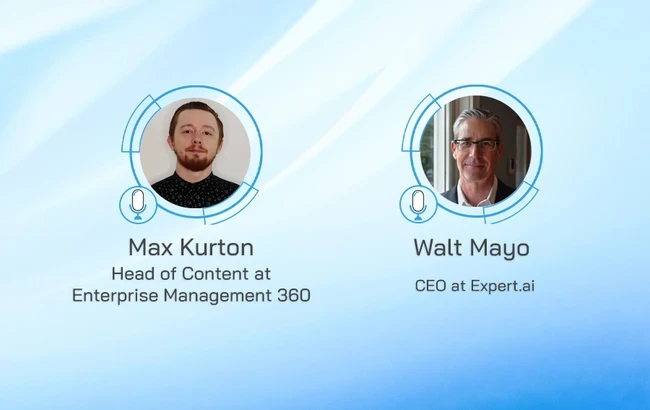
Joining us to discuss the matter is Walt Mayo, CEO at expert.ai. In this podcast, Walt goes into detail about the current state of AI, before drawing attention to the business benefits of a much spoken about AI application: Natural Language Processing (NLP). He then explores the key considerations organisations must note when deploying NLP and its partner in crime Natural Language Understanding (NLU). To end, Walt shares his thoughts on where he feels NLP/NLU is primed to make the biggest impact and sheds light on what expert.ai is doing to make the applications ubiquitous at the enterprise level.

Expert.ai is the premier artificial intelligence platform for language understanding. Its unique hybrid approach to NL combines symbolic human-like comprehension and machine learning to transform language-intensive processes into practical knowledge, providing the insight required to improve decision making throughout organizations. By offering a full range of on-premise, private and public cloud offerings, expert.ai augments business operations, accelerates and scales data science capabilities and simplifies AI adoption across a vast range of industries.
Expert.ai's platform is based on the principle that every NLU technique does not fit all applications. Rather, organizations must mitigate their risk against the continued development of the AI market. Thus, they formed a hybrid platform that bundles symbolic AI with machine learning (ML) or deep learning (DL) techniques to ensure maximum performance for each use case. This is based on an open architecture to ensure it integrates with new algorithms, techniques, and language models.


Comments ( 0 )