


In today’s data-driven world, organizations tend to have more data than they know what to do with. A recent study by Seagate found that 75 per cent of organizational data is unleveraged in a world where data is crucial to business success.
The problem is that the residential databases that many organizations rely on can’t handle the large amount of different data types stored within them, preventing organizations from gaining actionable insights and making the most out of their data assets.
To solve this issue, many organizations turn to NoSQL databases so they can easily keep an eye on the waves of big data in their possession and extract the value it contains within it.

What is a NoSQL database?
A NoSQL database – sometimes referred to as "not only SQL" or "non-relational" databases – is a type of database that stores and manages data differently from traditional relational databases.
NoSQL databases are built to scale horizontally by adding more servers. This makes it easier to handle increasing data volumes compared to relational databases that scale vertically by adding more powerful hardware to a single server, which can become expensive in the long run.
NoSQL databases therefore excels at handling large, complex datasets that traditional relational tables struggle with. This is especially useful for companies working with big data like social media feeds, sensor readings, or customer logs. Since NoSQL databases have a flexible schema, they can store this unstructured data "as is" without needing to force it into a rigid structure.
The flexible schema of NoSQL databases also allows developers to design and deploy applications faster. Since data structure isn't as fixed as with relational databases, there's less need to pre-define everything upfront. This can be a big advantage for companies that need to adapt quickly to changing requirements.
NoSQL databases vs SQL databases
Unlike relational databases with predefined table structures, NoSQL databases offer flexible schemas. This means data can be stored in various formats like documents, key-value pairs, wide-column stores, or graphs, depending on the specific NoSQL, allowing you to store data that doesn't fit neatly into rigid relational tables and easily adapt to evolving data structures.
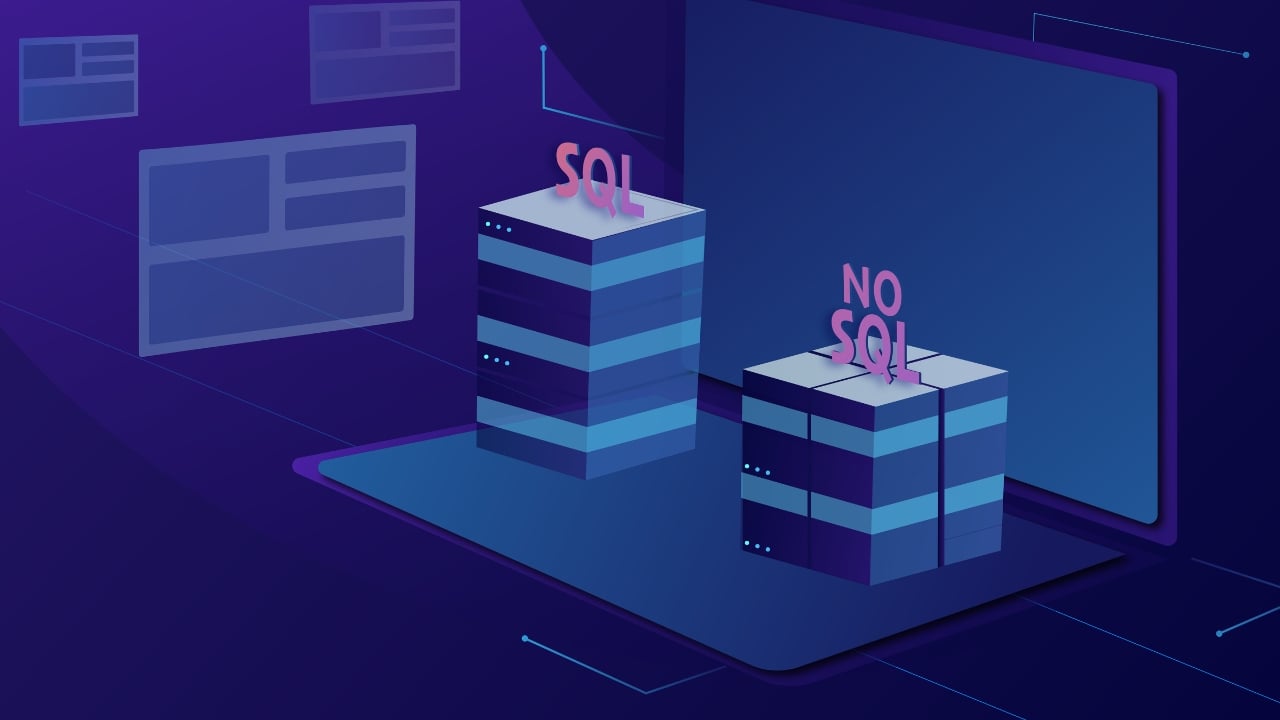
NoSQL databases are also built to scale horizontally. By adding more commodity servers to the cluster, you can easily handle increasing data volumes.
This contrasts with relational databases that typically scale vertically by adding more powerful hardware to a single server, which can become expensive and complex to manage in the long run.
NoSQL vs SQL: Key Benefits
NoSQL databases can outperform relational databases for certain types of queries, particularly when dealing with large datasets. This is because NoSQL is built are built for horizontal scaling and can be easily optimized for specific data access patterns.
The flexible schema of NoSQL databases also allows for faster development cycles, allowing you to store data in various formats, including unstructured, semi-structured, and structured data. This makes them ideal for complex data that doesn't fit neatly into rigid relational tables. Since data structures aren't rigidly defined upfront, developers can adapt to changing requirements more easily.
With NoSQL databases, you can easily add more commodity servers to handle growing data volume, making them a good choice for applications that expect significant data increases. NoSQL databases are often designed with high availability in mind too, meaning they can stay operational even if some hardware components fail.
These features make NoSQL databases a good choice for applications that:

Inside Customer Service AI Leaders
How top vendors use customer data and automation to turn support operations into a strategic CX advantage.
- Handle large and unstructured datasets, like social media posts or sensor data.
- Have data models that are constantly growing and evolving.
- Require high performance for specific queries on massive datasets.
- Need a flexible and agile development environment.
Best NoSQL databases
There are a variety of NoSQL databases available today, each of which can help your organization make sense of your large amounts of data faster and more efficiently.
In this list, we’re counting down ten of the best NoSQL databases on the market today, ranking each pick on its range of features, ease of use and scalability.



Comments ( 0 )