
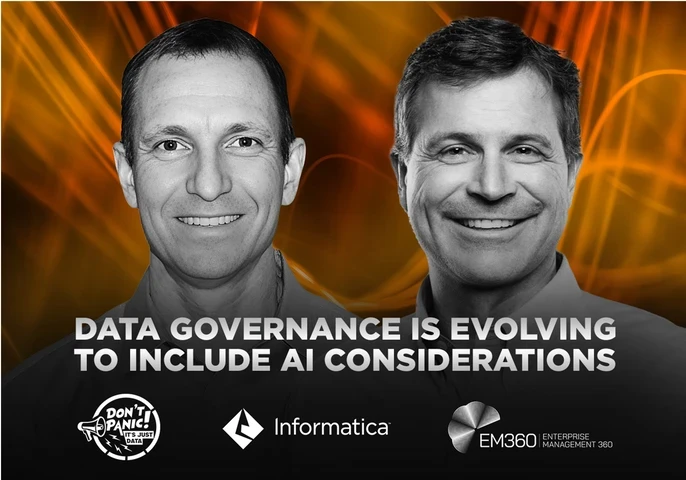
Enterprise AI budgets are climbing, but the data foundations beneath them remain uneven. In this episode of Don’t Panic, It’s Just Data, Kevin Petrie, VP of Research at BARC, and Nathan Turajski, Senior Director, Product Marketing at Informatica, examine the findings of the CDO Insights 2026 report, which argues that executive confidence in AI may be outpacing organisational readiness. The study centres on what it describes as a growing “trust paradox” as Chief Data Officers are accelerating AI initiatives even as data quality, governance maturity, and AI literacy struggle to keep up.
The Trust Paradox
The report exposes a striking disconnect. Turajski points out that while around 65 per cent of data leaders believe employees trust the data powering AI, 75 per cent say upskilling in data and AI literacy is essential. In other words, confidence is high, but readiness is lagging.
This is the trust paradox where employees increasingly rely on AI outputs, while data leaders remain cautious about the quality, governance, and lineage behind those results. The risk is not scepticism but rather overconfidence. When AI-generated answers are accepted without scrutiny, flawed data can quietly scale poor decisions. For CDOs, the challenge is cultural as much as technical.
AI Adoption Soars While Data Readiness Lags
The harsh reality is that AI experimentation is no longer confined to innovation teams. It’s spreading across marketing, operations, finance, and customer experience. As a result, scaling from pilot to production requires more than a model and a use case. To make AI work at scale, organisations need a data strategy that ensures consistency across domains, clear and transparent governance, measurable business impact, and sustainable management of their data assets.
Data Quality and Governance
Turajski explains that organisations are increasingly investing in data management and governance, with 86 per cent expanding data initiatives and 39 per cent prioritising upskilling. Metadata integration also helps unify distributed environments, providing the context AI needs to deliver reliable, trustworthy outputs.
Organisations need to remember that AI systems amplify whatever they are given, so if inputs are inconsistent, incomplete, or poorly defined, outputs will reflect those weaknesses which are often at scale. Data quality challenges frequently arise from duplicated or conflicting records, inconsistent definitions across business units, poor lineage visibility, and limited ownership accountability.
For example, a retailer might describe the same product in multiple ways across systems. Without standardisation, AI tools trained on that data produce fragmented insights, and when this occurs across thousands of products and regions, the distortions multiply. The takeaway from data leaders is clear: AI performance cannot be separated from disciplined, high-quality data management.
CDOs Rewriting AI Ownership
Why boards now look to CDOs to align AI, data governance and business outcomes, turning compliance roles into enterprise strategy engines.
Upskilling and Scaling AI Adoption
Both Petrie and Turajski stress that technology alone won’t close the gap. Upskilling employees in data literacy, AI fluency, and governance awareness ensures AI experimentation evolves into measurable, real-world results from improved customer experience to faster, more accurate analytics. The 2026 CDO Insights findings position data leaders at the centre of AI transformation. Their mandate extends beyond infrastructure to trust architecture. The trust paradox isn’t a reason to slow down innovation. It’s a reminder that lasting results require as much discipline as ambition. In 2026, the organisations that succeed won’t be the fastest to adopt new technologies, but those that build the most reliable data foundations to support them.
To learn more about this, visit informatica.com
Takeaways
- The trust paradox highlights a disconnect between employee confidence in AI and leadership's caution.
- Data leaders recognise the need for upskilling in data and AI literacy.
- Building a trusted context is essential for effective AI adoption.
- The vendor landscape for data management is complex and requires careful navigation.
- AI is being used to enhance customer experience and loyalty.
- Measurable results from AI adoption are becoming a priority for organisations.
- Data governance must keep pace with AI use to mitigate risks.
- Successful organisations are leveraging unified data management platforms to drive AI value.

Informatica believes data is the soul of business transformation. That's why we help you transform it from simply binary information to extraordinary innovations. As the Enterprise Cloud Data Management leader, we have pioneered a new category of software with our Intelligent Data Management Cloud™. Powered by AI and a cloud-first, cloud-native, end-to-end data management platform that connects, manages and unifies data across any multi-cloud, hybrid system, our Intelligent Data Management Cloud empowers enterprises to modernize and advance their data strategies.
That’s why our customers in more than 100 countries and 84 of the Fortune 100 rely on Informatica to drive their data-led digital transformation. Whether you're driving next-gen analytics, delivering perfectly timed customer experiences, or ensuring governance and privacy, you can always know your data is accurate, your insights are actionable, and your possibilities are limitless.
Informatica. Cloud first. Data always™.

Comments ( 0 )